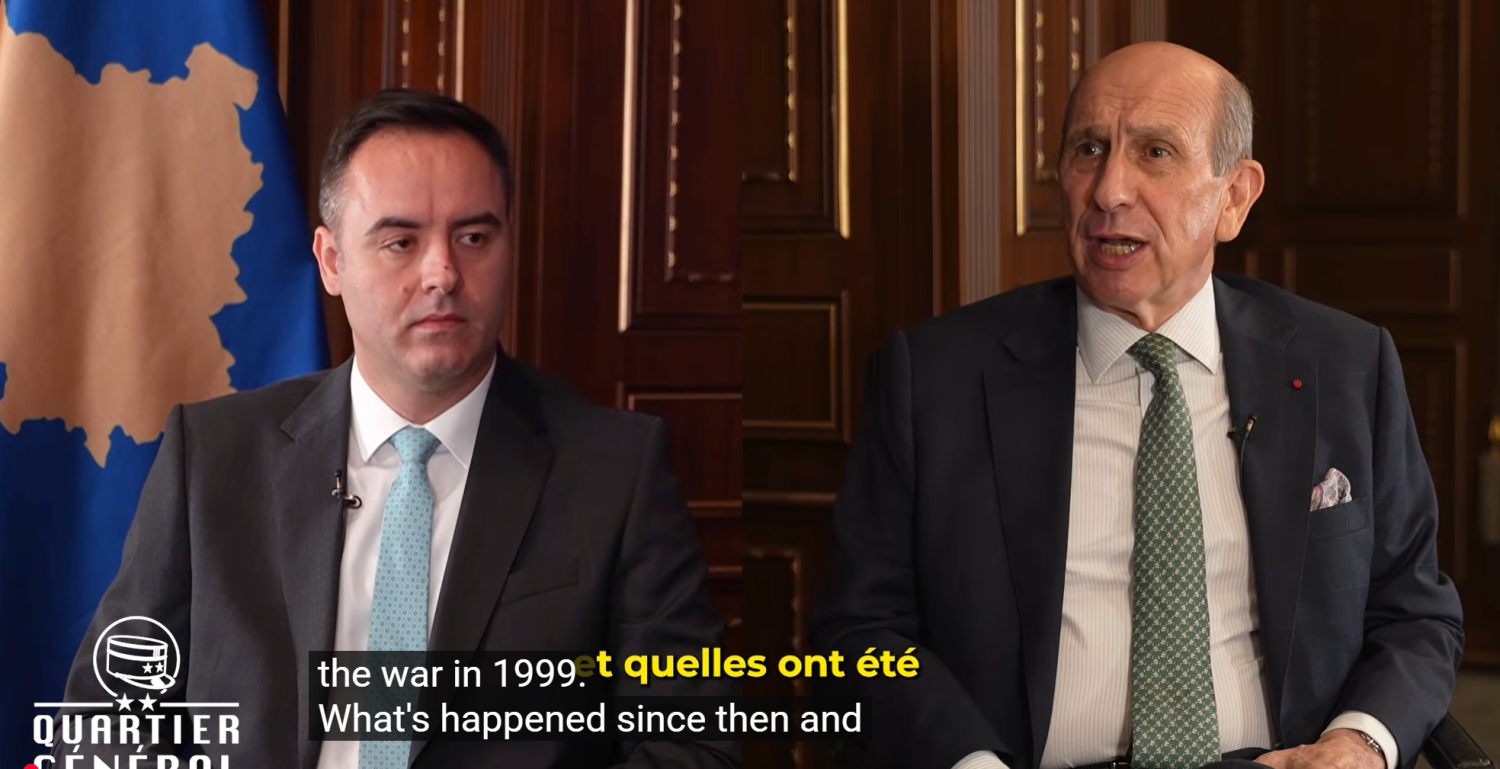
Glauk Konjufca with General Dominique Trinquand. Full transcript, with an editor's note.
Kosovo Dispatch, 10 September 2026
Editor's note
What follows is the full English transcript of Glauk Konjufca's interview with General Dominique Trinquand, published on 10 September 2026 under the title "Kosovo: 'Nous sommes prêts à rejoindre l'Europe'". It was recorded at the Ministry of Foreign Affairs and Diaspora in Prishtina [GAP: recording date, confirm against the episode page]. The exchange opens in French and is conducted in English; the episode as broadcast carries French subtitles. The full episode is at https://www.youtube.com/watch?v=5L0I8mqPXhk
We ran Trinquand's July conversation with Albin Kurti on 3 September as "The Interview Before August". This is its companion, and the title is the point. The minister is speaking after the August that the prime minister could not yet see: after Ratko Mladić was buried at Topčider with a Gendarmerie salute, after the burial-week statements from the capitals, and, on the evidence of one sentence in the text, after Kosovo signed its agreement with the Gaza International Stabilization Force on 7 September. Readers who set the two interviews side by side will notice what the second one does not contain. Serbia is named only by the interviewer. The minister's answer to the Serbia question is the twentieth century, Churchill and the quartet of 1999. Mladić does not appear. We have not edited the interview to help readers draw that conclusion or to spare them from it.
The audience is the same as before: French. Konjufca is addressing a country he calls one of Kosovo's big supporters, on Francophonie, on the 2030 Mediterranean Games, on visa liberalisation, and, at the end, on what he says a small country that suffered can advise a large one that has forgotten what suffering is. Those passages are written for that room and rarely reach the Anglophone readership we serve.
A word on the figures. The minister cites recognitions, diaspora numbers, athlete counts and survey findings at speed. They are the government's account and we publish them as spoken. Two are worth a reader's attention. Konjufca says 121 states recognise Kosovo; Kurti, in July, said 122. And the "public secret" in Brussels of a new member within two years is presented as a secret and left unnamed. The Churchill line on the Balkans is attributed here as the minister attributed it. Where a claim is checkable, readers should treat it as an invitation to check, not as our finding.
We have corrected proper names to house spelling and removed nothing.
Transcript
Dominique Trinquand: Bonjour, Monsieur le Ministre. Écoutez, nous sommes très heureux d'être ici au Kosovo, et merci beaucoup de nous accueillir pour ce programme, qui s'adressera bien sûr essentiellement à un public français. Je vous remercie.
Glauk Konjufca: Bonjour, et bienvenue en République du Kosovo, ainsi qu'au Ministère des Affaires Étrangères.
Trinquand: Thank you very much. We'll switch now to English to see the different points we are talking about. The first point is: could you explain, for our audience, which is not familiar with Kosovo and probably remembers Kosovo only for the war in 1999, what has happened since then, and what are the developments in Kosovo?
Konjufca: Thank you for coming, and thank you for this interview. It's really important to speak to the French public together. Welcome in our ministry.
I think that now, in the third decade of the 21st century, we cannot talk anymore, I would say, in terms of a post-war country. That period, I think, that era has already gone. Kosovo now is a part of the international family. Kosovo has enjoyed during many years very stable economic development and economic growth.
And I am happy when I meet many international guys who even served here in Kosovo many years ago, I'm speaking about the years immediately after the war, I mean 1999, 2000, early 2000. When they come now, they even don't know, don't recognise, the Kosovo of those years, because of the big transformation that we have had these last 27 years.
So I would say that if you visit Kosovo afterwards, believe me, you will bless your curiosity. Because in the region, I think that it is very interesting also for the people who live in countries of the European Union to come, to read about Kosovo and about the history of Kosovo, and to come here to see reality. You can feel the transformation yourself.
So Kosovo is now recognised by 121 states of the world. Kosovo has clear goals and strategic ambitions on the international stage. We are on the path of accession to the European Union. One day, we hope, we will join this wonderful family of nations. Our goal is also to become a NATO member, to be a member of the Council of Europe, a very important European institution of human rights, freedoms and democracy. But also, we want one day to become full members of the Francophonie.
As you know, we are associate members of the Francophonie. We had a very good visit of Francophone countries in 2024. I was at that time president of the parliament. A wonderful visit here in Kosovo of Francophone countries. We had this meeting of the Francophonie just for European countries, European Francophone countries. And it was an experience that left an important mark in our institutional life. And we are making a lot of efforts one day to become a full member of the Francophonie.
So I just want to briefly give you, let's say, the big picture of the international context of Kosovo. So you cannot call Kosovo just by the simple terminology of a post-war country. That time of the 1990s, you know, the dissolution of Yugoslavia, you cannot see it anymore in reality. Now there are new realities we are building. But we are building them with European values. And what is more important, we want to build them with our best friends and with our partners.
When we are here, I'll say that France, France is one of the big supporters of Kosovo in all of these processes I mentioned. The European Union accession path. Also visa liberalisation for Kosovo, which has been achieved in 2024. So our citizens now, for two years, are moving freely in Europe, in the Schengen area. This was quite an achievement for our country.
But also, let's say, when you talk about the hospitality of my people, that everybody receives when they come and visit Kosovo, gastronomy, enjoying our culture, which I would say is very old, and at the same time enjoying the landscape and the possibilities that Kosovo offers to all of those who decide to visit Kosovo. I think that after you visit Kosovo, I'm sure you leave from here with positive impressions. I hope.
Trinquand: Thank you. I am just looking at the flag you've got in your back, and that synthesises what's Kosovo. It's very close to the European flag, in fact.
Konjufca: Yes.
Trinquand: And may I say that you are not looking back, but you are looking to the future, and your future is there. Well, could you just tell what Kosovo itself will provide to the European community? I'm talking about your population, which is very young, for example. As you know, in Europe we've got a problem of demography. Apparently Kosovo has not this problem. When I was walking in the street yesterday, I saw so many young people. And to these young people, and because you are minister also of the people who are living outside Kosovo, what is the input of this population outside Kosovo to Kosovo, and inside Kosovo to the European?
Konjufca: I would say that because of hard circumstances during our history, a big portion, I would say, of our population left the country, most of them during the 80s and during the 90s. Most of our diaspora is situated in Germany and in Switzerland. Just in these two states, one million of my compatriots live there.
I'm calling them my compatriots not just because they were born here, or maybe their parents lived for some time in Kosovo and left, but also because they have Kosovo citizenship. They have citizenship. So when they have citizenship, then you cultivate a very specific relation, a very close relation, with our population who lives there.
But many, many of them, and you know, all of them contribute in different manners to Kosovo. But many of them also are engaged directly with our institutions, with their businesses, with their companies, because many of them, you know, are successful people who created something important in this country, in Germany, in Switzerland. We have a lot of diaspora in the United States also, and in many European countries, including France too.
We have in our ministry also some specific projects attracting young diaspora people to come here and to contribute to our institutions. We have even a specific programme including them, involving them. They come here, they go and work and contribute in different institutions and ministries of the government. And after they spent a whole year in Kosovo, we noticed something very important. Many of them decide to live here forever.
That is a very good programme. We want to expand that in the future. We want to expand that to hundreds and hundreds of young people getting engaged with our institutions, getting to know their country, of themselves but also of their parents, getting to know the country better. Because, can you imagine, some of them even were not born in Kosovo, but they were raised by their parents with the love of the country. And when they are like 24, 25 years old, they have finished international relations, political sciences and faculties like that. Then we contact them, we, let's say, include them. They come here, they see Kosovo, they start to live here, they start to contribute here. Then some of them, okay, if from 100 of them, 20 or 15, let's say, decide to live here and to continue their life in Kosovo, it is a big achievement, I think.
Why? Because, yeah, these were hard times in the 90s, during the occupation, when they left. And now you have a different picture, when the country offers so many opportunities that young people, some of them, even decide to come back and to continue their life in Kosovo. I think that projects like this, we are very interested to, let's say, strengthen, to support and to increase these efforts in this direction.
Trinquand: Thank you very much for that. But I see also the contrary, that young people coming from Kosovo with the will to join Europe will provide some increase in European countries, because, you know, very often European citizens have a bit too much, and they no longer think that Europe is beautiful. And when you are outside Europe, you think that Europe is beautiful, you want to join them, and that can provide something for the people in the country. I go to a specific point. I understand that you will organise the Mediterranean Games in 2030. What will that provide to Kosovo, this organisation?
Konjufca: It was big news, and we were so happy when in 2023 Kosovo won the bid, won the bid to organise the Mediterranean Games. You know, for us it was, some even could not believe, because Kosovo started to participate there in 2018, and within six years to be able to win, and for the Committee of the Mediterranean Games to trust Kosovo, being able to organise such a big event of sports, gathering 5,000 sportsmen, sports activists, and having them in Kosovo.
It's like a kind of event that best explains the big change that Kosovo has experienced from the end of the 90s to the third decade of the 21st century. So now we are not just in that, you know, distant time, when we were asking just for help, just for help, because we were in trouble. Now we are capable of organising events that even the European countries will participate in.
So that is the best example. Whoever, even those sceptics who were against Kosovo, you know, in 1999, and were criticising even France, why you are intervening in this country, you can see now, yeah, this is the result. It was freedom, it was development, and now it's a country that can organise itself, can organise big events with thousands of participants, like the Mediterranean Games, and it's contributing to peace in the world also.
Because Kosovo now will go to Gaza with all of these international missions of the world, in order to help reconstruct and recover Gaza. And people wonder, like, my God, 30 years ago we were in a position asking for help, and now we are in a position offering our willingness, and being totally ready to help others and to contribute to the world missions of peace. This is the change that is for sure to be praised.
Trinquand: Very interesting, because I see two ways. The first way is that you show that you are organised within the international community, to organise big events like that. So you show your capabilities. And because you've got all these Mediterranean countries coming here, they realise that you are part of the community. It's a winner on both sides, for the Mediterranean countries and for Kosovo.
Konjufca: It's mutual.
Trinquand: So of course it will be a big challenge to organise such games. But also, if it is a success, then the people will rise: okay, Kosovo is part of our community. So I think it's a very good example. May I ask you, if you want to convince Europeans, because we know that Kosovo is on the way to join the EU, but there are difficulties currently, what are the arguments you will give Europeans, mainly French, but Europeans, that you are ready to join the EU?
Konjufca: First, I would put the resilience of democracy in Kosovo. Even though, you know, in our political scene we have all of these discussions and disagreements, solving them with political dialogue, elections going very smoothly, the result is very precise, and everybody respects that. And the transition of power goes through very, very civil, democratic methods. All of this combined as elements gives you a clear picture, especially in this register, in the register of institutional functionality from the democratic point of view.
This is very important. This is maybe not attractive for a visitor, I'm not saying, but for a European Union representative who deals with this issue, I think that it's quite an achievement for Kosovo, these 25 years. So this is first.
Second is that we are a people who, let's say, you don't have to put a lot of effort to Europeanise us. We are the most European people in the Balkans, I would say. And this is, I'm talking, it's not just wishes, it's surveys conducted in a scientific manner, which show that the people of Kosovo like Europe and the European Union very much. We don't have in our political spectrum parties that are against Europe. It's okay also to be Eurosceptic. I do not have prejudice against that.
But when it comes to the European Union, we conceived it maybe not as you. We conceived it from a very, very specific dimension. And this dimension is peace and security. Peace and security first. And then it comes welfare and social protection and everything. But especially after the Russian aggression against Ukraine. And we strongly, when we are here, by the way, we are strongly supporting Ukraine, and we stand with Ukraine. We cannot tolerate, let's say, as Europeans, a country like Ukraine, just because they are freely expressing their will to join Europe, to be crushed in the middle of Europe by such a despotic force, by such a despotic power, such as the Russian Federation.
So I would say that this is very important, because when society is open, when society is pro-European, when within ourselves we cultivate these values, to respect the dignity of the human being, human rights, democracy, freedom of media, all of these components that come together with rule of law, with democracy, with a stable state, then I would say that, okay, there are some reforms to meet in the future, but mainly, in general terms, I would say we are ready. We are ready to join the club.
And we will not have, if you have this ambition as a collective ambition, and nobody is against that, so that will not cause a contradiction, a big contradiction that divides societies, like in some European countries it's happening, you know, around immigration, around what is Europe, you know, is it worth keeping it or do we have to abandon it. These debates, you cannot find them on Kosovo's soil. So when the time comes, for us it will be very easy, because it reflects the unity, somehow the national unity, of our country.
Trinquand: Interesting. If I take the two points the other way: the fact that in Kosovo people are sharing the values of Europe, perhaps having a big diaspora plays a role in that, because people who are living outside are compulsorily sharing the values, because those countries are organised like that, but also because of the freedom of movement that you mentioned initially. It is very important to travel around Europe, to see cultures. Paying in euro can help also, because it's not a value, but it's a way of having commonality. The second point is democracy, which is very important. Of course, democracy is a strength and sometimes a weakness, because we are changing government, it's always complicated, and Kosovo is not alone in that. In France, other countries are like that. But it is a strength where citizens can express themselves during an election. And that will change, because very often in all European countries you've got 55-45, 51-49, but that means that…
Konjufca: Divided.
Trinquand: And this is, of course, every one year, six months, two years, it's difficult, but that's a strength, certainly. So may I ask you what your idea is about the fact that Kosovo is close to Europe, but is also part of a geographical area called the Balkans. And around the Balkans, of course, there is the problem with Serbia. We know perfectly what is the problem with Serbia. But don't you think that all these countries want to join Europe? Europe has forbidden war in Europe after years of fighting each other. In the Balkans, it's not yet the case everywhere. So this is the first step that should be done in order to join the European values, whose main value is peace and security. What do you think about that?
Konjufca: I think that if you conceive the 20th century from the perspective of geopolitics, I say that the 20th century began in the Balkans. The 20th century began in the Balkans with the First World War. It began in the Balkans. But also the 20th century was closed in the Balkans. In 1999. With the last piece of the dissolution of Yugoslavia, of ex-Yugoslavia. So the whole 20th century is marked by two events, very important geopolitical events, that happened here in the Balkans.
So maybe from this comes also, when you comprehend better these events, then you understand better the Winston Churchill saying, that we have to do with a region that cannot bear the burden of the history that it itself produces. Winston Churchill said that. He said it because of this. Because it's a small region, in territory, if you compare it with the whole of Europe. And the whole of the Balkans now, it's 20 million. And if you put it into the whole population of Europe, it's not a big portion of the population. But the historical contradictions that were springing from this region, they imposed global involvement. Always a global involvement.
That's why I always thought that for the Western world, for the Western world's democracies, I think, it was a must, it was a must, to solve also the issue of Kosovo. The issue of Kosovo. And the way your countries decided to solve it, it was, I think, progressive. Progressive for human history. Because the decision was that in order to have peace, security, and, let's say, development for all of the region, you must solve the last piece in all of this equation, which is Kosovo. But to solve that, we need to decide upon the status of Kosovo. And the best for the status of Kosovo is to be an independent state. For these people to run their own affairs.
This was from, and I call it this transatlantic relation, from the United States to France, Germany, Great Britain and Italy. You know, this quartet of European big players. They decided together that if the solution is different, you will not have calm, you will not have peace, you will not have security. And that was a good point.
Then this opened the way for big projects of Europe. Like fast enlargement. You had, immediately after 2000, big waves of enlargement. Especially the wave of 2004, with so many states joining. And you have the last state, which was Croatia, in 2013. But now we are 13 years, 13 years, without enlargement. Without any new state joining.
But now Europe has this project of the Western Balkans joining. And we really believe in this. We hope that Europe believes genuinely in this. So it's not just words. It's not just words and promises. But it will be a concrete, a real project. And now we see some real results on this. Because it's already, let's say, as if a public secret, how they call it in Brussels, that within two years, the next two years, we will have a new member of the European Union. And one day Kosovo wants to be also.
And to conclude all of this, this completion of the European Union, after 2022 and the aggression of the Russian Federation, I think that's very important. It's a necessity, a strategic necessity, from the stability and security point of view. And what I am talking about, I believe you know better than me. Because I'm just a politician. And you are, as far as I know, an army guy. So you're a general. And you know how important this is nowadays.
Trinquand: I think your point, that the 20th century started with a war in the Balkans and finished with a war in the Balkans, is a fair point to show that Europe has built itself as it is, starting from that last war. And that the issue in the coming years is to include the Balkans, which have been the centre of war several times, to be in the centre of peace inside Europe, where we've done the easiest part when we were talking about enlargement. We were talking about the eastern part of Europe joining the family of the western part of Europe. But the Balkans have always been in a sort of fracture between, of course, Russia, the Ottoman Empire, the Christian empires, whether it was France or Austria, all that. This is the past. We need to look at the future. And perhaps the 21st century, we are at a quarter of this century, will lead to the reunification of all this part of Europe. And this is probably where Kosovo will play its part with other countries from the Balkans. I'm talking, I know better, Bosnia, for example, where I've been in operation for a long time, where you've still got three entities who are not agreeing on everything. But everybody needs to agree inside a common flag, the European flag, which doesn't mean that we are the same. We are different, but we share the same values. Would that conclude what you think about the future of Kosovo?
Konjufca: Yeah. Maybe, you know, I think sometimes of this that you mentioned earlier in your discussion, about this sometimes uneasiness, uneasiness of not a small portion of the European population, an uneasy feeling with the European Union, this Euroscepticism and everything.
But we, small people of the Balkans, who suffered a lot, and our suffering belonged to my generation also. You know, I was in secondary school during the 90s. I remember everything. I was 17 years old when the war started. And I remember very well, because we were generations which could not enjoy even the public, official secondary school education, because secondary schools were closed by Milošević for us. I could not attend secondary school in public buildings. And the population was forced to organise a kind of its own system of education, in private houses where we were going.
So I have vivid memories of everything that has happened. And they still call me a young minister. Can you imagine? Because it was just during the 90s.
So now, I think that, yeah, you have a lot of history, you are big nations, you have big countries, you even established the European Union. But believe me, we, small countries of the Balkans who suffered a lot, we can advise you something. That sometimes, maybe, you don't appreciate well what you have. You don't appreciate well what you have.
Trinquand: This is really a point I wanted to come to. Probably in France, in Europe, the old generation did suffer. I was telling you that, from the Second World War. Many generations now, they don't know what is real suffering.
Konjufca: Yes. Exactly.
Trinquand: And you can provide them the way that you have been suffering. And so now you are enjoying the way Europeans can live.
Konjufca: Peace and stability.
Trinquand: Don't be afraid. You are enjoying, that's fine. But just remember that people have been suffering, and perhaps your grandparents have been suffering. And now you achieve something, and we want to achieve that together. That's probably the point.
Konjufca: That's the message.
Trinquand: Thank you very much. It was very interesting to see at the same time the foreign ministry, but also the diaspora and the citizens of Kosovo. And thank you very much for this interview.
Konjufca: Merci beaucoup.
Trinquand: Merci.
Transcribed by Kosovo Dispatch from the English audio. Proper names corrected to house spelling; the text is otherwise as spoken.