Serbia’s lobbyists say the average congressman is misinformed. Their government’s answer is a retainer, and a rule that any American who disagrees was bought by an Albanian.
Mark Gojcaj | 9 October 2026
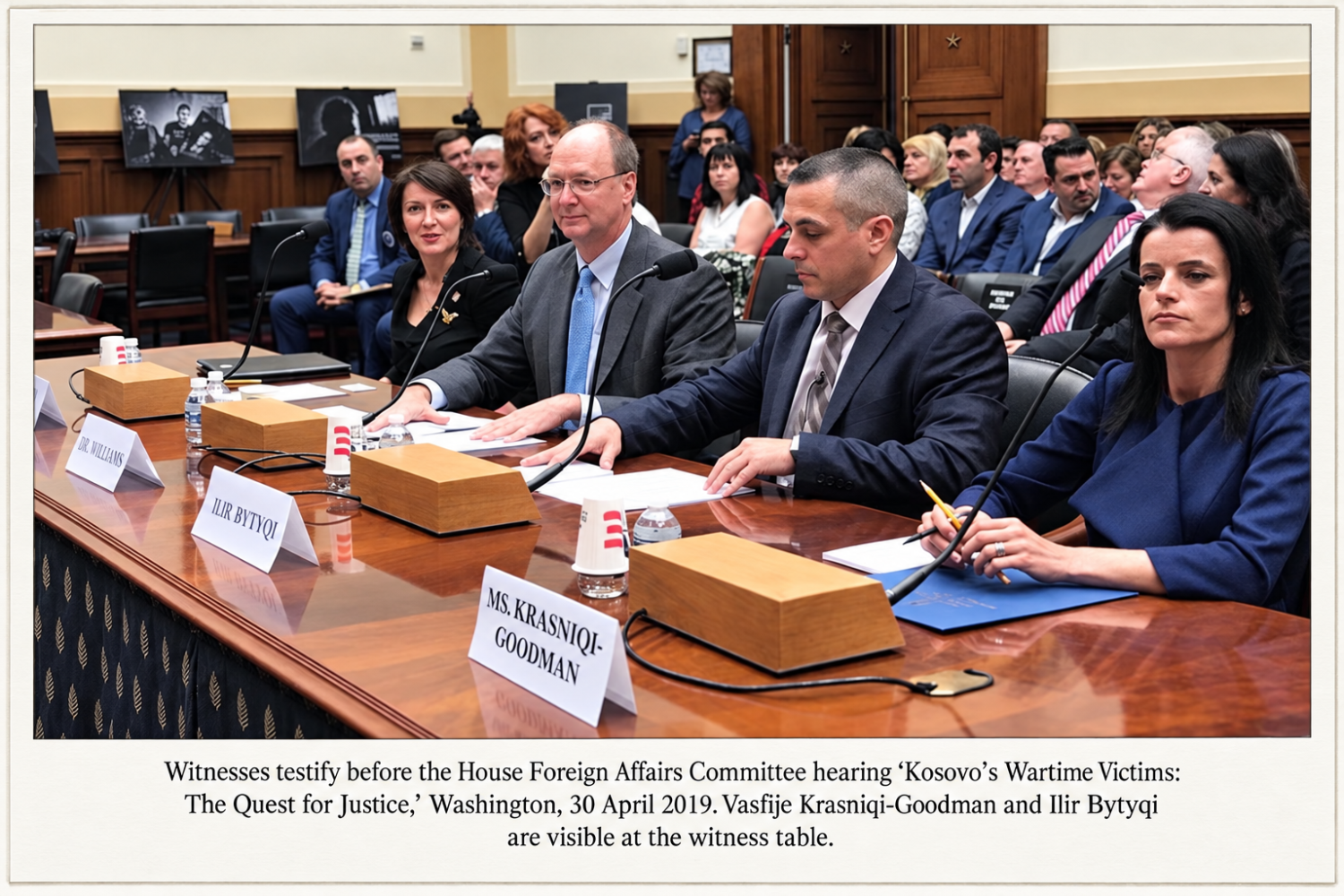
On 30 April 2019 the House Foreign Affairs Committee held a hearing called “Kosovo’s Wartime Victims: The Quest for Justice”. Vasfije Krasniqi-Goodman, who now lives in Texas, testified that a Serbian police officer took her from her family’s home in April 1999 and raped her. She was sixteen. Ilir Bytyqi of New York testified about his brothers Ylli, Agron and Mehmet, three American citizens who were abducted by Serbian police and found in a mass grave with their hands tied and bullet wounds in the back of the head.
Seventeen days later Politika, Serbia’s oldest daily, reported on the hearing. The headline was “Buy Me Eliot”. It called the committee’s chairman, Eliot Engel, and the Speaker of the House, Nancy Pelosi, “both longtime Albanian lobbyists”. Its evidence was that Americans of Albanian descent had donated to Engel’s campaigns. The newspaper named one of the donors. It did not name the rape survivor or the three murdered Americans whose case Congress had heard.
That is how it works in Belgrade. An American hears evidence about what Serbian forces did in Kosovo, and the story at home is about the Albanian who must have paid him.
I am an American of Albanian descent, and I have heard this all my life. In the Serbian press an Albanian with an opinion is a lobbyist. An Albanian with a chequebook is a buyer. An Albanian with money got it somewhere you are meant to wonder about. The people who say so hold office.
In May 2020 President Aleksandar Vučić said that from 1946 “Albanians started financing the Albanian lobby in America” with “horrific amounts of money”. That December his interior minister, Aleksandar Vulin, said Madeleine Albright and Engel had never examined the origin of the money “showered on them” by “the political representatives of narco-clans” in Kosovo. A serving interior minister accused a former Secretary of State and a committee chairman of taking drug money. Vulin has since announced a run for president of Serbia.
On 11 June this year the pro-government tabloid Informer ran this headline: “They’re squealing, and there’s more to come! Just look at their faces: Šiptar lobbyists in panic over the improving relations between Serbia and the US.” Šiptar is the slur. The lobbyists in the story were American citizens, members of an Albanian-American political group.
The same people talk differently about Serbian Americans.
In August 2019 Serbia’s foreign minister, Ivica Dačić, told a Belgrade daily: “The Serbs in America vote for Trump anyway.” He went on: “As a Foreign Minister I’ll organise the formalisation of support for Trump at the next elections.” A minister of a foreign government announced that he would organise a voting bloc in an American presidential election. In the same interview he complained that Engel “had a safe Albanian voters’ base for years”.
In July 2023 Serbia’s ambassador in Washington, Marko Đurić, went on TV Pink. “The Serbian lobby in the USA is functioning,” he said. “Today we have the Serbs who are American citizens and who talk and lobby with their elected representatives. I am very proud of that.” Đurić is now foreign minister.
The Informer article with the slur in its headline had good news too. It praised a Serbian-American political action committee, grown out of the campaign “Serbs for Trump”, and announced that Serbs now enjoy “the best political position in the US since the 1990s”.
A Serbian American who lobbies his congressman makes the ambassador proud. A Serbian-American committee that raises money for candidates is a national triumph. An Albanian American who does the same is a Šiptar lobbyist, and the congressman he supports has been bought.
Then comes the part where money really does change hands.
On 11 July 2023 Đurić signed a contract with KARV Communications of New York at $60,000 a month. The client named in the Justice Department’s files is the Government of Serbia. The filings show the contract renewed a year later at the same rate. Đurić explained the expense on TV Pink: Serbia’s bad image in America had been “paid for by Serbia’s regional rivals”, so Serbia would now pay to change it.
Later that month the site Kosovo Online asked Serbia’s lobbying establishment what the money was for. Nenad Vuković, president of the Serbian Lobbyists Association, said that “average congressmen”, even when they arrive briefed, find that “things are not completely clear to them or, even worse, they are misinformed. That is why it is very important that the Serbian truth be heard.”
A former ambassador, Milovan Božinović, was more precise. It does not matter much, he said, what Kosovo’s prime minister says about Serbs. “The problem is when that narrative is taken over by a congressman or senator. That’s the role of the lobbying agency, to provide such formats so that they can speak with more understanding about the Serbian side.”
Belgrade was paying Americans to change what members of Congress say, and its own lobbyists said the members were misinformed.
Vuković also named the enemy. “The Albanian side has been using that tool for literally a century,” he said. “The oldest Albanian lobby organizations, such as Vatra, have existed for 100 years.”
Vatra was founded in Boston in 1912 by Albanian immigrants. One of its founders, Fan Noli, was an Orthodox priest who took his Harvard degree that year. Its members are American citizens. Vuković offered no contract, no client and no payment. To the head of Serbia’s lobbyists, a federation of immigrants and their grandchildren, a hundred and fourteen years old, is a machine his government must hire professionals to defeat.
American law sees it the other way round. Citizens who petition their representatives on their own behalf do not become foreign agents because their cause concerns another country. The First Amendment protects the right “to petition the Government for a redress of grievances”. A firm hired to advance a foreign government’s interests is in a different position, which is why KARV had to register with the Justice Department. A foreign minister who says he will organise American votes stands a good deal closer to that line than any constituent who ever wrote a cheque to Eliot Engel.
The retainers are still running. Radio Free Europe reported in July that Serbia has three American firms under contract. KARV’s filings show it offering American media an interview with Đurić and circulating Serbia’s denial of involvement in an explosion in Kosovo. A second firm, Valcour, was hired at $65,000 a month. A disclosure examined by N1 shows that it helped arrange Vučić’s interview with Breitbart in May and texted President Trump about it the day it ran. This month the New York Times reported that two of the president’s own political advisers had been paid by the government of Republika Srpska.
Members of Congress should understand that the accusation is aimed at them. Every time the House or the Senate reaches a conclusion about Kosovo, Belgrade tells its public that an Albanian bought it. In March Senators Chuck Grassley, Roger Wicker and Thom Tillis signed a letter asking for sanctions on Milorad Dodik. By Belgrade’s rule they have been bought as well. I would like Mr. Đurić to name the Albanian who paid them.
The rule has a use. If every American judgment was purchased, nobody in Serbia has to read the testimony. Nobody has to ask who shot three Americans in the back of the head at Petrovo Selo. Twenty-seven years on, no one has been convicted of it.
Mr. Vuković thinks the average congressman is misinformed. The average congressman can check who is informing him. The “Serbian truth” comes from a firm with a Justice Department registration number and a client in Belgrade. My letter comes with my name, my address and my vote.
In Belgrade only one of us is called a lobbyist.
Mark Gojcaj writes from New York, where he analyzes the intersection between American conservatism and the political and security realities of Southeast Europe. He is a regular contributor to The Kosovo Dispatch on transatlantic coverage, focusing on U.S. foreign policy, NATO dynamics, and the Western Balkans.
