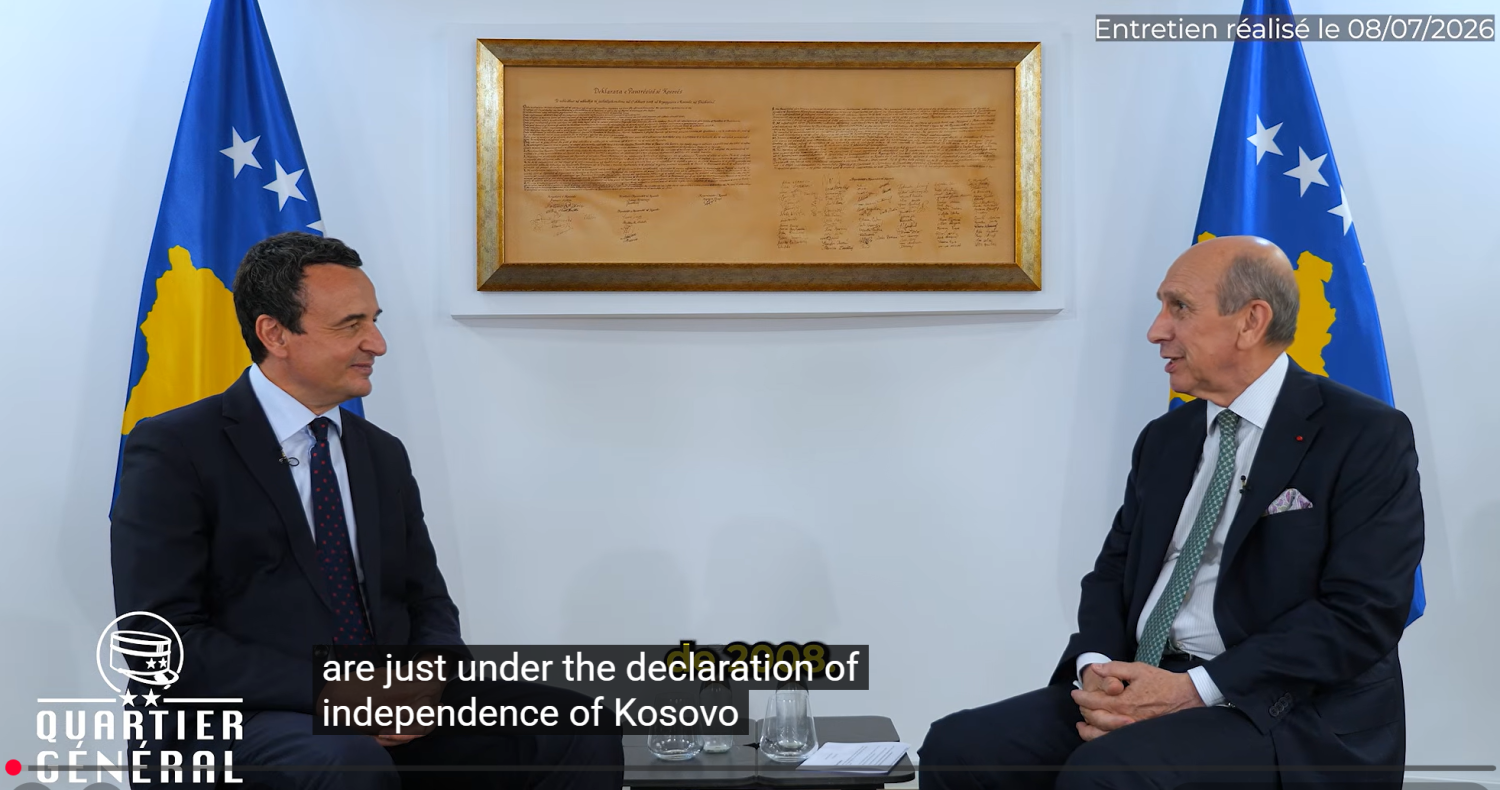
Albin Kurti on Quartier Général with General Dominique Trinquand. Full transcript, with an editor's note.
Kosovo Dispatch, 3 September 2026
Editor's note
What follows is the full English transcript of Albin Kurti's interview with General Dominique Trinquand for the French geopolitics podcast Quartier Général. It was recorded in Prishtina on 8 July 2026 [GAP: confirm date against the episode page]. We transcribed the English audio; the episode as broadcast carries French subtitles. The full episode is at https://www.youtube.com/watch?v=npEtlF0hNFw.
The interview resurfaced on 2 September, when the journalist Admirim posted a short clip of one passage: the prime minister's description of "an outdated hegemonic drive in Belgrade which does not want to accept that Serbs can be anywhere minorities," with Bosnia, Montenegro and Kosovo as the three cases. The clip travelled. By the morning of 3 September the Belgrade daily Danas was running the Association passage as news, via FoNet and KoSSev, without a recording date. The rest of the conversation did not travel, and we think it should.
Two reasons. The first is the date. Everything Kurti says here was said before the August that followed: before Ratko Mladić died and Belgrade decided how to bury him, before Volodymyr Zelensky stood in Belgrade and heard Kosovo's non-recognition restated in his presence, before the incendiary device near Brnjak, before Serbia's defence minister thanked Beijing for arms with Kosovo in the sentence. Readers can set the July diagnosis against the August record themselves. We have not edited the interview to help them.
The second is the audience. Trinquand's listeners are French, and Kurti is speaking to a country that recognised Kosovo in 2008 and hosts a diaspora he names alongside Germany and Switzerland. The passages on Francophonie membership, on the 2030 Mediterranean Games shared with Durrës, and on what he calls the politics of desire as distinct from the politics of acceptance are addressed to that room. They rarely reach the Anglophone diplomatic readership we serve.
A word on the figures. The prime minister cites rankings, growth numbers and survey results at speed. They are the government's account and we publish them as spoken. Where a claim is checkable, readers should treat it as an invitation to check, not as our finding.
We have corrected proper names to house spelling and removed nothing.
Transcript
Dominique Trinquand: Thank you for your time, Mr. Prime Minister. We are in your ministry and we are just under the declaration of independence of Kosovo in 2008. So your country is a young country. Could you tell us what you think has happened in the last 20 years or so, which means that Kosovo now is a country who wants to join Europe?
Albin Kurti: Thank you very much for having me and welcome to Prishtina, welcome to the government building and to the Prime Minister's office. 18 years ago, we declared independence, which so far has been recognized by 122 countries around the world. And it is interesting to mention that even though we are a young country, we are ancient people.
So people in Kosovo feel that they are autochthonous, coming from the very old Illyrians, from antique times. You had Illyrians and Greeks living side by side and then going through different empires, Roman Empire, Byzantine Empire, Ottoman Empire, very troubled 20th century. And 18 years ago, we declared independence, which didn't mean only freedom for the people, but also development for our economy and well-being for our citizens.
So if you compare GDP per capita nowadays with the year when we declared independence, now it's three times higher. And we are very proud that declaration of independence have had this economic dividend, so to say, which is not only important in terms of the growth that we have achieved, but also growing possibilities for further growth. Therefore, we are very optimistic for the times ahead. And we look forward to keep combining development with democracy in our European integration path.
Trinquand: Thank you very much. And I go back to democracy, because as all European countries, our democracy, we love our democracy, but there are strengths and there are difficulties. And currently, the electorates in all European countries, not specific to Kosovo, there are difficulties to have a majority. Could you explain why in your environment in Kosovo, like in my country in France, we've got difficulty on that. So could you explain that?
Kurti: We have had three times elections in less than a year and a half. We keep winning elections. I wish I wouldn't win this often. So more seldom is better.
We outright create the government because we have the majority. Our party won last time around 47%, before that 51%. We also have some coalition partners from some minority communities.
But in order to elect president, we need to have in the first two rounds out of three rounds, two third majority as a quorum. There has been slightly awkward decision of constitutional court in 2011, which says that you can elect president in the third round with 61 votes out of 120, but in the first two rounds, you must make sure that there are 80 people in the room. And now opposition, who is quite small, I must say, is big enough to make this obstruction, so we don't have a quorum.
I plan to engage with them constructively and to see whether they have any proposals for the way forward. Because so far, it was only us who was proposing different solutions. But every time our proposals have encountered opposition's refusals. And let's hope that in the summer, it will be different. I will continue to be active and constructive and creative. But when it comes to two third majority, it's not only us who should contribute.
We should also meet with the opposition regarding contribution in constituting the institutions of 11th Parliament of Kosovo, because we count also the legislatures which were before declaration of independence and after liberation of 1999.
Trinquand: Okay, very interesting, because this is really the difficulty of democracy, but the beauty of democracy, where you want to have everybody with you. Within this electorate, diaspora is very important in the diaspora of Kosovo, mainly in Germany and in Switzerland. What is the influence of this diaspora in the electorates within your country?
Kurti: According to the census, registration of population of Kosovo in 2024, 1.6 million are residents of our country. But over a million are citizens, but not residents. And we have a vast diaspora, as you said, mainly in Germany and Switzerland, but also in France, Scandinavia, UK and US.
They are a vital part of our economy and society. They left our country, not because they wanted a better life, but because Kosovo during occupation of Serbia in the 90s became unlivable. And beforehand, during Federation of Yugoslavia, we had an autonomy which was not republic, but then was abolished altogether. So it was a very heavy 20th century for us. And we have several waves of migrants. First they went to Switzerland and Germany, then all over Europe.
However, this traumatic origin of having to leave your country, wanting every week to go back and not being able to, is reflecting in a certain feeling of being homesick for our diaspora. So every diaspora family buys an apartment or two in Kosovo, in Prishtina, but not only. And they come several times per year. Students want to come here and do their master degree, checking their roots as well of their grandparents. Business people, they want to open a franchise in their homeland. Elderly, they want to spend their last two decades after retirement in their birthplace.
So there is a very vibrant diaspora, which evermore is using their right to vote. They do it in our embassies, they do it by mail, but also they do it by flying back home. So during summer months, for example, of July and August, there are 27 direct flights of diaspora per day from Switzerland alone to Prishtina International Airport, Adem Jashari. So this kind of summer holiday-ish behavior repeats itself also in winter if we have elections.
And I think that as long as they are so active, as long as 20% of our GDP is the amount of remittances that they are sending to their families and friends, as long as FDI is doubling, our exports are doubling also thanks to diaspora, I think it's reasonable to expect that they should have a voice in our everyday politics. However, if you quantify their contribution, it is up to several MPs. So the results, the ultimate results of a certain round of elections can change up to several MPs depending on the participation of the diaspora, and just as we are 50% in Kosovo in terms of support, more or less, they are much more than that in our diaspora.
Our diaspora has work ethics from Western Europe, which is very much worth for us in our economy. They also live in democratic, well-developed countries, they bring their know-how, and they want more. They don't want our country to be compared with grave times of previous century, they want us to compare with European Union average, where we want to belong one day, sooner rather than later.
Trinquand: Another point of interest is the problem of minorities. You know, as in Europe, there are rules about minority. There are still problems in Kosovo. Could you tell us how you will follow this subject in the future? Or have you done before, of course?
Kurti: Our constitution is very generous regarding minority rights. Our constitution has been drafted mainly by former Finnish President Martti Ahtisaari, who was the special envoy of Secretary General of the United Nations back then, Kofi Annan, and he foresaw 20 reserve seats out of 120 members of parliament for the minorities, 10 reserve seats for the Serbs, and 10 reserve seats for other non-Serb minorities, namely Turks, Bosniaks, Roma, Ashkali, Egyptian, and Gorani.
So, I cooperate with all national minorities, and I want to make sure that their voice is heard, their rights are respected, and the collaboration in institutions and in the economy is always in place. I have a Serb minister, I have a Turk deputy prime minister, used to be Bosniak in the previous mandate, and I also have a Bosniak minister, a minister from the Egyptian community, and deputy ministers from all the communities. On the other hand, Serbian language is official language in Kosovo at every level of administration all over our country, even though Serbs in Kosovo are 4%. Albanians in Kosovo are 92%, 4% are Serbs, and 4% are these other minorities.
Those nationalistic hegemonic dreams of perfect ethnic borders, they belong to the 19th and 20th century. In the 21st century, especially after Russian aggression in Ukraine, we see that no nation state is self-sufficient, and there can be no perfect ethnic border. There will be minorities everywhere all of the time, but we need to have democratic parliamentarian republics in place where people, individuals, are equal citizens in front of law and in the economy and labor market where they should flourish ever better, ever more.
So this is our policy, and in terms with our northern neighbor Serbia, we want good European neighborly relations, we want full normalization of relations, which at its center should have mutual recognition. People of Kosovo support EU integration, around 87%, and we don't have an alternative because we don't want to have an alternative. We want to join European Union because we consider that European Union is the most important and successful historical process and political project of peace and prosperity. So we might not sometimes, as politicians, particularly like each other, but we are all united in our orientation towards Brussels as a triple capital, not only of Kingdom of Belgium, but also of NATO and EU.
Trinquand: Very interesting about Europe, and I will go back to that. Could you talk a bit about the problem of the agreement with the Association of Municipality, where I think that for European Union, Brussels, it is a subject, and where are you on this subject?
Kurti: Three years ago, in February 2023, with President Vučić of Serbia, we have made a basic agreement, six sentences in the preamble, 11 articles, and a month later we've done also an implementation annex in Ohrid in North Macedonia. We have been respecting this agreement and we asked this agreement to be signed. Serbia is violating this agreement and they refused to sign it.
Part of this agreement are also previous agreements of my predecessors. So also the agreement that you're referring to is part of 39 agreements that have been done by my predecessors. So all those agreements will be considered once they are valid and legally binding as article in basic agreement, the respective one, mentions.
Kosovo has association of its municipalities. All 38 municipalities are there. Our constitutional court decision over a decade ago has concluded that mono-ethnic character of the Association of Municipalities is colliding with the spirit of the constitution, whose architect is Finnish President Martti Ahtisaari, who won Nobel Peace Prize as well for his work in peacemaking.
On the other hand, I am in favor of municipalities cooperating, but that should be done in order to provide better public services within the frame of Republic of Kosovo. The difficulties we have is that Belgrade wants inside the Republic of Kosovo, which they do not recognize, to have a certain entity which will be like Republika Srpska in Bosnia and Herzegovina to undermine statehood, independence and functionality from within. And here lies the difference. So whoever wants an association of municipalities, we already have one. But what Serbia calls association is actually not about Serbian community, but against independence of Kosovo. And here we have a gap.
I think that these hardships that we have in our relations are not only in relation to our independence, are also in relation to our orientation. We are oriented towards Brussels, substantially and formally, whereas Serbia occasionally, nominally is oriented towards Brussels, but substantially towards Moscow. And even more important element is that they have never admitted and regretted crimes committed during the past, especially during the years 1998-1999, when atrocities, massacres, crimes against humanity, genocide, war crimes forced NATO to intervene.
In spring of 1999, 19 NATO member states joined together and bombed Serbia. It must have been very bad, because it's very difficult, 19 countries, to agree on press release nowadays. So Serbia is still reluctant to face its own past. And the issue of association is just epiphenomena of a very problematic stance that keeps thriving at the top levels of their state.
Trinquand: Very interesting and very clear explanation. Thank you very much. So I'm going back to Europe, the point you made before, but linked to that, is that Europe is a big success because a lot of European countries have been fighting each other for centuries. And after the Second World War, they decided no longer to fight each other, you know, German, French, British, all that. Now we no longer think that we will be able to fight each other. So this is the big success, which leads to the Europe we know, actually, and the eastern part of Europe joined after the 90s.
In the Balkans, as you described, even beginning of this century, there were still problems inside different countries. Bosnia-Herzegovina, of course, and inside Bosnia-Herzegovina, the different entities, but in other European Balkans countries. So what do you think about the fact that this country, and I'm talking about all the Balkans countries, will join Europe only when they will cease to think that they are able to fight each other, like you just described about Serbia and Kosovo, for example?
Kurti: I don't think that in Western Balkans 6 there is any more nationalism of masses as fuel for war machinery of dictators. So the problem are not the people, the problem are certain structures, certain elites, who do not like to leave behind 20th century, who are bringing always in front of us what is behind us.
30 years ago, if you would have brought a truck with AK-47 in a village in Croatia, Bosnia, Serbia, Kosovo, Montenegro, or North Macedonia, in a minute the villagers would have emptied it. They would have taken with themselves guns. Now they report you to the police. So things are much more different now.
So our danger does not come from Serbs in Kosovo, or from any kind of nationality, ethnicity, religion, or people. It comes from this outdated hegemonic drive in Belgrade, which does not want to accept that Serbs can be anywhere minorities. So they must have their republic in Bosnia and Herzegovina. They don't recognize Montenegrin identity. They keep refusing recognition of Kosovo's independence. So I think that the problem is not people and ethnic difference, but political elites who instrumentalize their differences for political gains.
After Russian aggression in Ukraine, things became even more complicated, because now the support for EU in Serbia, which used to be after the fall of Milošević, around 75 percent, it dropped below 30 percent. So it's not only politics of acceptance, how much French people, German people, Austrian people are in favor of these six countries joining the EU. We should also check politics of desire, how much these people want to join EU.
And I think that those who work hard in rule of law, democratic reforms, economic growth, European values, namely human rights, should be acknowledged, recognized, and helped. Now, for example, Montenegro and Albania are frontrunners towards EU. We are doing very well in Western Balkan Six in terms of rule of law, anti-corruption, safety and security, peace, political rights and civil liberties. We are either first or second in Western Balkan Six.
Or for instance, according to World Justice Project, we are second after Montenegro, 59th in the world, but we are in four categories number one in the Western Balkan Six, namely open governance, order and safety, absence of corruption, and limitation of central government powers. Our passport got higher in Henley Index of Ranking from number 108 to number 57 in five years. Or Transparency International Corruption Perception Index, we advanced in the same period of five years, 28 places upwards, from 104 to 76. Or Gallup International Survey, we are number one in Europe in terms of rule of law and order, number third in the world and in top ten countries in the world for safety to walk at night. Or Democracy Report of V-Dem Institute, we are far ahead Serbia, and Serbia is behind Russia and Belarus.
So we are one region because we are not integrated into EU, but if you zoom in and you look inside, you see so many differences. And those who are working hard for European kind of democracy, for rule of law, human rights, etc., they should be acknowledged more. So I do not mind when certain diplomats and politicians from EU criticize us, but I must say that I mind when our progress is not being recognized and acknowledged accordingly.
Trinquand: Following that, just a point I want to make to you before going to economy, which could be interesting too. There will be an event in 2030, Mediterranean Games. And my point is that do you think that this organization will be very important in the fact that other countries will recognize Kosovo as being able to organize such a game and to gather all these people here, and it will show another face of Kosovo? The second point is Francophonie, is the fact that Kosovo wants to join Francophonie, and perhaps it's a way to join another club in the world, and all together sports and Francophonie could have an impact on the fact that the world will better recognize Kosovo efforts since it is independent.
Kurti: Kosovo is a member of dozens of international organizations, starting from IMF and World Bank, FIFA and UEFA, to Open Government Partnership. So we are increasing our membership, and we like in next phase, sooner rather than later, to be a full-fledged member of Francophonie. To that end, we are going to invest so more young people learn French language, which is a great language of great literature, and also is a language of so many other people and nations around the world outside of France.
So we want to do a bit of our homework for what we think is necessary for our country to join Francophonie, and also to cooperate with France in terms of organizing Mediterranean Games 2030, which will be taking place in 10 different municipalities in Kosovo, first and foremost in the capital Prishtina, but also in Durrës, in Albania. We need to build 20 new stadiums or renovate them, a lot of infrastructure necessary for Mediterranean Games, and we seek to welcome in 2030 close to 5,000 sportsmen and women and around 30,000 new tourists.
So this is a great opportunity for affirmation of our country, which has a lot of cultural heritage from ancient times to medieval times to modern times, and at the same time has two beautiful mountain rings, Rugova Mountains and Sharr Mountains, and we have this unconditional hospitality as a trait of our people.
Hopefully, this is going to improve relations also with countries that still do not recognize us. Let us not forget that majority of countries do recognize us, vast majority of members of EU, 22 out of 27, and there is no going back. The number will increase, but we want to work hard so we achieve a universal recognition as fast as we can.
Trinquand: Thank you. I think it will be a great event anyway. The last point I want to talk about is economy, and may I link that to the fact that in Kosovo you've got a very young population. So what will be the impact of this young population on the economy, in helping development inside Kosovo and inside Europe?
Kurti: Once we start in the government, we immediately address the issue of unemployment among youth, because many social problems that you get in a country are out of unemployment and passivity of youth. So, altogether, unemployment dropped from 26 percent to 11 percent. We doubled the number of employed youth, and we have been focusing on giving to students scholarships, especially for STEM studies, science, technology, engineering, maths, especially for female students there.
And we had Superpuna program, which meant that whichever company employs a young woman or man, in the first six months they could receive from the state, as a bonus to the salary that their employer is giving them, minimum wage. We tripled minimum wage in Kosovo. As we speak, it's 500 euros.
In addition, we have also helped businesses by participating in different business fairs around Europe and the world, but also by subsidizing them whenever they took loans to buy production machinery. In Kosovo, fiscal system is simple and convenient for businesses. Therefore, in the last six years, business turnover doubled from 12.5 billion to 25 billion.
GDP, when I took power in 2021, was 7 billion. This year is 12 billion. Each year we've added 1 billion to our economy. Public debt is the lowest in Europe, only 16% of GDP. In addition, corporate profits increased tremendously. Before we took government, aggregate corporate profit was around 900 million euros. And last year, it was 2.3 billion euros, so two and a half times higher.
What we also took care is to decrease inequality in salaries. For example, the income in private sector, average salary increased by 50% in five years, more or less the same in public sector. But in public sector, the inequality shrank fivefold. The highest salary with the lowest salary five years ago had a ratio of 20 to one. Now it is four to one.
So we increase the economy and we decrease the inequality. This is good not only for people, for citizens, but I must say is also good for the economy itself. Because lower inequality, greater the aggregate demand in the economy.
So what we have seen in these five years is that when there is no corruption in the government, when you have a cabinet of ministers who are middle-class people, well-educated, who don't want to get rich from politics, then the trust in institution increases, people pay more taxes, they don't try to do creative accounting on one hand, and on the other hand, they spend more. Because out of optimism, they rather spend than save, which is good for their lives in their families and society, but that is also good for the growth of our economy.
Trinquand: Thank you very much. And this point, I think, is linked also to the confidence of the electorates afterwards in the institution, which is the basic of democracy. So I think we'll leave here. Thank you very much for the time you gave us. I take the point that you are a young nation, but an old people, and this is very important in Europe, because we are made of all these old people who gathered at one stage to different nations, and now to the community of Europeans. Thank you very much, Mr. Prime Minister.
Kurti: Thank you. It's great having you here, and you're more than welcome anytime you want to return.
Trinquand: Thank you very much. Merci beaucoup.
Transcribed by Kosovo Dispatch from the English audio of Quartier Général. Proper names corrected to house spelling; the text is otherwise as spoken.
