A paid influence network is teaching Washington to see Bosnia’s Muslims as the threat, so the next act of coercion arrives already labelled counterterrorism.
by Drizan Shala | 13 September 2026
On 11 September, between five in the morning and seven in the evening, one argument surfaced across accounts in four countries and came out as doctrine.
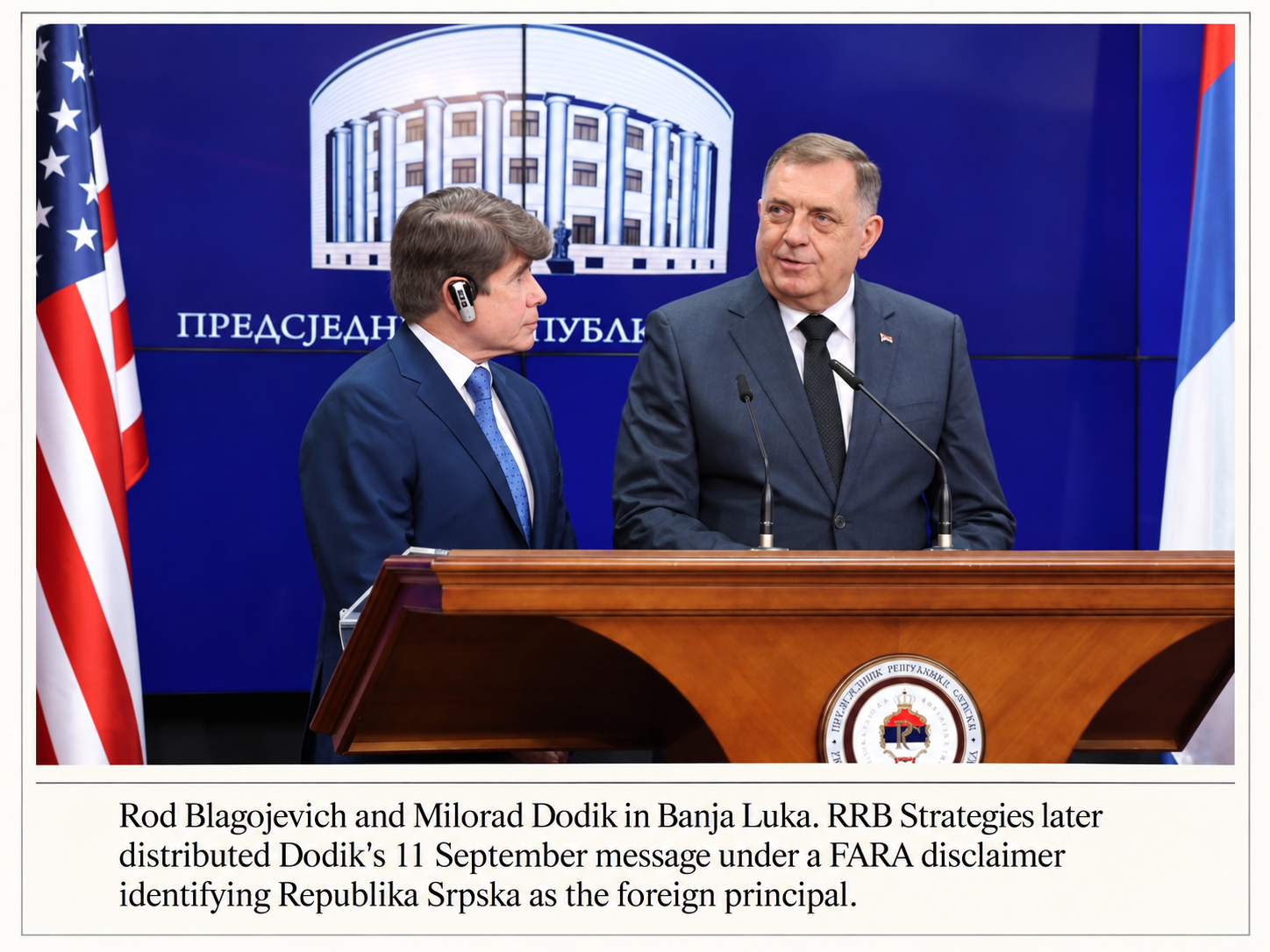
Jack Posobiec opened at 05:15: why was Clinton on the same side as al-Qaeda in Yugoslavia. A Belgrade nationalist account supplied the names at 06:05. Knights Templar International, a UK counter-jihad brand, put the counterfactual into English at 13:33: 9/11 might not have happened had America let the Serbs win in Bosnia. Milorad Dodik posted the official version at 14:03 in Serbian and 14:38 in English. At 14:45 Rod Blagojevich quoted it under RRB Strategies' FARA disclaimer identifying the material as distributed on behalf of Republika Srpska. Belgrade's tabloids reprinted it by evening as Trump's man sharing Dodik.
Two of the nineteen hijackers, Nawaf al-Hazmi and Khalid al-Mihdhar, fought in Bosnia in 1995. The 9/11 Commission recorded it in 2004, then followed them through Kuala Lumpur, the failed watchlists and California. Bosnia was biography.
Dodik's text gave the rest its official form. "The September 11 attackers" fought against Republika Srpska: the Commission documents two. The Bosnian passports that let them travel the world appear in no Commission finding, which traced the documents the team used to reach the United States. "A Bosnia and Herzegovina authority" once confirmed 3,500 sleeper operatives: no authority, no year, no document. Then the sentence the operation exists for: "This is not some abstract threat. It is a reality that breathes and waits."
Read the tense. The Bosniak enemy is being described as present, armed and asleep, four days after Mladić was buried with a military salute and three weeks before Bosnia votes.
The funeral did the rehabilitation for the domestic audience: the convicted man as general. The anniversary does it for the American one: the general as the first soldier of the war on terror. Srebrenica goes unmentioned because it can. A reader who accepts that the enemy in Bosnia was al-Qaeda has already been told what eight thousand men and boys from the enclave were.
The one contracted part of that day is on file at the Justice Department. RRB Strategies' FARA proposal describes the work under the heading "Media Campaigns": lobbying state representatives to post warnings on social media about the situation in Bosnia. On 11 September, material distributed under that contract supplied one such warning: Bosnia's Muslims as a terrorist reservoir. What was delivered into Washington was a threat assessment of Bosnia, issued from Banja Luka, distributed under a contract paid for by Republika Srpska, and timed for the anniversary. A population moved in the American picture from the victims of a campaign to a reservoir of sleepers changes what the next act of coercion is called: counterterrorism, and the burden of proof moves. The first cable after the next crisis starts from a different premise.
Bosnia's 2004 intelligence law abolished both entity services and created a state agency; the defence reforms that followed removed the entity armies. The State Department's 2004 terrorism report called the government of Bosnia and Herzegovina a strong and active partner in the war on terror. Washington had read the same file. Its answer was the Bosnian state. The 9/11 record has not changed since. The market has: Republika Srpska has spent 2.38 million euros on US lobbying since Trump's return, and in October 2025 Washington lifted the sanctions.
Two days before the anniversary, Željka Cvijanović told reporters what the Bosnian defence minister intended: to bring in mujahideen as in the nineties, to put Serbs in chains, to cut off heads. Vučić had used the same imagery at the end of August. Dodik then set the enemy in the present tense and gave it a number. A population defined as a sleeping jihad, breathing and waiting, is a target file.
Serbia's leadership has kept such a file on Kosovo since 1997, and refills it weekly from stock. Bosnia's is being brought back into service on an American memorial day, in English, with a lawyer's disclaimer at the bottom, for a Washington whose threat picture is now for sale. The first war was fought against people who were told they were the enemy of Christendom. The text now says they still are.