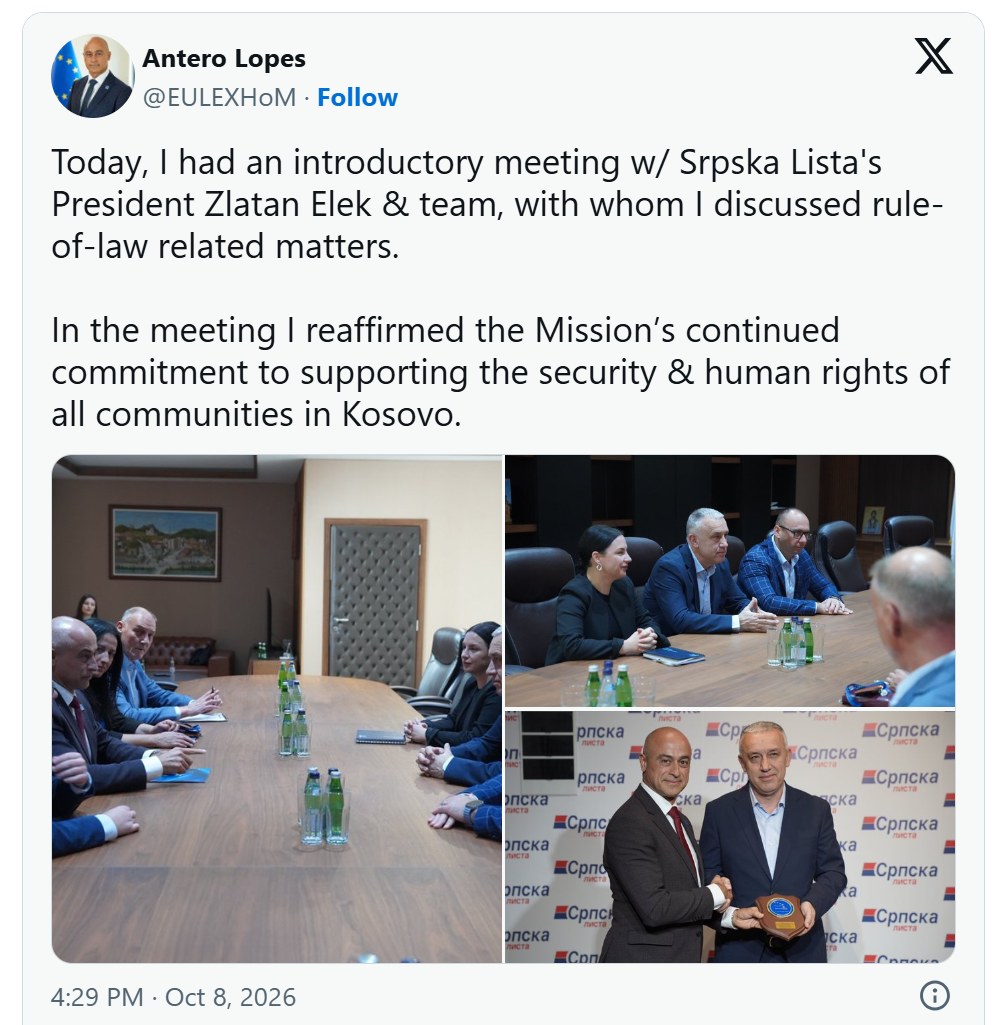
Antero Lopes sat down with Srpska Lista and has not answered its charge of “institutional violence” in public. The next evening the party’s president was on television speaking for Aleksandar Vučić’s list.
the Editorial Board | 11 October 2026
On 8 October the head of the European Union’s rule of law mission in Kosovo sat down with the leadership of Srpska Lista. Antero Lopes posted three photographs. In one he shakes hands with his host in front of a wall of party logos. He called it an “introductory meeting” on “rule-of-law related matters” and said he had reaffirmed the mission’s commitment to “the security & human rights of all communities in Kosovo.”
Srpska Lista published its own account the same day. The party says Lopes was told of “continuous institutional violence against the Serbian people.” It asked for “continuous, objective and professional oversight” of the Kosovo Police and the prisons. Then it told him what his job is. EULEX’s role “must not be reduced to formal monitoring of the situation.” The party wants concrete steps and accountability for unlawful conduct. All of it, the statement adds, within the mission’s mandate.
The party’s president, Zlatan Elek, has used the phrase before. In December 2024 Kosovo’s election commission declined to certify his list, and he called that “institutional and legal violence against the Serbian people.” This time Večernje novosti in Belgrade put “institutional violence” in its headline, with the EU mission chief beside it. EULEX has not answered it in public.
Lopes runs a mission that monitors, mentors and advises. Following how the police and the prisons treat a detainee is already its work, and Srpska Lista is entitled to ask for its recommendations. Accountability belongs to Kosovo’s inspectors, prosecutors and courts. EULEX’s power to investigate and prosecute ended in June 2018. It said so itself when this same party asked it to look into an alleged police beating. No party statement can hand that power back.
On his first day Lopes promised to work for a rule of law “independent, impartial and free from undue political influence.”
Srpska Lista is political influence. Marko Đurić, now Serbia’s foreign minister, called it a “state project” of Serbia when he ran Belgrade’s office for Kosovo. The evening after the handshake, Elek sat in a campaign debate on TV Nova, speaking for the list that carries Aleksandar Vučić’s name in Serbia’s election. “I am a member of the Serbian Progressive Party,” he said. Both parties’ statutes forbid membership in another party. He added that he is no longer a deputy in Kosovo’s parliament. The Assembly still lists him as one, and when the host said so, Elek agreed.
In September 2023 the party’s vice-president, Milan Radoičić, took public responsibility for the armed attack at Banjskë (Banjska), where a Kosovo police sergeant, Afrim Bunjaku, was killed. The third anniversary passed two weeks before Lopes stood at the party’s wall. The police who buried Bunjaku are the police this party asked Lopes to oversee.
The Council of the EU, announcing his appointment, listed six years at UNMIK among his qualifications. UNMIK governed Kosovo. Its chief held all legislative and executive authority and could overrule the elected Assembly. For years it administered North Mitrovica directly, while structures paid from Belgrade ran schools, hospitals and courts beside it. An official of that mission received Serb political leaders as a constituency and Kosovo’s institutions as pupils to be graded. A complaint against the police came to him because he was the police.
That is the manner of a colonial administrator. In 1999 it at least came with a legal title, because Resolution 1244 gave UNMIK the powers. Nobody has given them to EULEX. Lopes has brought the manner to a mission with no government to run, no police to command and no Assembly to overrule.
Srpska Lista knows this. It made the same request of his predecessor. It places the order with each new head of mission and waits for one who will fill it.
A head of mission who leaves unanswered a public claim that the institutions he advises practise violence against a people lends his office to the claim. A head of mission who is told that formal monitoring is not enough, and does not say where his mandate stops, lets a party define it for him.
Lopes can settle this with one post. He can repeat what his own mission told the same party before. EULEX monitors and advises. It does not investigate and it does not discipline. Allegations of violence go to Kosovo’s Police Inspectorate and its prosecutors, whose work EULEX already monitors.
Or he can stay silent and own the party’s account, “institutional violence” included.
His appointment runs ten months. Kosovo is entitled to know which mission he intends to lead in them: the one the Council extended, or the one he remembers.
