Croatia's president called Serbia's rearmament "very strange." He was right. Measured against the Balkans it makes little sense; measured against the contingency of a wider European conflict, it becomes disturbingly coherent.
By Albatros Rexhaj | 9 July 2026
On July 8, after the NATO summit in Ankara had closed, Zoran Milanović told the Croatian press that he had raised the question of Serbia's rearmament among the allies because, as he put it, it was his duty to do so. The Croatian president is not a man given to alliance solidarity for its own sake, and much of what he said in Ankara about Ukraine and about the American delegation will have irritated the same allies he was addressing. That is partly why the Serbian portion of his remarks deserves more attention than it has received. Milanović was not performing hawkishness for a domestic audience. He was reporting, in the deliberately loose language available to a head of state at a press conference, something he had already said in the closed format.
What he said was this: that Serbia's arms purchases, "the buying of all sorts of systems," are established by data he did not further describe; that Serbia fields Israeli missile systems with a range of several hundred kilometers; that the hypersonic weapons Aleksandar Vučić confirmed in March are only one part of the picture, and that "there is more"; that Croatia will have to respond by acquiring comparable systems of its own; and that NATO must be informed of all this and must discuss it. Twice he reached for the same word. Serbia is behaving strangely, he said, and its armament policy is very strange. He allowed himself one joke, that he hoped Belgrade would not be buying aircraft carriers on wheels within six months, given that it has no sea, and then he asked the questions that any procurement program is supposed to answer and that this one, so far, has not: what is it for, why are you buying it, what is your threat assessment, and how do you intend to use it.
I want to take the word "strange" seriously, because it is doing diplomatic work. In the vocabulary of a summit press conference, strange is what you call behavior that makes no sense within the frame you are permitted to use, and Milanović's frame in Ankara was necessarily the frame of Serbia's own declared security environment. Within that frame he is right. Nothing about the arsenal adds up. The question is whether the frame is the correct one, and I do not believe it is.
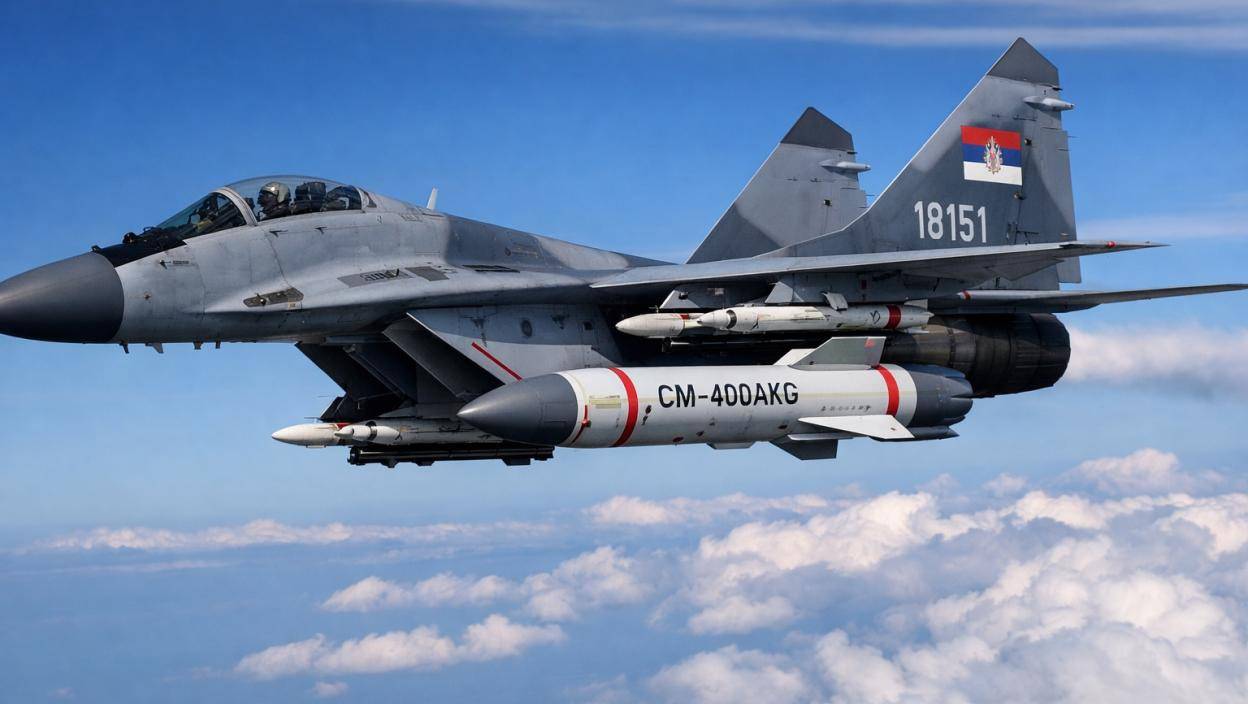
Begin with what the arsenal actually contains, because the specifics matter more than the adjectives. In March, after photographs surfaced of a Serbian MiG-29SM carrying two Chinese CM-400AKG air-to-ground missiles, Vučić confirmed the acquisition and volunteered that Serbia holds "a significant number of those missiles and we will have even more." The CM-400AKG flies at speeds approaching Mach 5 or beyond in its terminal phase, with reported ranges between 240 and 400 kilometers depending on variant; until those photographs appeared, its only foreign operator was Pakistan, and the class of air-launched standoff capability it represents is otherwise fielded in Europe only by Russia. The Israeli systems Milanović referred to are also identifiable. Under a $335 million contract with Elbit Systems confirmed in early 2025, Serbia has taken delivery of the PULS rocket artillery system, whose munition family runs from short-range rockets through the EXTRA missile at 150 kilometers to the Predator Hawk ballistic missile at 300, and which paraded through Belgrade in September. A second Elbit contract disclosed last August, worth $1.63 billion and among the largest in Serbia's modern history, adds loitering munitions, electronic warfare, signals intelligence, and a full command-and-control digitalization layer. Add the twelve Rafale fighters ordered from France for some €2.75 billion, the Chinese FK-3 air defense system flown in by six Y-20 transports in 2022, the CH-92 armed drones, defense spending headed toward 2.6 percent of GDP this year, and Vučić's statement at the June 28 exercises at Pasuljanske Livade that he intends to deepen cooperation with Beijing further, including interest in the HQ-9 long-range air defense system. That is the inventory behind the word "strange."
Now consider the explanations available to anyone trying to make it cohere. Belgrade's own account is deterrence against its neighbors, and Vučić has given this account a specific shape, claiming repeatedly that Croatia, Albania and Kosovo have formed a military alliance with plans to attack Serbia. Milanović dealt with this in March with visible exasperation, pointing out that the trilateral memorandum the three countries signed is a cooperation document rather than a pact, that he had told Vučić as much personally, and that Croatia in any case has no army configured for such an attack. But leave the rhetoric aside and test the claim against the hardware. Deterring Zagreb, Tirana and Prishtina does not require near-hypersonic standoff missiles with 400-kilometer reach, a radius that drawn from Serbian territory extends well past the neighborhood into Central Europe and the Adriatic approaches. Milanović made the essential point in March: Serbia is fielding offensive medium-range systems of a kind no other European state possesses. A deterrent is sized to the threat it addresses. This one is sized to a different map.
A second explanation is prestige, the familiar phenomenon of the strongman's parade arsenal, and Serbia did stage its largest military parade in history last September. But prestige procurement is episodic and theatrical, and the rest of the record is neither. According to figures published by Kosovo's Ministry of Defense and restated by Minister Ejup Maqedonci as recently as this spring, Serbia maintains twenty-eight forward operating bases within 300 meters to five kilometers of the boundary with Kosovo, supplemented by twenty Gendarmerie bases along the same line, with three of the army's four combined-arms brigades, at Raška, Niš and Vranje, and roughly seventy percent of its capacities stationed in the south. The day before Milanović spoke in Ankara, Prime Minister Đuro Macut and Defense Minister Bratislav Gašić toured two of those bases, Karaula and Merdare, with the chief of the general staff, and then laid a wreath at the Kuršumlija barracks for soldiers killed, in the official phrasing, during the NATO aggression of 1999. The itinerary is worth pausing on, because ceremonies tell you who the adversary is in a state's official imagination, and in this one the adversary being commemorated is not Croatia or Kosovo but the alliance itself. None of this is theater. It is a program, with a program's continuity and a program's cost.
The third and most charitable explanation is hedging: a candidate country buying insurance against an uncertain European future while keeping its options open. This hypothesis has one genuine piece of evidence in its favor, and honesty requires stating it. In May, Serbia hosted its first joint exercise with NATO in its history, two weeks of peace-support training at Bujanovac with some six hundred troops from allied nations, conducted, in the alliance's careful phrase, in full respect of Serbia's stated policy of military neutrality. But set that single exercise against the other side of the ledger. Serbia's refusal to align with EU sanctions against Russia has been maintained continuously since February 2022, at real and compounding cost to the accession process it claims as a strategic objective. The service relationship with Moscow has not merely survived the war; it has been decorated. Aleksandar Vulin, the former intelligence chief sanctioned by the US Treasury in 2023 and returned to government as deputy prime minister regardless, has received orders of merit from both the FSB director and Putin personally for his contribution to cooperation between the Serbian and Russian services, and has continued traveling to Moscow to meet Bortnikov and Naryshkin in that capacity. In March of last year, facing protest allegations about an acoustic weapon, Belgrade's response was to invite an FSB team into Serbia to conduct the investigation, a Russian security service asked to audit the conduct of Serbian forces against Serbian citizens. In the summer of 2025, Moldovan authorities released video footage and testimony alleging that locations in western Serbia had been used to train Moldovan citizens for election-related sabotage ahead of that autumn's parliamentary vote, and reporting over the past year has described FSB officers acquiring Serbian citizenship through expedited procedures. A hedge is defined by the preservation of both options. One two-week exercise does not preserve an option; it maintains the appearance of one, which is the cheapest item in the entire budget. The choice was made years ago, and the arsenal is being built on the far side of it.
Which brings me to the assessment I actually hold, and which I would rather state plainly than leave implied. The cumulative record, in my judgment, is most consistent with preparation for the contingency of a large conventional confrontation in Europe, in which Serbia's function would be that of Russia's extended arm in the Balkans. That is an analytical conclusion drawn from indicators, not a fact I can document the way I can document a missile purchase, and the reader should weigh it as such. But I have set out the indicators, and I have yet to encounter a rival explanation that survives them.
Let me also be precise about what the conclusion does not claim. It does not claim that Serbia intends to fight NATO, an idea its critics will rightly call absurd and which forms no part of the argument. The function an aligned Serbia serves in a European war is not combat but fixation. An armed, offensively postured, doctrinally sympathetic military inside southeastern Europe, outside the alliance and unaccountable to it, generates a permanent planning requirement: it must be watched, garrisoned against, and factored into every allocation of attention and air defense, and it imposes those costs simply by existing. A second theater does not have to open in order to work, and from Moscow's side of the ledger the arrangement costs nothing, since Belgrade pays for the posture itself. Nor is this reading eccentric to me; the Atlantic Council observed in November that Serbia's neighbors already worry that in a war between Russia and the West, Belgrade would use the opportunity to pursue its own designs on the region.
The claim is also not that Serbia figures in any current Russian operational plan, and the recent reporting from the northern flank should be read carefully on exactly this point. On July 3, The Telegraph and its Warsaw stablemate Onet reported, on sources close to President Nawrocki, that Washington has repeatedly warned Poland of a possible armed Russian provocation in the coming months, from strikes on critical infrastructure to a limited ground incursion dressed up as accident or rescue, designed to force negotiations whose price would be the suspension of Western support for Ukraine. The two outlets share an owner, so this is one sourcing ecosystem rather than two, but the warning does not stand alone: The Guardian carried a parallel report in late June, Latvian intelligence has flagged preparation indicators, Prime Minister Tusk has called the coming months critical, and Foreign Minister Sikorski addressed Putin directly, saying we know what you are planning, don't do it. None of this mentions Serbia, and I will not pretend it does. What it establishes is a calendar: allied intelligence has converged on the coming months as the window in which NATO's cohesion is likely to be tested in the northeast. It was in the opening days of that window that a NATO head of state stood up at a summit to report that the alliance's southern flank carries an armed and unexplained weight nobody has priced, and that the state carrying it, asked the most elementary question in defense planning, declines to answer. In the same week, Vladimir Solovyov was sketching on Russian state television a Eurasian security bloc of Russia, China, North Korea and Belarus whose distinguishing feature was an open door for whoever wishes to join. Solovyov names no Balkan country and his broadcasts are mood rather than policy; the connection between that open door and Belgrade is made not in Moscow's studios but in Serbia's procurement contracts, its base construction, and its four-year sanctions record. Those are the documents. The inference from them is mine, and I have given my reasons.
One more feature of the calendar deserves notice. On June 27, the day before the Pasuljanske Livade exercises, Vučić announced that he will resign the presidency within weeks, with early elections to follow and, most observers assume, the premiership waiting for him on the other side. Whatever that maneuver means for Serbia's internal crisis, it changes nothing in this analysis, and that is itself the point. The bases were built, the contracts signed, and the doctrine set across changes of government, ministerial reshuffles, and now a change of presidency. The posture is institutional. It will outlast whoever holds which office in Belgrade this autumn, which is precisely what distinguishes a state preparing for something from a leader improvising.
Milanović's joke about aircraft carriers on wheels was meant to capture the absurdity of a procurement policy unmoored from geography, and as a line it worked. But the absurdity dissolves the moment one stops assuming the shopping list was written for Serbia's geography. Measured against the geography of a European war, the reach into Central Europe, the strike systems no neighbor requires deterring, the fortified line facing the alliance's newest member, the list is coherent from the first item to the last, and the strangeness a Croatian president could name but not explain in Ankara is simply what preparation looks like inside an alliance that has not yet decided to see it. Serbia is not buying for its own sea. It is buying for someone else's war.
Albatros Rexhaj is an independent analyst and author focused on Western Balkans political and security affairs.