Serbia's president had a name, a rank and an alliance available to him. He reached for an ethnonym instead. In the Balkans, that ethnonym has a record.
By Ngadhnjim Brovina | 19 August 2026
This week in Belgrade, touring the construction site of the Tiršova children's clinic, Aleksandar Vučić was asked about the main bridge over the Ibër (Ibar) in Mitrovica. He answered that the opening could never have been permitted without the consent of the Serb mayors in the north, and then he identified the man he holds responsible. "To radi Turčin, komandant KFOR-a." The Turk is doing this, the commander of KFOR.
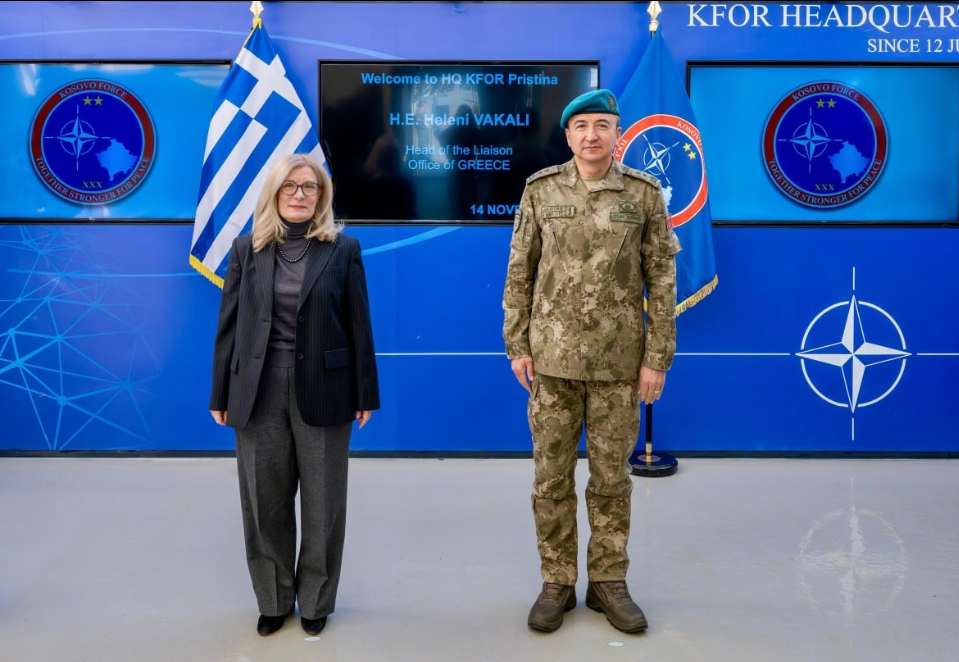
Consider what was available to him. The officer has a name. Major General Özkan Ulutaş of the Turkish Army became the first Turkish commander of KFOR in October 2023 and returned last October for a second term, the first commander in the mission's twenty six years to serve twice, a distinction NATO's own biography of him records. He holds a doctorate, and its subject is worth pausing on: NATO and the Turkish Armed Forces. He keeps regular and transparent contact with the chief of Serbia's General Staff, has attended a Serbian Army exercise as an invited guest, and commands under Security Council Resolution 1244, the instrument Belgrade invokes more often than any government in Europe. Serbia's president could have named the man. He could have named the alliance. Either would have placed the decision inside an institution, and an institution can be petitioned or argued with. An ethnicity cannot.
The word does not arrive empty.
During the war in Bosnia, the forces of Republika Srpska and their political leadership routinely called Bosniaks "Turci." The usage converted rather than described. Bosniaks are Slavs, indistinguishable from their neighbors in language and lineage; calling them Turks moved them out of the present and into the national epic, where the enemy has carried one name for six centuries and where violence against him is narrated as the settling of an old account.
"Poklanjamo srpskom narodu ovaj grad. I napokon, došao je trenutak da se posle bune protiv dahija osvetimo Turcima na ovom prostoru." We present this city to the Serbian people as a gift. Finally, the time has come, after the uprising against the dahije, to take revenge on the Turks in this territory. Ratko Mladić said it to a camera in Srebrenica on 11 July 1995. The dahije were the Janissary strongmen whose massacre of Serb notables ignited the uprising of 1804; the revolt was put down in 1813. The revenge Mladić announced was collected one hundred and eighty two years later, in the days that followed his sentence, from more than eight thousand men and boys who were not Turks. The word had finished its work before the shooting began. It had already decided who the victims were allowed to be.
The register is older than Bosnia, and its home address is here. The Serbian national myth is organized around a defeat by the Ottomans in 1389, on a field at Fushë Kosova (Kosovo Polje), a short drive from where KFOR keeps its headquarters. In that myth the adversary needs no introduction. When Serbia's president calls the commander of KFOR "the Turk," his audience completes the substitution without instruction: the Atlantic alliance dissolves, and in its place the empire stands at the bridge again. A dispute about traffic becomes a chapter of occupation.
"Sve što rade zapadne zemlje je civilizacijska sramota." Everything the Western countries are doing is a civilizational shame. The adjective is Vučić's own, and it carries the argument. A shame can be diplomatic, legal, moral; each of those words would keep the dispute inside the world of states, where a bridge is infrastructure and a commander is an officer executing a mandate. "Civilizational" moves the dispute somewhere else. In that vocabulary the parties are faiths rather than governments, the timeline runs in centuries rather than communiqués, and a Turkish general on the Ibër stops being a detail of NATO's rotation schedule and becomes a cast member.
The rest of the frame was assembled in the same remarks. The persecuted people, Serbia's president said, is "pravoslavni i hrišćanski," Orthodox and Christian, driven daily from its hearths. Set that sentence beside the sentence about the Turk, under the heading he supplied himself, and the claim completes itself without ever being stated: a Muslim officer administers the civilizational persecution of a Christian people, and Europe watches. No single sentence asserts it. Delivered together in one appearance, they leave the listener nowhere else to arrive.
The frame has a documented author, and he presented it as a bill for services. In February 1995, explaining to the Assembly of Republika Srpska why every peace plan had failed, Radovan Karadžić claimed that Western diplomats had confided the real reason "at the cocktails and lunches": gentlemen, we do not want an Islamic state in Europe. Europe, he told the deputies, is "a community of happy Christian peoples," and the Serbs guard its walls, "a kind of a moat filled with filthy water, with no other purpose to its existence but to neutralise Islam." The grievance in the sentence is the point of the sentence. Karadžić was not merely claiming the rampart role; he was invoicing the West for it, casting the war as anti-Islamic labor performed on Christian Europe's behalf and left unpaid. Fifteen years later, at The Hague, he was still calling that war just and holy. The frame's function, then and now, is recruitment. A quarrel between Serbia and a NATO mission over a bridge has no natural constituency abroad. A war of the cross against the crescent has several. The vocabulary is fluent in Moscow, where civilizational conflict is state doctrine, and it is legible to audiences farther west prepared to read the Balkans as a front line of faiths. When Belgrade's head of state files a traffic dispute under civilization, he is not describing the bridge. He is applying for allies.
The honest objections deserve their space, and the first is that presidents speak every day. One recorded utterance is not a campaign, and a frame is not yet a campaign either, though this one arrived fully assembled in a single appearance; if the state-aligned press begins repeating the epithet as a fixture, that will be a separate and checkable finding. The second objection is that Belgrade's relations with Ankara are warm, and this one is true in the strongest terms. Vučić stood beside Recep Tayyip Erdoğan in Ankara this February to sign a joint declaration celebrating trade of 3.5 billion dollars and a target of five; at their Belgrade summit in October 2024, the one Erdoğan called a golden age, Vučić announced that Serbia had exported an enormous number of shells to Türkiye and declared his full trust in its president. But the warmth is precisely what settles the question of address, because the register has a documented switch. Days before that Ankara visit, Vučić complained that Kosovo would seek more Turkish weapons, saying he had the complete list, and Belgrade's own press records him declaring, of Turkish drones in Kosovo, that Türkiye dreams of restoring the Ottoman Empire. In Ankara, Türkiye is a strategic partner. The moment Kosovo enters the sentence, it becomes the empire again. The word is not policy toward a state. It is a switch thrown for a domestic audience old enough to know what it meant the last time it was doing political work.
The letter, when it reaches Brussels, will arrive in English. It will speak of security assessments and premature decisions, in the grammar of a member of the international community addressing an alliance it hopes to persuade. That is the version written for Mark Rutte. There is another version, and it was written for everyone else. It exists in Serbian, on the record, distributed by the state-aligned press without correction, and in it the Secretary General's commander in Kosovo is not General Ulutaş executing a mandate. He is "Turčin." In the vocabulary this piece has traced, that word does not mean a citizen of Türkiye. It means the figure from the epic: the occupier, the barbarian at the bridge, the enemy of six centuries whose defeat is owed. A man who has spent thirty years in public life choosing words for a living does not stumble into that one.
Ankara should remember the sentence. Türkiye joined the alliance in 1952, fields its second largest army, and twice now has supplied the commander whom thirty capitals entrusted with Kosovo, a soldier who wrote his doctorate on his country's place inside NATO. His reward, from the president of a state that courts Turkish trade, Turkish construction, Turkish trust, is the oldest insult the region owns.
And the Secretary General should read both documents, because the letter smuggles in a question the polite version never states. Belgrade is asking NATO to overrule an officer it has already, in its own language, expelled from the alliance and deported into the fourteenth century. To answer the letter is to answer the question. Either Özkan Ulutaş is a NATO general, and the judgment that the security situation on the Ibër had improved, and the gradual reduction of KFOR's permanent presence on the bridge that followed from it, carry the alliance's authority, and his ethnicity has no place in its chain of command. Or he is a Turk in the sense Belgrade's head of state used the word, and the alliance accepts that its commanders come sorted by faith. There is a third reading, that the word is beneath notice and can be ignored, and it is the one Belgrade is counting on: Vučić announced the letter and predicted its refusal in the same breath, because a refused petition and an unanswered insult are entries in the same ledger of grievance. What the word has been made to carry needs no speculation; the record established it in Assembly minutes and on camera in Srebrenica. The Secretary General does not have to repeat Belgrade's word in order to answer it. He only has to decide whether his commander in Kosovo serves inside the alliance or inside the epic.
Ngadhnjim Brovina teaches political science at UBT in Prishtina. His work concerns enlargement, conditionality, and the institutional politics of the Western Balkans, including the political vocabularies through which the region's conflicts are framed and fought.
