Kosovo Dispatch | 22 January 2026
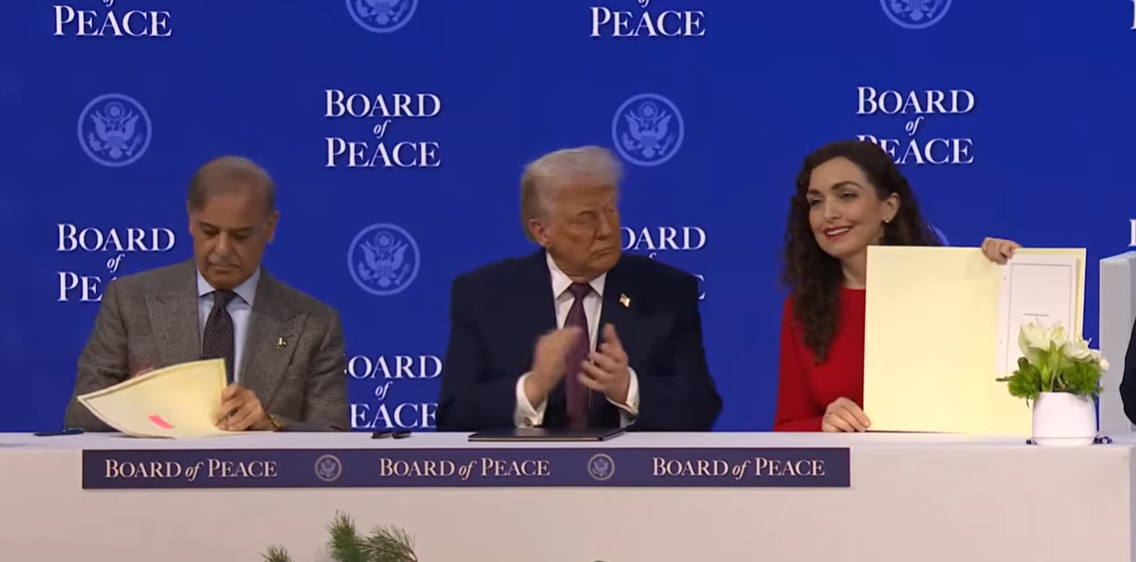
When the White House unveiled the Board of Peace on the margins of the World Economic Forum in Davos, much of the attention fell—predictably—on President Donald Trump’s sweeping claims of wars ended and conflicts soon to be resolved. But away from the rhetoric, the composition of the room told a more durable story.
Kosovo was there.
President Vjosa Osmani’s presence among the founding participants was not ceremonial. It placed Kosovo inside a selective, U.S.-curated framework that reflects how Washington is increasingly distinguishing partners from bystanders as it experiments with new tools of conflict management.
The Board of Peace, as described by Secretary of State Marco Rubio, is not meant to replace existing international institutions outright. But his critique was unmistakable. Institutions that “served us well for more than 70 years,” Rubio said, had failed to deliver results in Gaza and elsewhere. The implication was clear: Washington is no longer waiting for consensus to act—and it is assembling mechanisms that reflect that reality.
In that context, Kosovo’s inclusion matters.
This was not a universal gathering, nor a symbolic summit of aspirational democracies. The invite list mixed regions, regimes, and reputations—countries Washington sees as relevant to outcomes, not moral exemplars. Kosovo’s presence among them signals something specific: trust, alignment, and functional reliability in U.S. eyes.
That distinction is often missed in Balkan commentary, where participation is still framed as recognition-seeking. In Washington, recognition is no longer the metric. Utility is.
Kosovo’s role in U.S.-led security frameworks, its consistent alignment on transatlantic priorities, and its absence from the growing list of states hedging between Washington and its rivals have quietly reshaped how it is treated. Being present at the creation of a new American instrument—however experimental—reflects that shift.
The contrast with Serbia was equally instructive. Belgrade was not part of the founding group. In diplomatic terms, absence from a selective forum is itself a signal. At a moment when Washington is testing alternative architectures and parallel tracks, it is also recalibrating whom it brings aboard.
President Trump’s own remarks underscored the nature of this moment. His declaration that there is now “peace in the Middle East” and his assertion that another major war could be resolved “very soon” were less about verification than authority. Trump governs through outcome claims; Rubio builds the scaffolding beneath them.
Kosovo, notably, was positioned alongside the scaffolding.
Kosovo was present when Washington signaled a willingness to bypass inherited constraints and prototype something new.
In diplomacy, being in the room when rules are being tested is often more consequential than the rules themselves.
Kosovo was in that room.
