The EU Office and the embassies of Germany, Italy and the United Kingdom issued statements on Thursday. The US Embassy has taken no public position.
KD Newsroom | 13 November 2026
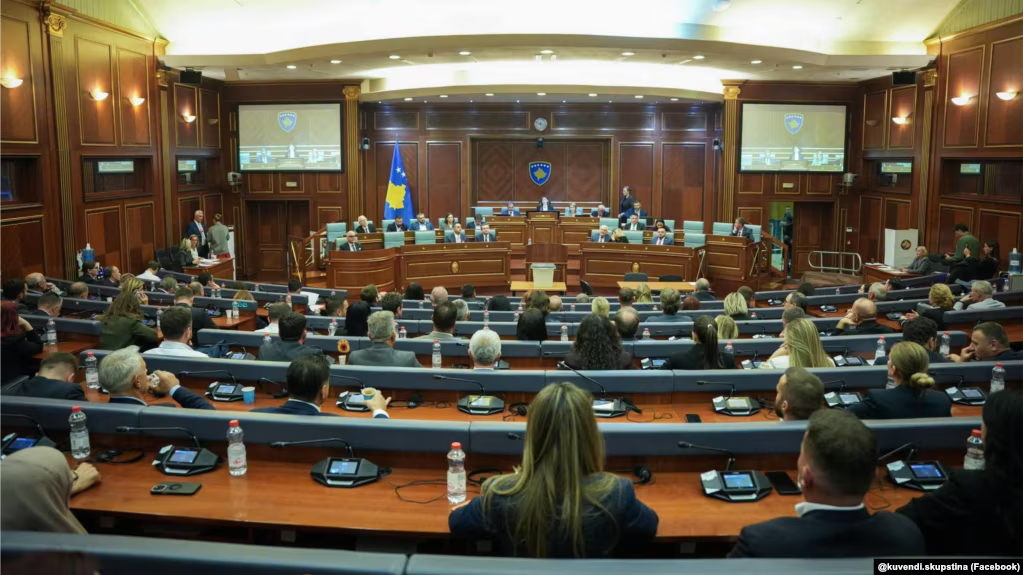
The Assembly of Kosovo resumes its plenary session at 11:00 today with the law amending the Law on the Specialist Chambers and Specialist Prosecutor’s Office on its agenda. Deputies cannot change the text at this stage. They vote on it as adopted on 6 October and returned by President Justina Shiroka-Pula on 22 October. Sixty-one votes make it law. Fewer, and it is considered not adopted.
Vlora Çitaku, acting leader of the PDK, moved on Thursday to add the law to the agenda, and 79 of the 84 deputies present backed her. The Committee on Legislation reviewed the President’s decision the same day and left the final word to the plenary. The session collapsed in the afternoon when deputies failed to return from a break. Speaker Albulena Haxhiu postponed it to Friday.
The PDK launched the initiative after the Chambers convicted four former KLA leaders at first instance on 16 September and sentenced them to a combined 81 years. The Assembly adopted the amendments on 6 October as part of the political compromise that also produced the election of the President. The PDK then asked her to return the law, saying legal experts had recommended it in order to strengthen its legal basis and secure its implementation. The party and the parliamentary majority could not agree on whether a returned law may be amended during reconsideration. The PDK now asks for the same text and promises a new initiative on Monday, 16 November, with amendments handled within two weeks.
“I do not expect the European Union to applaud this initiative” (“Nuk pres që Bashkimi Evropian ta duartrokasë këtë iniciativë”), Çitaku told Ekonomia Online. She invited the EU, international allies and civil society to consultations. In the chamber she said the PDK knew the decision would cost it politically. Radio Free Europe reported that it sought her comment on the process and received no answer. The Presidency did not answer the outlet’s question on how it views re-adoption without changes.
Vetëvendosje will vote for the law. Caucus leader Arbërie Nagavci told Radio Free Europe the party promised the PDK its support and will not withdraw it. Her colleague Vigan Qorrolli, who chairs the Committee on Legislation, told the same outlet he fears the law cannot be implemented as written. He described the PDK’s pace at every stage as “an inexplicable haste” (“një nguti të pashpjegueshme”), from the first adoption to the request for the return and now the push for re-adoption. The majority, he said, was never convinced by the route, and both the burden of proof and the political burden lie with the PDK.
Vullnet Bugaqku of the Kosovo Democratic Institute asked Radio Free Europe why the Assembly would overturn a return that asks for the law to be improved, leave the law in force, and then open a new process to revise it. Regular legislative procedure takes up to three months, he said. The Assembly’s Rules of Procedure reserve accelerated review for bills on national security, public health and budgetary matters. A departure from procedural deadlines needs two thirds of the deputies present, must comply with the Constitution, and can be challenged by the Ombudsperson and other authorised parties. Former Constitutional Court judge Kadri Kryeziu called the situation unprecedented.
The EU Office in Kosovo said the amendments raise serious concerns about judicial independence, the protection of victims and witnesses, procedural rights and accountability. It questioned their constitutionality. Since the law was returned, the Office said, it has conveyed its concerns and expectations to Kosovo’s authorities, including the need for consultations before any adoption, in line with Kosovo’s international obligations.
Germany’s embassy reshared the EU post and declared full agreement with it. Italy’s embassy repeated the EU text, regretted that consultations have not yet been held, and said the law in its present form serves neither Kosovo nor the men recently convicted.
“We fear that the proposed amendments will do nothing to serve Kosovo’s essential interests and will undermine its relations with international partners and supporters,” the British Embassy said. London said it had “taken full note of the strength of feeling surrounding the recent verdicts”. It said Kosovo’s goals are best served by upholding its international commitments and its dedication to accountability, justice and the rule of law, and it encouraged the Assembly to take time for further consultations, internally and with the EU and other allies, “to find a better solution”.
The US Embassy had issued no position by late Thursday. Its only public communication that day was a notice to American citizens that protests are expected in Pristina in the coming weeks.
The EU’s consultation demand rests on an exchange of letters from April 2014 between President Atifete Jahjaga and EU High Representative Catherine Ashton, which opened the way to the Chambers. In it Kosovo undertook to consult the EU on legislative initiatives affecting the court’s mandate or the proceedings arising from the Special Investigative Task Force. When the President returned the law in October, an EU spokesperson said Brussels expected to be consulted “in the spirit of the exchange of letters”. Enlargement Commissioner Marta Kos had called the amendments unacceptable on 12 October.
Brussels has since confirmed it is holding consultations with the Government of Kosovo. Qorrolli said contact with EU representatives has been constant and that their objections concern provisions touching the international agreement on which the Chambers were founded. Italy’s statement says the consultations have not happened.
The law does not abolish the Chambers. It confines them to crimes directly linked to the organ-trafficking allegations in the Council of Europe Parliamentary Assembly’s 2011 report, committed between 1 July 1999 and 31 December 2000. Panels would have 30 days from entry into force to review jurisdiction in every case. Cases outside the new jurisdiction would pass to Kosovo’s courts. Sentences would be capped at 15 years, and a presidential pardon would become possible. The PDK argues this would not automatically annul existing judgments or free anyone convicted.
Ehat Miftaraj, director of the Kosovo Law Institute, has told Radio Free Europe that any change must respect Kosovo’s international obligations and Article 162 of the Constitution, the constitutional basis of the Chambers.
The Government has separately formed a working group under Deputy Prime Minister Glauk Konjufca to coordinate institutional support for the four men’s appeal. Qorrolli called that the more suitable way to support their defence.
Asked whether adoption could affect Kosovo’s relations with the EU, Qorrolli said he hopes not. Which provisions the PDK intends to change is not yet known.