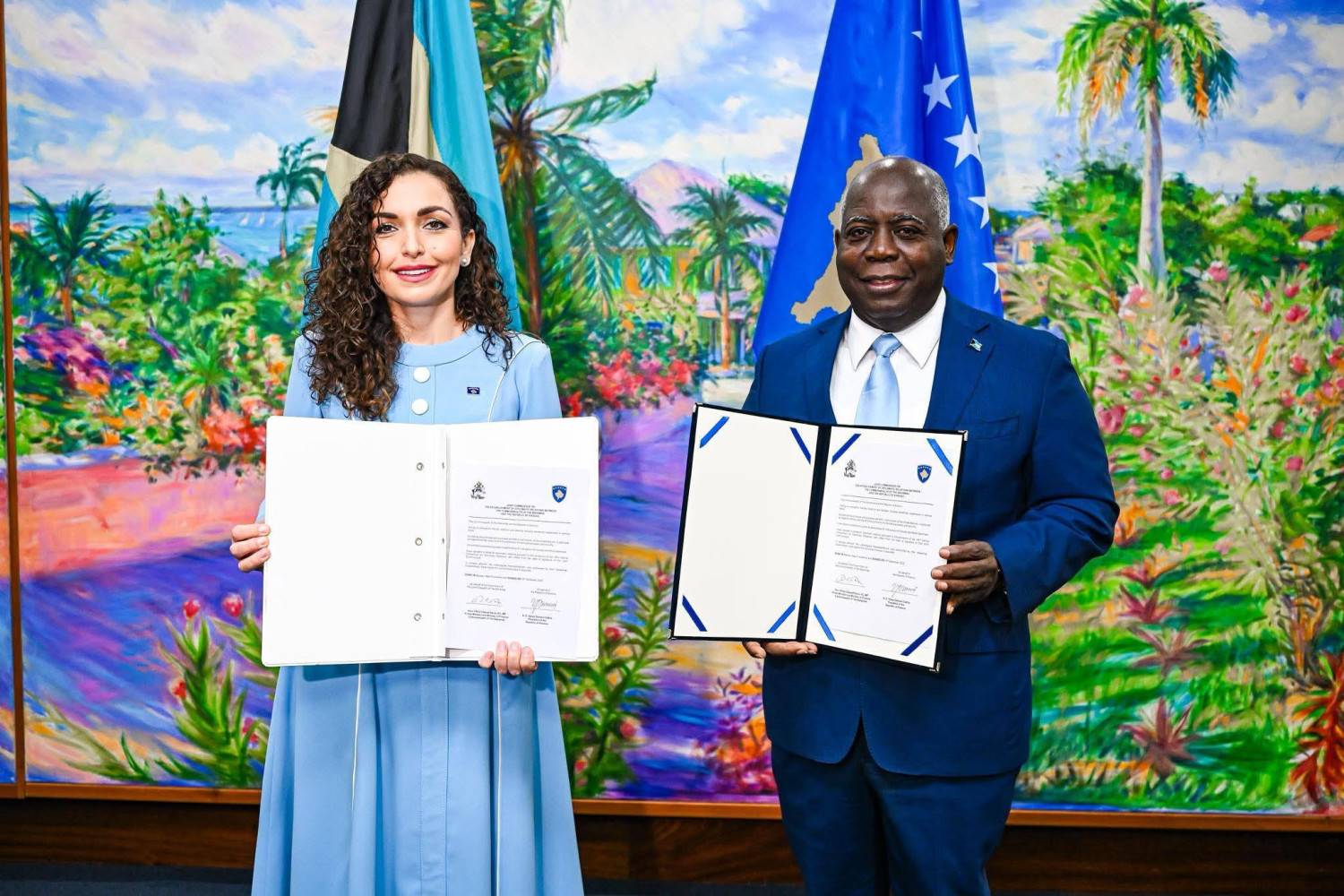
Pristina / Nassau — 19 December 2025
The Commonwealth of The Bahamas has formally recognized the Republic of Kosovo as an independent and sovereign state and established diplomatic relations with Pristina, marking a significant diplomatic development and reinforcing a renewed momentum in Kosovo’s international recognition process.
The recognition was formalized through a joint declaration signed by the President of Kosovo and the Prime Minister of The Bahamas, Philip Davis, in the Bahamian capital. With this act, The Bahamas becomes the 121st state to recognize Kosovo, and the fourth to do so in 2025, following Kenya, Sudan, and Syria.
The declaration confirms not only recognition, but also the establishment of diplomatic relations in accordance with international law and the Vienna Convention on Diplomatic Relations (1961). Both states reaffirmed their commitment to the principles of the United Nations Charter, including respect for sovereignty, equality of states, and the peaceful resolution of disputes.
A Coordinated Diplomatic Outcome
Kosovo’s leadership presented the recognition as the result of sustained institutional coordination rather than an isolated breakthrough.
President Vjosa Osmani, who announced the recognition, described it as another step in strengthening Kosovo’s international standing and diplomatic legitimacy. Prime Minister Albin Kurti framed the development within a broader political arc, noting that while 2024 marked a turning point for Kosovo’s passport and freedom of movement, 2025 is emerging as the year of renewed recognitions, following a prolonged period of stagnation.
Deputy Prime Minister and Foreign Minister Donika Gërvalla emphasized the cumulative nature of Kosovo’s diplomatic progress, stating that the country continues to consolidate its sovereignty “through work, dignity, and sustainable alliances.” She also publicly acknowledged the role of Bahamian Foreign Minister Frederick A. Mitchell in facilitating the recognition and in laying the groundwork for bilateral cooperation.
The recognition was welcomed across Kosovo’s political and diplomatic spectrum, including by former Foreign Minister Petrit Selimi, who highlighted its importance as part of a broader 2025 recognition trend.
Regional and International Reactions
The development was also welcomed in the region. Albanian President Bajram Begaj publicly thanked The Bahamas, calling the recognition a meaningful contribution to peace, stability, and the strengthening of international order.
Such reactions underline the symbolic weight of the recognition beyond its bilateral dimension. While Kosovo and The Bahamas have limited immediate economic or strategic ties, recognitions by small and medium-sized states carry disproportionate importance in multilateral diplomacy, particularly in contested statehood cases.
Why This Recognition Matters
From a legal and diplomatic standpoint, recognition is a unilateral sovereign act. Once extended and formalized, it is effective regardless of the pace or visibility of subsequent administrative steps. The establishment of diplomatic relations further cements the recognition, placing it firmly within accepted international practice.
Politically, the recognition adds to Kosovo’s efforts to:
- reinforce its legitimacy in international organizations,
- counter narratives of diplomatic isolation,
- and rebuild momentum after several years in which recognition efforts had largely stalled.
The Caribbean and Commonwealth dimension also matters. The Bahamas is a visible actor within small-state diplomatic networks and multilateral coalitions, where consensus-building often relies on trust and reciprocity rather than power politics. In such environments, each additional recognition can influence voting dynamics and diplomatic alignments in forums ranging from the United Nations to specialized international agencies.
The 2025 Recognition Pattern
The Bahamas recognition fits a broader pattern that has begun to emerge in 2025. After years of relative diplomatic inertia, Kosovo secured recognitions from Kenya (March), Sudan (April), Syria (October), and now The Bahamas (December).
While these recognitions do not alter Kosovo’s core challenges—particularly its EU integration path and the normalization process with Serbia—they do indicate a renewed diplomatic assertiveness and a willingness by a diverse set of states to engage with Kosovo as a sovereign actor.
For Kosovo, the immediate significance lies less in bilateral substance and more in cumulative legitimacy. Each recognition strengthens the country’s standing as a normalized international actor and narrows the space for claims that Kosovo’s statehood remains provisional or reversible.
A Signal, Not a Conclusion
The recognition by The Bahamas does not resolve Kosovo’s strategic dilemmas, nor does it substitute for progress in EU-facilitated normalization talks. But it does send a clear signal: Kosovo’s statehood continues to be affirmed, incrementally and persistently, across regions and political alignments.
In diplomacy, such signals matter. They accumulate. And in 2025, Kosovo appears intent on ensuring that they do.