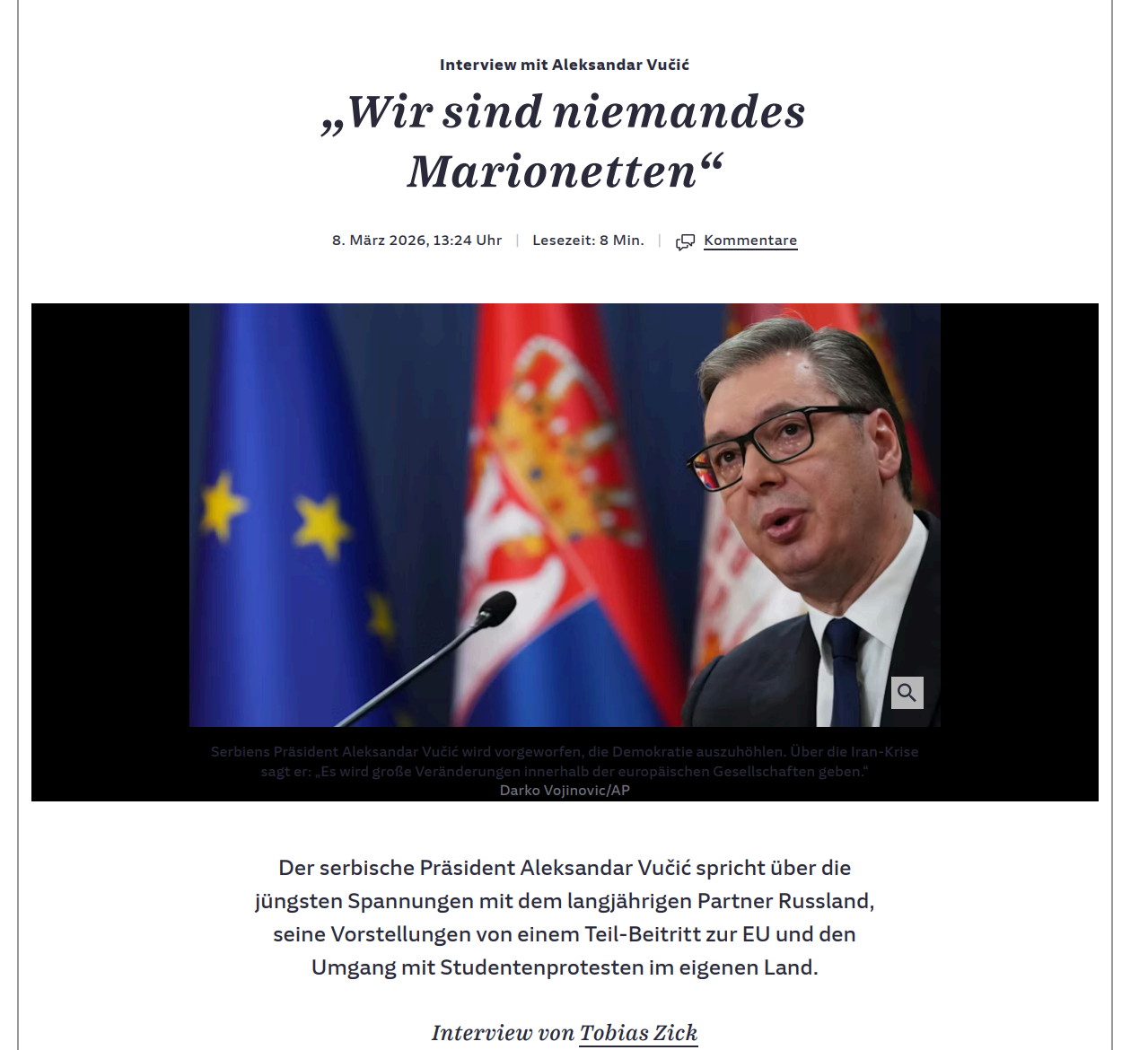
In a single German sentence, Serbia's president dismissed a U.S.-built diplomatic process as "so-called." That choice was not accidental.
by Elmi Berisha | 9 March 2026
There is a sentence in Aleksandar Vučić's interview with Germany's Süddeutsche Zeitung last week that has received almost no attention. It should receive a great deal more — particularly in Washington.
Discussing his disappointment with the Trump administration's handling of Kosovo, the Serbian president said the following:
„Und dann dieser sogenannte Friedensrat, wo Kosovos Präsidentin Vjosa Osmani als Star auftritt."
"And then this so-called Peace Board, where Kosovo's President Vjosa Osmani appears as a star."
Read it again. Slowly.
Not "the Peace Board." Not "the process." Not even a dismissive paraphrase. Three distinct choices in a single sentence, each worth examining on its own terms.
Sogenannte. So-called. In German, as in English, this word does not describe something you disagree with or find inconvenient. It describes something you consider fraudulent — unworthy of the name it has been given. Scare quotes, in print. Vučić was not quoting a critic. He was not describing Kosovo's position. He was speaking in his own voice, in one of Europe's most widely read newspapers, about a diplomatic framework the United States government created, convened, and put its name on.
Dieser. This. Not "the." This so-called Peace Board. The demonstrative carries contempt. It points at something the speaker considers beneath serious engagement — something to be gestured at, not named with care.
Als Star auftritt. Appears as a star. Kosovo's president is not described as participating, representing, or negotiating. She is performing. Seeking a spotlight. The framing strips her of diplomatic standing and replaces it with vanity — a deliberate diminishment of a head of state attending a process her country was invited to join.
Three words. One sentence. A complete picture.
Let that land for a moment.
The Trump administration built this process. American officials invested time, credibility, and political capital in standing it up. It bears the implicit endorsement of the United States government. And the president of Serbia — a country that presents itself to Washington as a partner, as a responsible regional actor, as a government worth engaging — sat down with one of Europe's most widely read newspapers and put that process in scare quotes.
This is not a translation artifact. It is not a diplomatic nuance lost in passage from Serbian to German to English. Vučić has been in politics for thirty years. He chose every one of these words knowing they would be published, knowing they would travel across European capitals, knowing that most of his Western interlocutors would either miss them or let them pass.
The question for Washington is whether it will.
Because the sentence matters beyond the insult. If Belgrade is willing to publicly mock a U.S.-created diplomatic process in a German newspaper while simultaneously asking Washington for favorable treatment on sanctions, on Kosovo policy, on regional positioning, that is not the behavior of a partner. It is the behavior of a government that has correctly calculated it can have it both ways: pocket American engagement while signaling to its domestic audience, and to Moscow, that it does not take American frameworks seriously.
Every actor watching the Western Balkans — in Pristina, in Sarajevo, in Tirana, in Moscow — read this interview. They are drawing their own conclusions about what Belgrade can get away with. They are asking whether Washington notices when its own processes are dismissed in the European press by governments it is trying to court.
The answer to that question will shape how the region positions itself for years to come.
Vučić put the Trump administration's peace process in scare quotes. He did it in public, in print, in a newspaper of record.
Washington is allowed to notice.
About the author
Elmi Berisha is a prominent Albanian-American community leader and businessman based in the New York area, best known as the President of the Pan-Albanian Federation of America "Vatra", the oldest Albanian American organization in the United States, founded in 1912.
