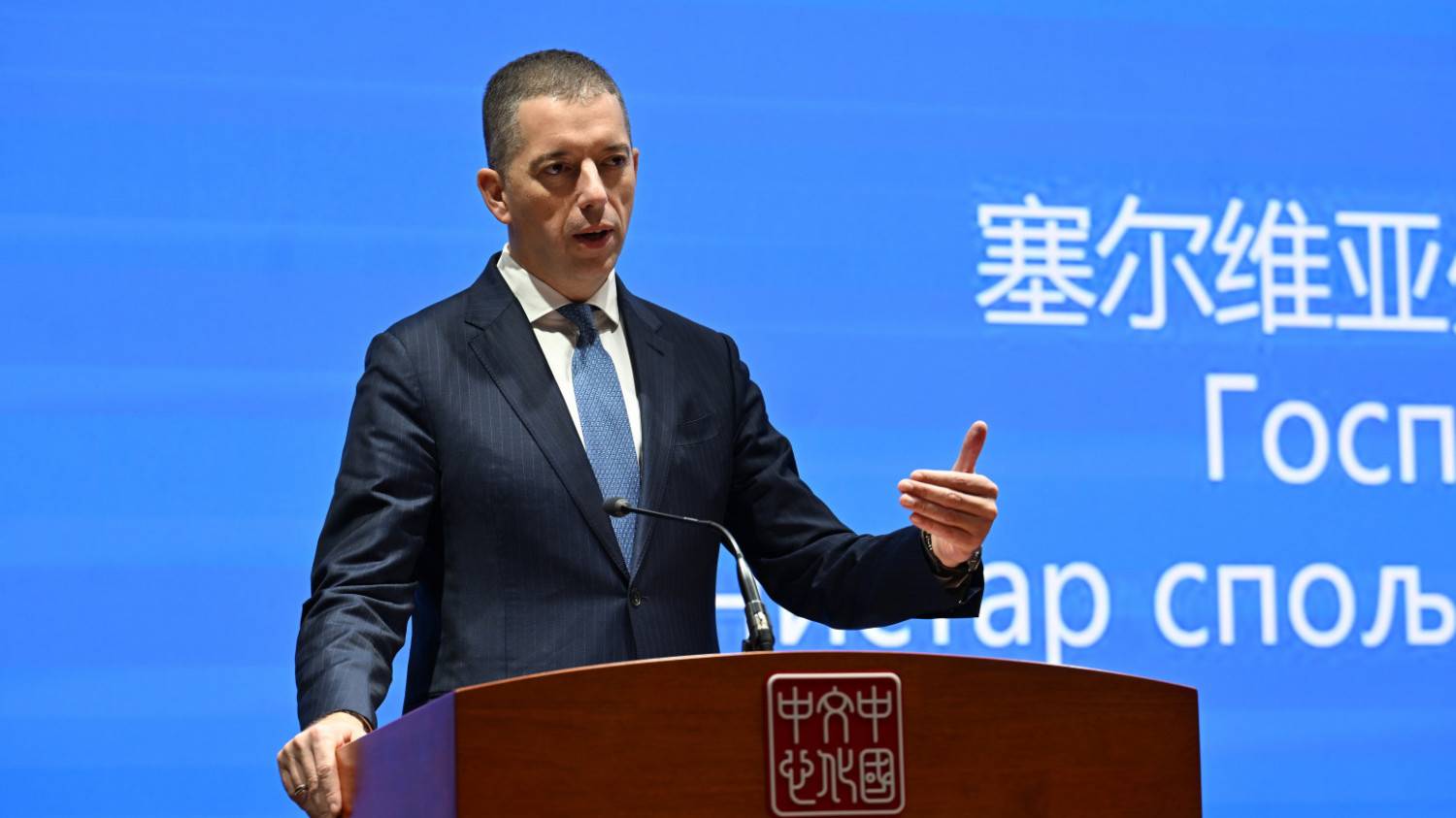
By presenting its China relationship as values-neutral cultural cooperation, Belgrade masks the strategic calculations and ideological signaling embedded in Beijing’s soft-power playbook—an approach that invites closer scrutiny from U.S. policymakers at a time of intensifying great-power competition.
by Mark Gojcaj | 13 Januar 2026
On Monday, Serbia’s foreign minister Marko Đurić addressed the opening of a China–Serbia youth cultural camp, offering a carefully constructed account of Belgrade’s relationship with Beijing. The partnership was presented as benign, culturally driven, youth-oriented, and values-neutral—framed as an investment in education, exchange, and future generations rather than as a strategic choice.
For Washington, that framing warrants closer attention.
A strategic relationship presented as apolitical
Serbia increasingly describes its engagement with China as cooperation divorced from ideology or geopolitics. In practice, however, the relationship functions as a strategic hedge, enabling Belgrade to diversify its external partnerships while limiting exposure to Western conditionality.
What stands out is not the relationship itself, but the effort to sanitize its strategic character. By emphasizing culture and youth while excluding questions of alignment, Belgrade recasts a geopolitical partnership as administrative normalcy. In the context of intensifying U.S.–China competition, such framing obscures how Beijing understands these relationships—as long-term positioning, not episodic exchange.
Ideological language, not diplomatic ornament
The vocabulary used to describe Serbia–China ties is also instructive. References to “steel friendship,” a “shared future in a new era,” and “the highest level of cooperation” are not neutral diplomatic flourishes. They are standardized formulations drawn from Xi Jinping–era political discourse, deployed globally to signal trust and ideological proximity.
For U.S. policymakers and analysts, this language is familiar. It is widely recognized as narrative signaling rather than ceremonial rhetoric. Reproduced without scrutiny, it risks blurring the distinction between diplomatic engagement and ideological alignment.
Culture and youth as influence vectors
The focus on youth and cultural exchange fits a broader pattern in China’s external strategy. Beijing has systematically invested in education, culture, and people-to-people programs as tools of long-term influence, particularly in countries seeking to preserve strategic ambiguity.
These initiatives are not inherently problematic. But portraying them as politically inert misreads their function. In contemporary statecraft, cultural diplomacy is not separate from power; it is one of its enabling layers.
Why the framing matters
For U.S. audiences, the issue is not Serbia’s right to maintain relations with China. It is the deliberate narrowing of the frame through which those relations are presented. At a moment when Washington and its allies are reassessing influence operations, dependencies, and alignment signals, Belgrade’s messaging is notable for what it omits.
Language matters in geopolitics. When strategic alignment is described as culture, and ideological signaling is presented as friendship, the risk is not misunderstanding—it is strategic miscalculation.
About the Author
Mark Gojcaj writes from New York, where he examines the intersection of American conservatism and Southeast European political and security realities. He is a regular contributor to The Kosovo Dispatch’s transatlantic coverage, with a focus on U.S. foreign policy, NATO dynamics, and the Western Balkans.
