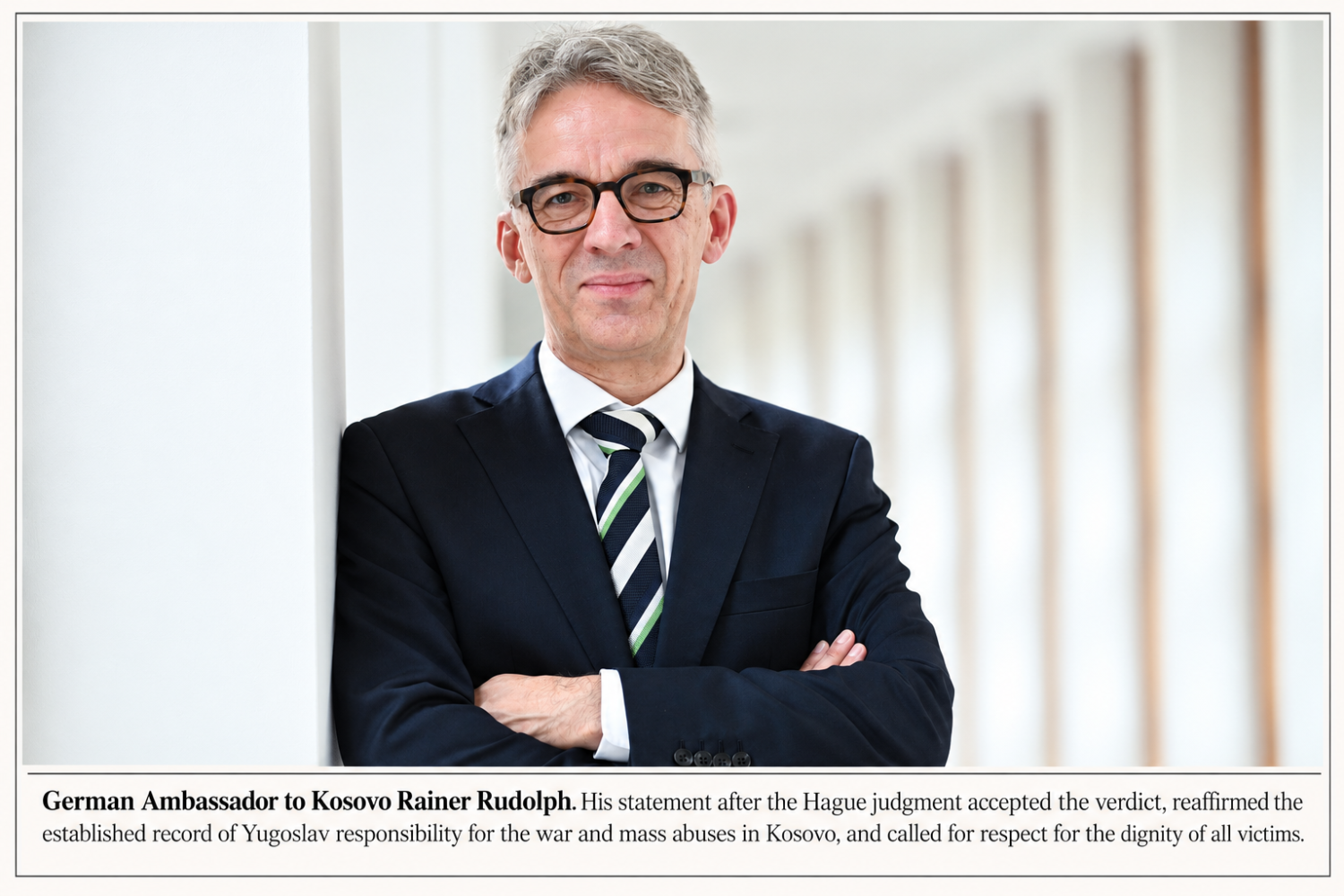
A German ambassador accepted the Hague judgment and defended the truth about Kosovo in the same statement. Pristina should have written it first.
Albatros Rexhaj | 17 September 2026
The German ambassador in Pristina issued five paragraphs on the judgment in The Hague. Most of it is what embassies always write. The fourth paragraph is not. The judgment, it says, in no way absolves the Yugoslav actors responsible for the armed conflict and the large-scale human rights violations inflicted on the people of Kosovo, violations already investigated by international courts and which prompted the intervention of the international community.
I have waited twenty-five years for a Western government to say that sentence on the day it was needed.
Since the war ended, Kosovo has been offered one bargain, over and over. Either you accept that men from your side committed crimes, in which case you accept Belgrade's story of a terrorist gang and a war that was nobody's fault. Or you defend the war, in which case you must insist that no innocent person was ever beaten in a KLA camp. With rare exceptions, Pristina has taken the second half of that bargain, because the first half was unbearable. Belgrade has spent the same years insisting the bargain is real, because it is the only way it can turn four convictions into a verdict on 1999.
The German ambassador refused the bargain. Four men were on trial. The KLA was not, and its aim was not. The Yugoslav side has already been tried, and what it did is on the record and stays there. Germany remembers what happened in Kosovo. This verdict changes none of it.
That is what the fourth paragraph says, and it is enough.
Michael Martens, who has covered this region for the Frankfurter Allgemeine for two decades, did the same thing in his own voice within hours. He accepts the convictions as sound on the evidence. He doubts that Thaçi's sentence is in proportion to what Serbian war criminals got for Kosovo, and says so. And he refuses to let the verdict blur who started the war, who paid the men who burned the villages, and why the struggle against them was unavoidable. All three at once, from one man, without contradiction. Kosovo's leaders should read how easily he does it.
Belgrade heard the judgment and announced that the court had found the KLA to be a criminal and terrorist organisation. The court said nothing of the kind. It convicted four men of war crimes against hundreds of people. It acquitted them of every crime against humanity, because the prosecution could not show a widespread or systematic attack directed against a civilian population, which is what that charge requires. An army that attacked a people was the story Belgrade needed. The court declined to tell it, and the fourth paragraph took away the rest.
Pristina heard the judgment and called it an unacceptable injustice, and promised the four men the support of the state with all the means at its disposal.
I understand the reflex. When the court hurts us, delegitimise the court. The Prime Minister could have said something much stronger. We will appeal these sentences. We believe them disproportionate. We stand by the justice of our war, and the court left that alone. And we recognise every person the court found was abused in our name. No Serbian government has ever managed a sentence like that. Kosovo could have, on Wednesday, and did not.
The statement ends with one more line, the kind every embassy writes, and it is the one I want to thank the ambassador for. It calls on all sides to respect the judgment and the dignity of the victims. Belgrade spoke on Wednesday about Serbian victims. Albanian ones appear, when they appear at all, inside the phrase "on all sides," which is Belgrade's way of saying we were all the same. We were not. One court found a state campaign against a people. Another has just found that the KLA never ran one. Pristina spoke about suffering in general and named none of the people this judgment is about, which is the same habit with the nationality changed. The ambassador said victims and stopped there. It came in his last sentence, where diplomats put the things they mean. Whether Thaçi, Veseli, Selimi and Krasniqi are guilty is for the courts. There is an appeal and the process is not finished. But the victims are not waiting on the appeal. The court found that people were held, beaten, tortured and killed, some of them Serbs, some Roma, some Albanians whose offence was to be with Rugova's LDK. Their dignity does not depend on how the appeals chamber rules. We cannot hold this argument as if they were an inconvenience in someone else's history, and it should not have needed the German embassy to remind us they exist.
Kosovo does not need every man who fought for it to be innocent in order for its war to have been just. That is the more confident position, and it is the one the German ambassador took on our behalf. He accepted a judgment against Hashim Thaçi and kept the truth about Kosovo in the same five paragraphs. Those are different things, and this week neither Belgrade nor Pristina could keep them apart.
Albatros Rexhaj is an author, playwright, and analyst with a background in national-security studies and nearly three decades of experience in political and security affairs.
