Serbia held an election on Sunday. On Saturday it arrested a citizen for saying how it would end. That is the result.
By Ardit Rada | 25 October 2026
On Saturday, under electoral silence, police acting for the Higher Public Prosecutor in Belgrade took Dejan Lučić from his home over a TikTok video. The charge is causing panic and disorder, Article 343 of the Criminal Code. In the video Lučić says that Aleksandar Vučić will steal the election and declare victory, that a million people will come out, and that the army and police will not act against them. He instructs no one. He predicts. He spent election day in custody, and RTS carried the news the same evening, so that every voter knew of it before the polls opened.
Article 343 is written for the false alarm. It punishes whoever, by presenting or spreading false news or allegations, causes panic or a serious disturbance of public order. The offence has two elements and the prosecution needs both: a statement of fact that is untrue, and panic or disorder that follows from it. Lučić supplied neither. A forecast of what a government will do on Sunday is not news, true or false, and the opposition’s own candidates were saying the same thing from every stage in the country. Nothing followed. No crowd formed, no polling station was disturbed. The prosecution’s statement to Tanjug says Lučić “wanted to cause panic and fear among citizens”. Wanted to. The office charged with proving a result is describing a motive, because the result does not exist. The same article was used once before in this crisis: after 15 March 2025 a Belgrade prosecutor opened an inquiry into whether protesters who said they had been hit by an acoustic device had committed Article 343 by saying so. First the victims, then the forecaster. The law was not applied. It was borrowed.
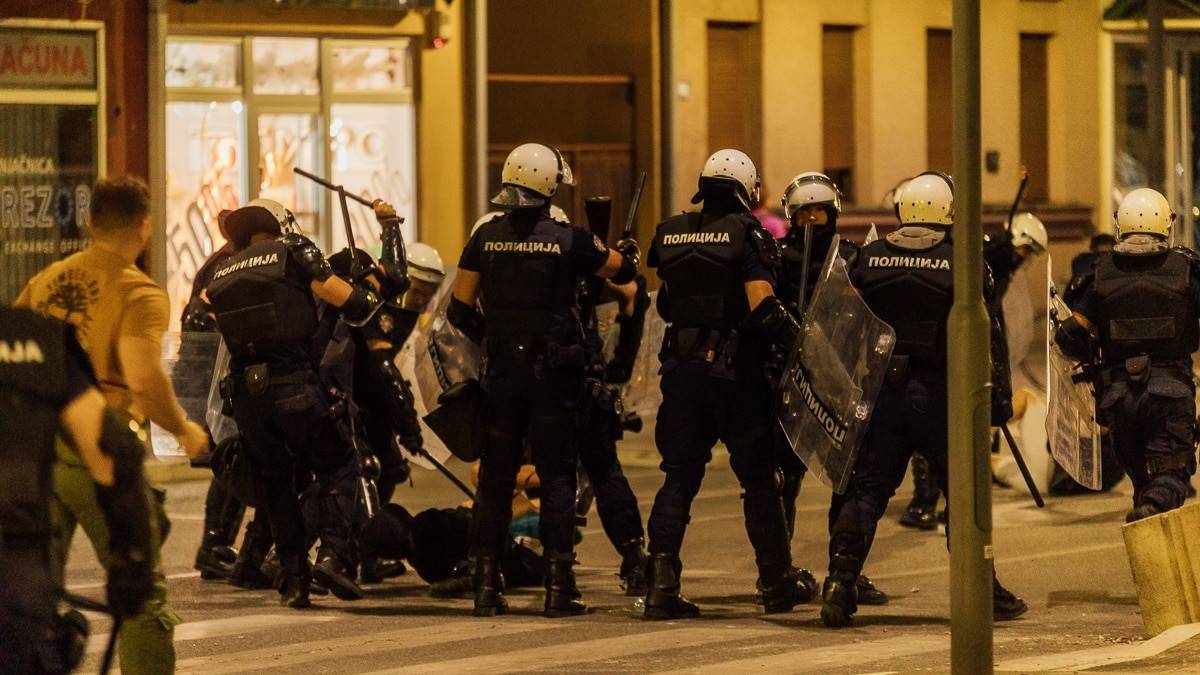
He was not alone that week. The prosecution ordered arrests in Novi Sad for planning election-day unrest, and in Kraljevo for incitement to violent change of the constitutional order, on the basis of a plan to bring about eighty people to Belgrade. The office that found those crimes is that of Zagorka Dolovac, whose name protesters chant beside Vučić’s. It has brought no charge over the acoustic device used on Kralja Milana, which the European Court of Human Rights ordered Serbia in April 2025 to stop using, none against the masked men with bats filmed working polling stations in March from behind a police line, and in two years no one to trial for the sixteen people killed under the Novi Sad station canopy. It finds crimes on one side of the street. The police act on the same logic: in one night in August 2025, riot police clearing blockades in four cities detained seventy-nine people and hospitalised four students, one with a broken collarbone, and the Council of Europe’s Commissioner for Human Rights recorded the arrest of children that week.
The European Union’s executive has watched all of this from an office in New Belgrade. In two years the EU Delegation has not once described Serbian police conduct as disproportionate. Its first statement came in August 2025, nine months into the protests, with students in hospital: a call on all sides to de-escalate, a sentence that police action must be proportionate, a request that suspicions of excessive force be investigated. All sides. One side had batons and an acoustic device; the other was sitting on a road. The one time a Commissioner said “unacceptable” about Serbia was Marta Kos after the March local elections, and her subject was the masked men, not the police who shielded them. On the arrests in Novi Sad and Kraljevo the Delegation issued nothing. On a citizen taken from his home for a video on the eve of a national vote it issued nothing, and it will issue nothing on Monday either, because on Monday it has to work with whoever counted the ballots.
On 22 October 2025 the European Parliament, by 457 votes to 103, recorded that the Serbian authorities had “resorted to violence against political opponents and the use of excessive force against demonstrators”, listed the sonic weapon, police brutality and torture, and named “politically motivated prosecutions by the Higher Public Prosecutor”. That is the office that took Lučić. The Parliament has said it. The Court has said it. The Delegation, which holds the enlargement file and writes the reports, has said “all sides”.
A democracy is not the holding of an election. It is what the state may not do to a citizen in the days before one. In Serbia the prosecutor’s office is an instrument, the police are its hand, and the Criminal Code is whatever the office needs it to be that morning. A man sat in a cell on polling day for saying how the count would end, and the European Union’s representatives in Belgrade found nothing to say about it. Whatever the count says tonight, that is the result.
Ardit Rada is a Tirana-based journalist covering politics, governance, and institutional developments. Focused on the intersection of domestic political dynamics and Albania’s European trajectory.