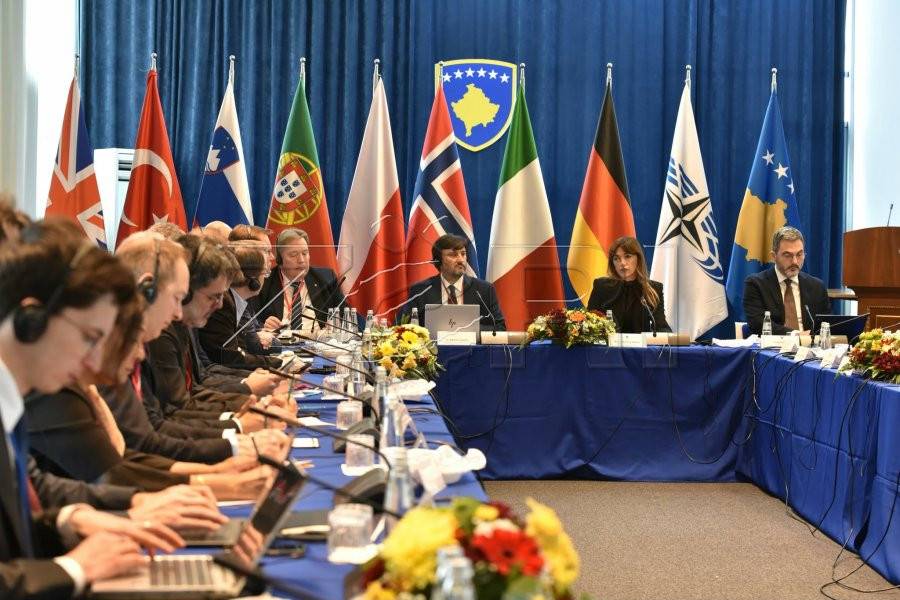
Emilija Redžepi told the visiting NATO PA delegation that Kosovo’s other non-majority communities are being overlooked, said she no longer supports any separate political entity for Serbs, and doubted that Serbia’s new government will change its policy. Srpska Lista did not attend.
By Artan Rugova | 29 October 2026
Emilija Redžepi, Deputy Speaker of the Assembly of Kosovo, told a delegation of the NATO Parliamentary Assembly on Wednesday that she and her colleagues from the non-Serb communities are tired of the fact that nearly every discussion of Kosovo’s non-majority communities centres on one of them. The deputies of Srpska Lista, the Belgrade-backed party that holds the ten seats reserved for the Serb community, were not in the room.
The delegation belongs to the NATO PA’s Political Committee and is in Kosovo on 28 and 29 October. It is led by Alberto Losacco, Vice-President of the Assembly, and Sverre Myrli, chair of the Political Committee, and comprises twelve members of parliament from eight NATO member states, according to Shqipe Mehmeti-Selimi, who heads the Kosovo Assembly’s permanent delegation to the NATO PA. The Assembly of Kosovo has held associate member status in the NATO PA since 2024.
On Wednesday morning the delegation held three meetings in room 506 of the Assembly. At 09:05 it met Speaker Albulena Haxhiu, with Deputy Speaker Ardian Gola and MPs Mehmeti-Selimi and Besa Kabashi-Ramaj; the Assembly’s readout says the sides discussed the terrorist attack in Banjska and the importance of bringing those responsible to justice, Russia’s aggression against Ukraine, the security of critical infrastructure and parliamentary oversight of defence, and that Haxhiu reaffirmed Kosovo’s commitment to Partnership for Peace and NATO membership. At 10:00 the delegation met the committees for Foreign Affairs and European Integration, and at 11:00 the representatives of the non-majority communities. Media were admitted for opening footage only; KOHA reported that the meetings themselves were held without the press. Later in the day the delegation was received at KFOR headquarters at Camp Film City by the mission commander, Major General Roberto Vergori, who briefed its members on the security situation and KFOR’s priorities.
Redžepi (Emilija Rexhepi in the Albanian-language press) set out her account of the 11:00 meeting in a written statement, published by Gazeta Demos in the afternoon and, in a fuller version, by KOHA, which said she had given it in answer to its questions.
“In answer to a question from members of the delegation on the readiness of citizens of Serb nationality to integrate into the institutions of the Republic of Kosovo, I openly stated my position that we are tired of the fact that almost every discussion about non-majority communities in Kosovo focuses exclusively on the Serb community” (jemi lodhur nga fakti që pothuajse çdo diskutim për komunitetet joshumicë në Kosovë përqendrohet ekskluzivisht te komuniteti serb), she said.
She said she had also raised the Association of Serb-majority municipalities.
“I stressed that, although I once voted in support of this process, I do not support the creation of any separate political entity within the Republic of Kosovo. My support was based on the conviction that such a mechanism would contribute to the integration of the Serb community into Kosovo’s institutional system, and not to the creation of parallel structures or of a separate republic. I do not want a model similar to Republika Srpska in Bosnia and Herzegovina to be created in Kosovo, which could deepen ethnic and institutional divisions. We need integration, not segregation (separate schools, hospitals, cultural institutions...), we need common institutions and not new political and territorial divisions. I do not believe that in any European country pupils attend separate schools, or that there are hospitals where only members of one ethnic community are treated. Regrettable!”
On the Serb community she said: “I consider that the representatives of the Serb community should speak about their own positions, needs and political commitments, while we, as representatives of the other non-majority communities, have the responsibility to represent the interests of the citizens we represent.”
Redžepi also addressed the change of government in Serbia after the Student List’s victory in Sunday’s election, and said she had serious reservations about whether it would change Belgrade’s policy toward Kosovo, Bosnia and Herzegovina and the rest of the region.
“The statements of the representatives of the Student List, so far, do not give me enough confidence that the new government will follow a more moderate policy, based on peace, stability, good-neighbourly relations and respect for the sovereignty of neighbouring states. A change of government does not necessarily mean a change of policy, but it remains to be seen whether there will be substantive changes,” she said.
Her statement ends: “At the end of the meeting I reaffirmed my firm commitment to building a democratic, multi-ethnic and secure Kosovo, in which all citizens will have equal rights, opportunities and responsibilities. I believe that the future of our country lies in Euro-Atlantic integration, in peace and in mutual respect, without distinction of national, religious or ethnic affiliation.”
Redžepi, who leads the New Democratic Party (Nova Demokratska Stranka) of Kosovo’s Bosniaks, was elected Deputy Speaker from the ranks of the other non-majority communities in this legislature with 70 votes in favour and seven abstentions. Of the Assembly’s 120 seats, twenty are reserved for non-majority communities: ten for the Serb community and ten for the Bosniak, Turkish, Roma, Ashkali, Egyptian and Gorani communities together. Her remarks were carried within hours by Kosovo Online, the Belgrade-based Serbian-language portal.
The NATO PA is a separate body from the Alliance’s command structure; its committees visit member and partner countries and report to the Assembly’s plenary sessions.