Serbia did not say it would come back. It reminded its neighbours that it could and Brussels taught Belgrade that the reminder carries no price.
Drizan Shala | 15 September 2026
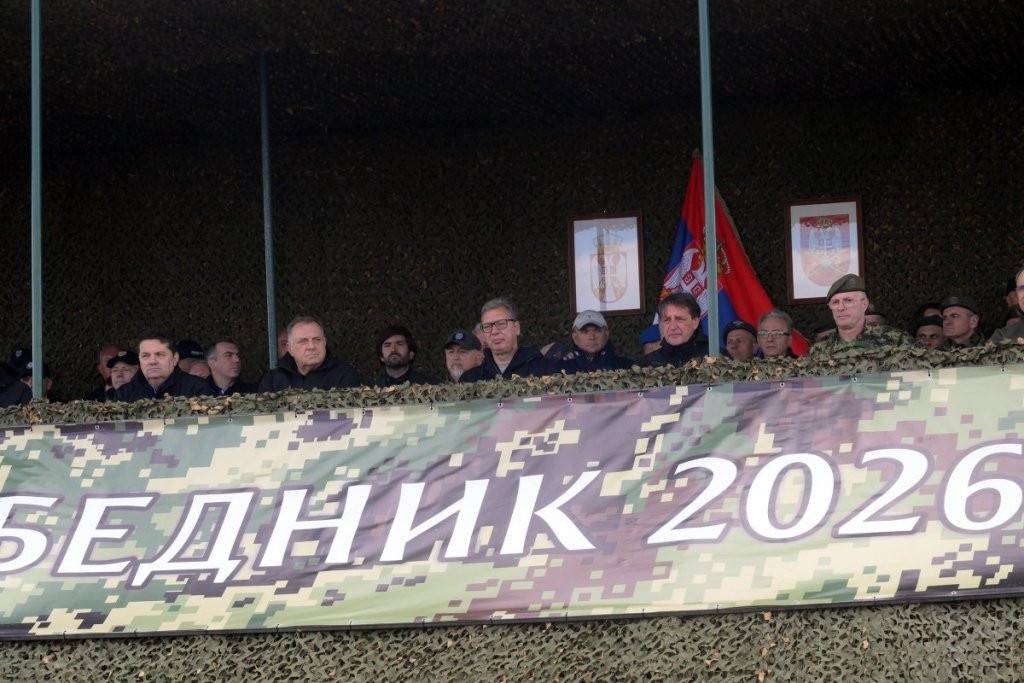
On Sunday the political leadership of Republika Srpska sat in a reviewing stand on the Pešter plateau and watched the Army of Serbia rehearse an offensive operation. When it was over, Milorad Dodik said: "This is like our army, and I experience its success as my own." The Serbian side let the sentence stand.
Read Pešter as an exercise and it is a training day: two thousand soldiers, more than five hundred pieces of hardware, a stated theme of "conducting an offensive operation", a new rocket system fired in public for the first time since entering service. Read it as communication and it is the most important thing Belgrade said all week. Serbia did not threaten to cross a border on Sunday. It did something more useful. It reminded the governments around it that military capability remains part of Serbia's political vocabulary, then left each of them to decide how seriously to take the reminder.
That is how signalling works when the sender wants deniability. Vučić supplied the disclaimer on the spot: "It is clear to everyone that we do not want to threaten anyone." His chief of the General Staff supplied the scope: the army, Mojsilović said, guarantees security and peace "not only in the Republic of Serbia, but in the Balkans." The RS interior minister, Željko Budimir, supplied the doctrine: the display mattered "for the region, for the balance of power, for the Serbian people," and for those who wish Serbia ill. Three officials said the same thing from three angles, and none of it is a threat anyone can be asked to withdraw.
The context that turned a scheduled exercise into that message is six days old. On Monday the Army of Serbia buried Ratko Mladić with a salute. The neighbours objected. Vučić went on RTS, called their objections hatred of Serbia's success, and announced reciprocity, "but slowly", ali polako. On Wednesday night Macron received him at the Élysée. On Sunday the same neighbours watched Serbian military power displayed with the leadership of Republika Srpska in the stand. Pobednik was not invented for this week and the units were in the field before the burial; nobody needs to argue that Belgrade ordered a drill in reply to Tirana or Pristina. The point is juxtaposition. Belgrade had a stage already built. Who stood on it and what they said gave the stage its political meaning. Nobody in Belgrade needed to explain the result. Ambiguity was the product.
The Republika Srpska delegation is what makes this a regional security event rather than a Serbian one. The entity has had no army since the 2005 defence reform transferred defence to the state of Bosnia and Herzegovina. Its prime minister, assembly president and interior minister sat beside Serbia's caretaker prime minister, defence minister, chief of staff and intelligence director while the theme of the day was attack. Sarajevo has heard this before. In August its defence minister asked whose armed men had been found without insignia near Bugojno, and Serbia's defence minister answered that the Drina is not the border of the Serbian people. Pešter is the same answer with hardware.
Four audiences, one stand. To Republika Srpska: you are not strategically alone. To Serbia's own nationalist public, six weeks before an election: Mladić has not put us on the defensive. To Sarajevo and Pristina, each holding its own file, Bugojno and Banjska: remember what stands behind the rhetoric. To Brussels: this is how far we can go without a material response.
Brussels cannot see the event whole because Brussels reads it in pieces. The Mladić honours went into the enlargement drawer: Kos cancelled her visit before the burial, and after it came the von der Leyen and Costa statement. The reciprocity threat went into the dialogue drawer. Dodik belongs to the Bosnia drawer, where he has been filed for years. The exercise belongs to no drawer at all; by Tuesday morning the Commission, the EEAS and the Council had said nothing about it or about who sat in the stand. Each file, read alone, produces a paragraph of concern. Read together they are a posture. Europe has spent years trying to deter escalation in the Balkans, and it is teaching Belgrade that coercive signalling carries no price. Vučić quoted the price on RTS: von der Leyen and Costa, he said, had "always been on Serbia's side."
Belgrade tested the cost of honouring Mladić and found it was a press release. Pešter was the receipt.
Drizan Shala is a security researcher and doctoral candidate at the University of Sarajevo. He writes on defense, private security, and the security architecture of the Western Balkans.