The opposition wants Vetëvendosje’s votes to fill its offices before saying whether it will keep the Assembly alive. A nomination is a right. The votes to carry it are not.
Fatos Kabashi | 12 September 2026
Kujtim Shala has already said he will not vote for Bekim Sejdiu. Lumir Abdixhiku named him on 1 September, together with Avdullah Hoti, Hykmete Bajrami, Arben Gashi, Armend Zemaj and Janina Ymeri, as six deputies refusing the decision of their own party presidency. Eleven days later Shala remains LDK's nominee for deputy speaker, an office he cannot reach without votes from outside LDK, while he withholds his own vote from the agreement meant to keep this Assembly from ending where the last one did.
That is the dispute. The rest is procedure.
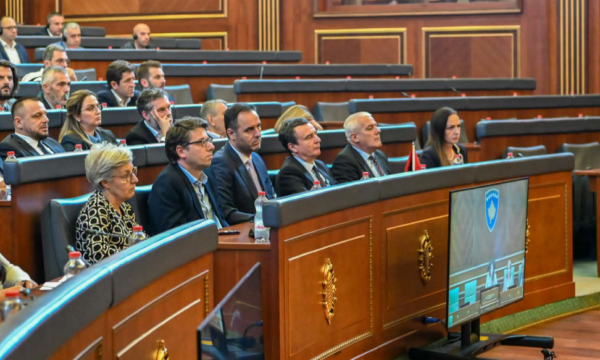
On Friday morning Ardian Gola was elected deputy speaker with 101 votes, one abstention and none against. Vlora Çitaku received 44 for, one against and 56 abstentions; Vetëvendosje's deputies did not vote for her. PDK left the chamber. "From today, PDK has no reason to take part in the plenary session and we will send the case to the Constitutional Court," Bedri Hamza said on the way out. "We voted for LVV's candidate, but they did not support ours." In the afternoon LDK refused to nominate until PDK's seat was filled, then left when Albulena Haxhiu tried to put Shala to a vote anyway. Albin Kurti, still asking Hamza and Abdixhiku for a meeting, said what everyone in the building already knew: PDK needs LVV's votes for its deputy speaker, and LVV needs PDK's for the president.
PDK's answer is Article 67. The three largest groups have the right to propose their deputy speakers, and using that right as a bargaining chip over Article 86 turns one constitutional entitlement into leverage over another.
Yes. That is exactly what Kurti is doing, and he is right to.
PDK has 22 deputies. It can nominate Çitaku; it still needs other people to elect her. Sejdiu can be nominated with the signatures of 30 deputies; his sponsors still have to find 80 votes in the first two ballots, and Kosovo has just held an election because its previous Assembly failed to elect a president. Neither party has the votes to complete what it is entitled to start, which is the ordinary condition of a parliament with no majority for anything beyond a government. To call one half of the exchange a constitutional duty and the other half blackmail describes nothing about the law. It describes who wants to be paid first.
The sequence the opposition demands, deputy speakers now and president later, has a known ending. If the third ballot produces no president, the Assembly dissolves and the country votes within 45 days. LVV and the non-Serb minority parties have enough votes to govern. They do not have enough on their own to carry the presidential process through. For that they need opposition deputies in the room. PDK can provide that. So can the LDK deputies who have already announced they will not.
Kurti has been precise about what he is asking. "They need our vote in favour; for us, even one against does the job," he said on Friday. He is not asking PDK to vote for Sejdiu. He is asking it to stay in the process. Political agreement is what he sought on 9 September and was still seeking on 11 September; PDK's reply was to leave and file. LDK's request, by contrast: provide the votes that install a man who has already declared he will withhold his own when the Assembly's survival is at stake.
Whatever the Court decides about Friday's procedure, it will not be a decision that elects a president.
An Assembly constituted on the opposition's terms would be a building with a nameplate and a demolition date.