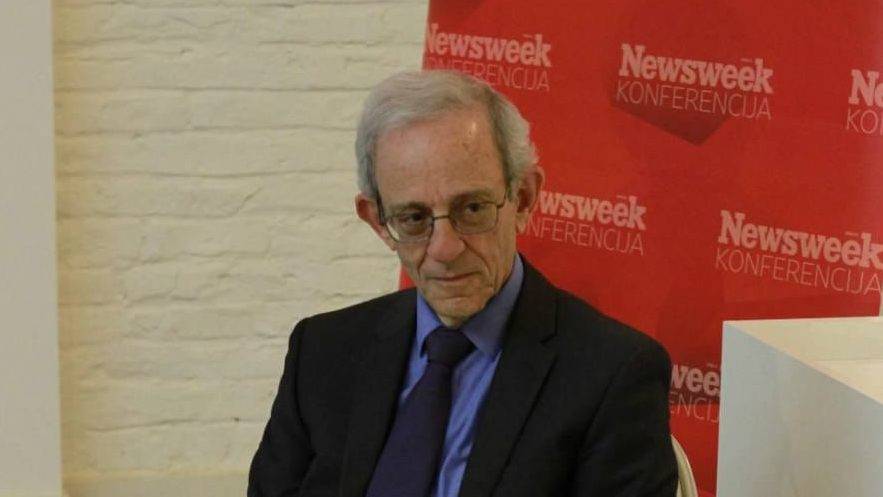
By Jelena Diković (DANAS) | 5 January 2026
Student protests could lead to a change of power in Serbia, but I do not know whether they will. President Vučić is a master of manipulating popular protests: dismissing a minister here or there, calling new elections, inserting ballot boxes or voters into swing districts—without putting his own power at serious risk, says Daniel Serwer, professor at Johns Hopkins University in the United States, in an interview with Danas.
As he points out, Vučić is unlikely to make the mistake that Slobodan Milošević made, believing he could win relatively free and fair elections.
“Vučić will be even more careful to secure the outcome,” Serwer emphasizes.
Aleksandar Vučić is doing absolutely everything to stay in power. How do you view his moves—from ‘Ćacilend’ to the detention of those who publicly criticize him?
– All of this is part of his effort to ensure zero risk to his own power.
It seems that the EU still does not understand the scale of corruption and crime in Serbia and does not criticize Vučić’s regime strongly enough. In your view, why does the EU not side with the students?
– I do not think anyone should expect the EU to “side with the students.” The EU should side with its own values, which are opposed to the growing autocracy in Serbia. The desire for lithium, dependence on “stability,” and even opposition to Russian influence are secondary to restoring the rule of law and democracy in Serbia. That is what European values and interests require.
Vučić tried to sell the General Staff building to Trump’s son-in-law. He is clearly trying to win Trump over. How do you interpret the fact that Trump’s son-in-law abandoned the purchase of that building?
– I am not familiar with Kushner’s thinking. But Vučić appears to have somehow offended the Trump administration, which in my opinion is a good thing. It means that Belgrade and Washington cannot, at least for now, sell off the rule of law and democracy in the way Washington has already done in much of the rest of the world.
What do you think about the creation of the “Serbian World”? Many media outlets write about Serbia interfering in Montenegro’s politics and in Bosnia and Herzegovina through Republika Srpska…
– The Serbian World is merely a modernized version of Greater Serbia. That would mean death and destruction across much of the Balkans today, just as it did in the 1990s. It would also end Serbia’s hopes for EU membership. Belgrade is jeopardizing the prosperity and security of its own citizens in order to expand its influence over neighboring countries. That is not an ambition that will end well.
How do you see the region in 2026 and Serbia’s role in those relations?
– It is difficult for me to expect anything other than further stagnation in regional relations. The best hope for progress lies in EU accession for Montenegro, Albania, and North Macedonia. Serbia has chosen the slow path.
What do you think marked 2025 in terms of foreign policy?
– For me, the key event was the decision of the Trump administration to side with Russia against Ukraine and to stop speaking out in favor of democracy and the rule of law around the world. The United States is now governed by a deeply corrupt administration that demands bribes, including into the pockets of the president and his family. None of us has fully come to terms with this dramatic change.
Is the end of the war in Ukraine in sight?
– No. There may be a ceasefire, perhaps even an agreement, but I expect Ukrainians to continue resisting ongoing Russian occupation and aggression. The only quick end to this war would be a Ukrainian victory in Donbas and Crimea. That is not likely given the lack of American support.
Editorial Note
This interview with Daniel Serwer was originally published by Danas and is reproduced here in full as a faithful translation. Serwer’s assessments are notable not for rhetorical excess, but for their consistency with long-standing Western policy debates on Serbia, regional stability, and democratic backsliding.
For Kosovo and the wider Western Balkans, the interview is revealing on two levels. First, it underscores how developments inside Serbia—student protests, institutional pressure, and the consolidation of executive power—are inseparable from Belgrade’s regional posture. Second, Serwer’s characterization of the so-called “Serbian World” as a rebranded version of Greater Serbia reflects a concern shared across much of the region: that unresolved nationalist projects, even when rhetorically modernized, continue to pose risks to peace, EU integration, and democratic consolidation.
The views expressed are Serwer’s own and do not necessarily reflect the editorial position of this outlet. Their value lies in offering a clear, external reading of Serbian policy choices at a moment when regional trajectories are increasingly diverging—between those moving, however slowly, toward European integration, and those choosing prolonged ambiguity.
