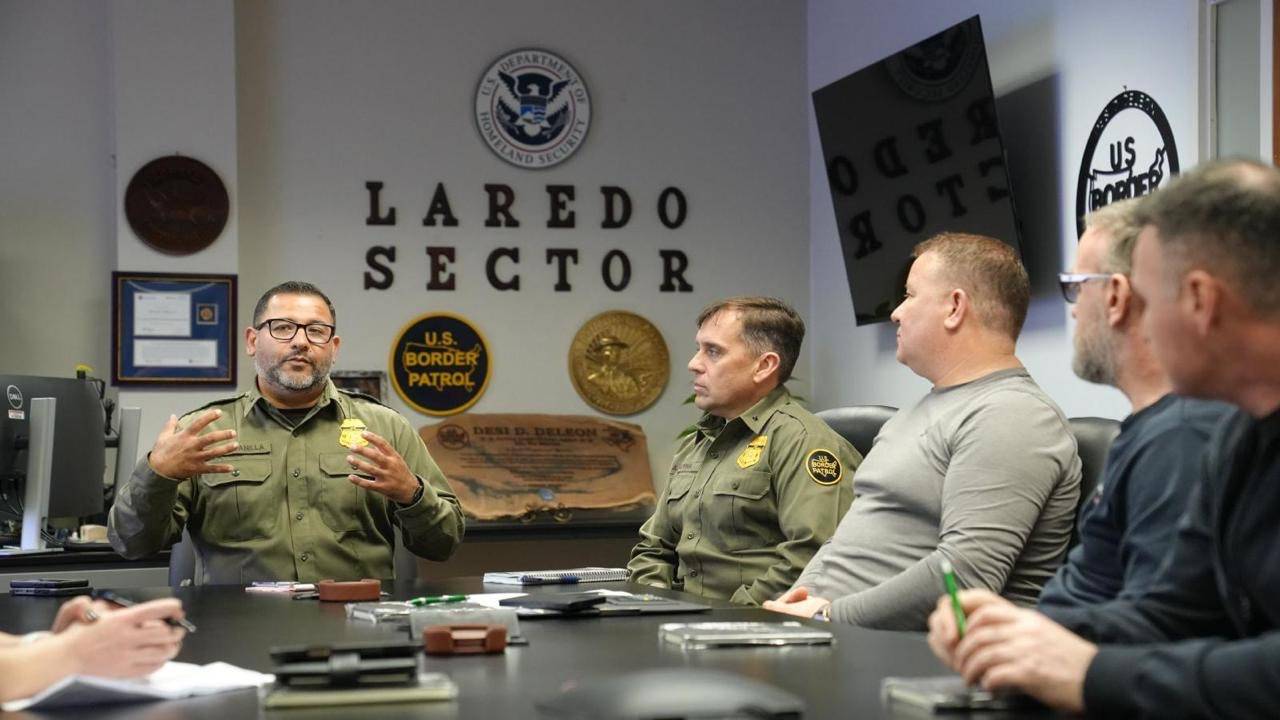
Watching U.S. border officers at work — and receiving a high-tech scanner at home — Kosovo is learning what modern border control really means.
By Klea Ukaj | 30 January 2026
When Kosovo’s police chief stepped onto the concrete of the Laredo Port of Entry in Texas last week, he arrived at one of the world’s most difficult classrooms.
Laredo is not a postcard border. It is a place where migration, trade, crime, and politics collide daily — where thousands of trucks pass under scanners, where officers decide in seconds what to stop and what to let through, and where technology is no longer a luxury but a necessity.
On January 23, Director General Gazmend Hoxha and a senior Kosovo Police delegation watched those decisions unfold in real time. Hosted by U.S. Customs and Border Protection, with support from the U.S. Embassy in Pristina and the Department of Justice’s ICITAP program, the visit marked the first time Kosovo’s police leadership had observed operations at the U.S.–Mexico border from inside the system.
It was not a courtesy tour. It was exposure to pressure.
American officers demonstrated how risk-based profiling replaces random checks, how scanners replace crowbars, and how security must coexist with commerce. Every truck stopped too long is an economic loss. Every truck waved through too easily is a potential threat.
That balancing act is one Kosovo increasingly faces itself.
A scanner at home
One day earlier, in Kosovo, another piece of the partnership became visible.
The United States donated a high-tech mobile cargo scanner — worth about $3 million — to be installed at the Merdare border crossing, Kosovo’s busiest commercial gateway with Serbia. It is the kind of scanner used at major ports and airports, capable of seeing inside trucks and containers without unloading them.
At Merdare, where queues of lorries can stretch for kilometers, the scanner changes the logic of control. It allows officers to check faster, target better, and interfere less with legal trade. Smugglers lose time. Honest businesses gain it.
This is not symbolism. It is infrastructure.
Together, the visit to Laredo and the scanner in Merdare tell a story about where the Kosovo–U.S. relationship has moved. It is no longer only about declarations of friendship or post-conflict support. It is about institutional trust — the kind that opens operational doors and transfers expensive tools.
Why the U.S. opens its hardest doors
The United States does not usually showcase its most sensitive border operations to partners it doubts. Laredo is one of its most stressed and strategic crossings. Foreign delegations that pass through it are there to learn, not to be impressed.
Canada’s border agency has visited. British diplomats have toured it. Central Asian customs officials have studied its systems. Kosovo now joins that quiet club — not because it is large, but because it is seen as capable of absorbing what it learns.
For Washington, this is part of a broader logic: strong borders are not built by walls alone but by professional institutions. If Kosovo is to align with Western standards of movement and security, its officers must see how those standards operate under real pressure.
For Kosovo, the lesson is less about copying America than about internal discipline: how to let traffic move while tightening control, how to use machines instead of muscle, how to make law enforcement predictable instead of arbitrary.
Borders as diplomacy
There is a political message hidden in this technical cooperation.
At a time when Kosovo’s borders are still politically contested, every scanner and every training program quietly reinforces sovereignty in practice. Not with speeches, but with procedures. Not with flags, but with competence.
The Merdare scanner will not solve regional tensions. But it will reduce smuggling, speed up trade, and professionalize oversight — three things that matter more to ordinary citizens than slogans.
And Laredo will not transform Kosovo overnight. But it shows that the U.S. sees Kosovo’s police not as a problem to be managed, but as a partner to be trained.
That is what mature alliances look like: less ceremony, more systems.
The real test
Now comes the harder part.
Technology must be integrated into daily work, not left as a photo opportunity. Risk-based inspections must replace habits built on suspicion alone. Customs, police, and intelligence services must talk to each other more than they issue press releases.
If Kosovo succeeds, the scanner at Merdare and the lessons from Laredo will become part of a quiet transformation: a border that protects without choking, that checks without humiliating, that secures without isolating.
And if the partnership works, it will be remembered not for what was donated, but for what changed.
From Laredo to Merdare, the message is simple: this is what trust looks like when it leaves the conference room and reaches the checkpoint.
About the author:
Klea Ukaj writes from Michigan and contributes to The Kosovo Dispatch’s trans-Atlantic coverage.
