Belgrade’s appeal to “Christian heritage” in Kosovo is less about preservation than power — a calculated attempt to recast a political sovereignty dispute as a civilizational struggle.
by Mark Gojcaj | 27 February 2026
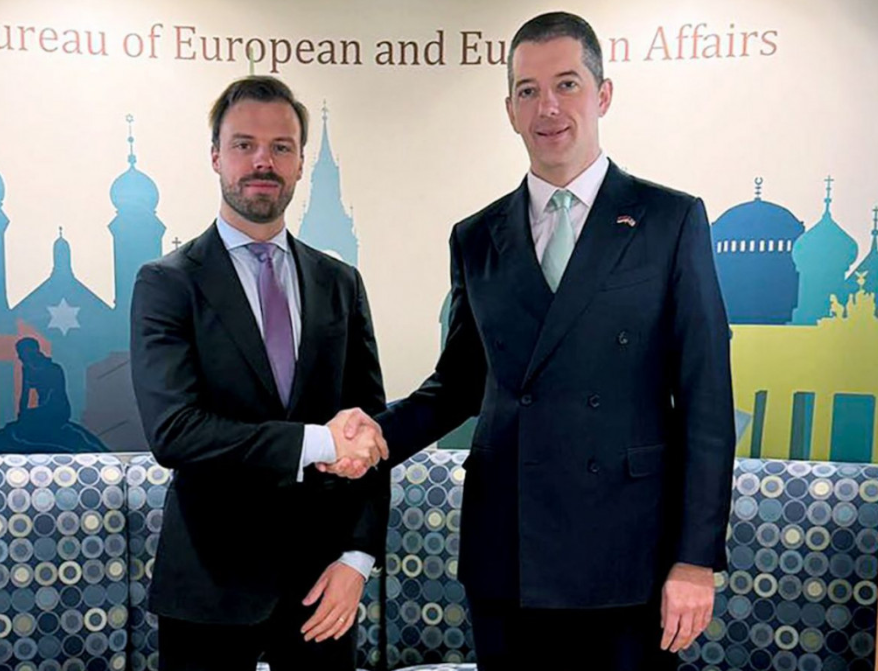
When Serbian Foreign Minister Marko Đurić concluded his meetings in Washington by stressing to U.S. Assistant Secretary of State Brendan Hanrahan that the “protection of Christian heritage in Kosovo” is of essential importance to Serbia, the statement was carefully constructed.
It was not merely about monasteries.
It was about narrative positioning.
No serious actor disputes that religious heritage must be protected. The monasteries of Visoki Dečani, Gračanica, and the Patriarchate of Peć are treasures of European civilization. They deserve preservation. They deserve security. They deserve respect.
But they are not instruments of sovereignty.
And they are not evidence of civilizational siege.
The Shift from Political Dispute to Religious Frontier
Kosovo’s constitutional order — derived from the Ahtisaari framework — embeds special protections for the Serbian Orthodox Church. Protective zones exist. Property rights are codified. International monitoring mechanisms remain present. NATO’s KFOR has, at various periods, physically secured major religious sites.
There is no institutional void.
Yet Belgrade increasingly frames the issue not as a matter of legal guarantees, but as a question of Christian survival.
That reframing matters.
Because once the Kosovo dispute is described as a confrontation between Christianity and an Albanian majority society, the nature of the conflict changes. It ceases to be a post-Yugoslav sovereignty dispute. It becomes a civilizational frontier narrative.
That narrative is historically inaccurate — and strategically dangerous.
The conflict between Serbs and Albanians in Kosovo has been political, territorial, and national. It has never been a theological war. Albanians themselves are religiously plural: Muslim, Catholic, Orthodox, and secular. Kosovo’s legal order guarantees freedom of religion and institutional autonomy for the Serbian Orthodox Church.
To suggest that Kosovo represents a civilizational threat to Christianity is not analysis. It is political construction.
Why the Religious Frame Is Convenient
The appeal of the civilizational frame is obvious.
It travels well in Western political discourse. It resonates in religious communities abroad. It shifts the focus from recognition and normalization to moral guardianship. It subtly implies that Serbia retains a higher custodial authority over Kosovo’s sacred ground.
But heritage does not confer jurisdiction.
And moral concern does not substitute for political sovereignty.
If Belgrade’s argument were purely about preservation, cooperation with Kosovo’s institutions would be the rational course. The legal mechanisms exist. The international presence remains robust. Monitoring is constant.
Instead, the language increasingly suggests something larger: that Kosovo is not merely disputed territory, but contested civilization.
That escalation carries consequences.
Civilizational rhetoric hardens identities. It reduces compromise to betrayal. It transforms pragmatic diplomacy into existential struggle.
The Balkans have seen that movie before.
The Reality Washington Understands
Kosovo is one of the most internationally supervised political spaces in Europe. The European Union, the OSCE, UN structures, NATO forces, and Western diplomatic missions maintain continuous engagement. Any systematic assault on Christian heritage would be visible and documented.
It is not.
There have been incidents over the years, as in any post-conflict society. But incidents are not strategy. And they are not evidence of religious persecution.
The core dispute between Belgrade and Pristina remains political: status, recognition, implementation of agreements, and alignment with Euro-Atlantic norms.
Recasting that dispute as a civilizational struggle obscures rather than clarifies.
Serbia is free to defend its cultural heritage. It is not entitled to transform heritage into leverage over another state’s sovereignty.
Christian civilization in Kosovo does not require geopolitical confrontation to survive. It requires legal guarantees, institutional cooperation, and regional stability.
Those tools already exist.
What is required now is not a sacred narrative — but political clarity.
