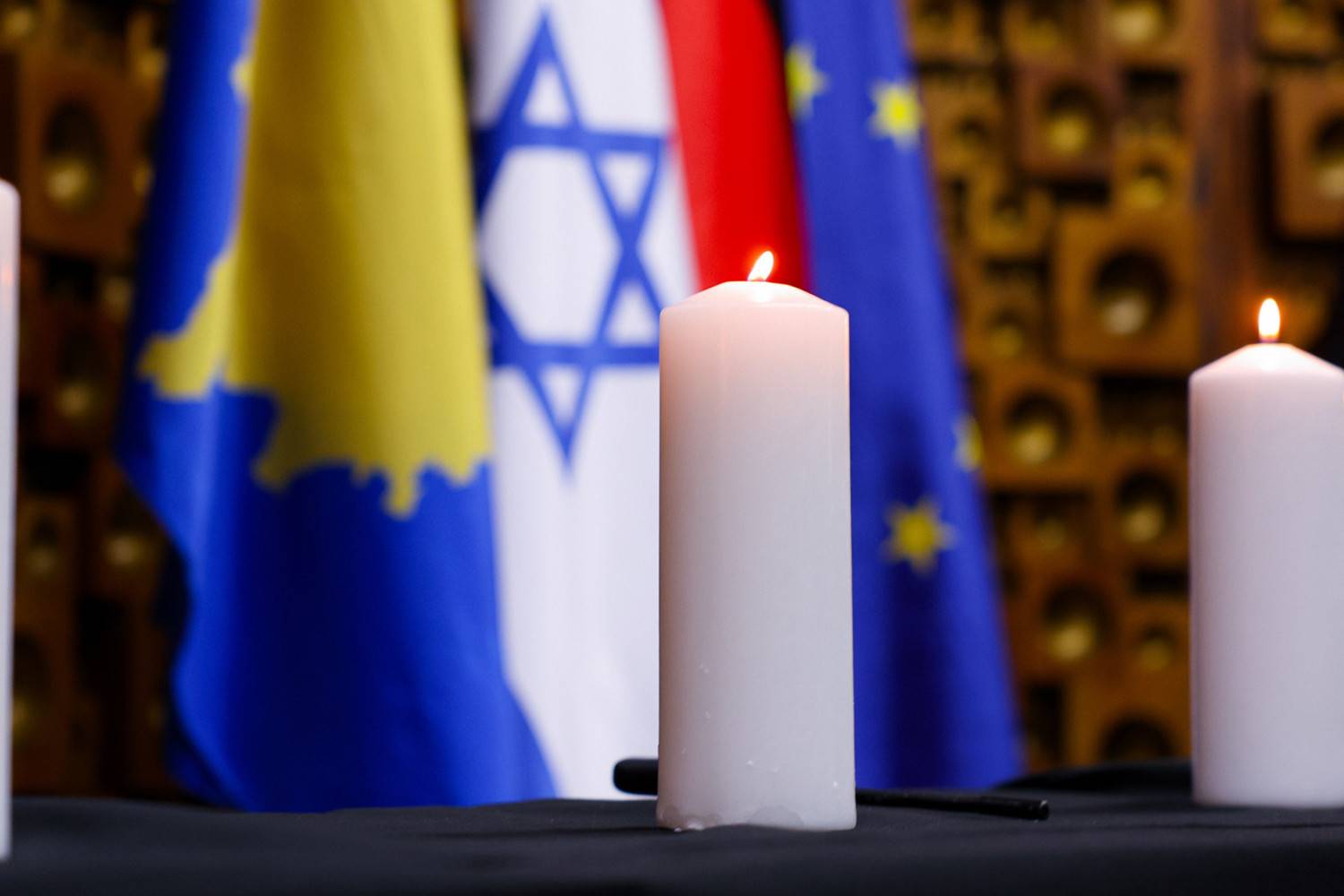
From six lit candles in Prishtina to rising global antisemitism, leaders and diplomats used the Holocaust anniversary to link memory with today’s moral dangers.
Kosovo Dispatch | 27 January 2026
Prishtina — In the amphitheater of Kosovo’s National Library, six candles were lit on Tuesday evening to honor the six million Jews murdered in the Holocaust. Around them stood diplomats, state officials, and civil society representatives — gathered not only to remember the past, but to confront what many warned is a dangerous present.
Israel’s Ambassador to Kosovo, Tamar Ziv, told the audience that antisemitism did not end with the liberation of Auschwitz 81 years ago. It merely changed form.
“The Holocaust was the ultimate denial of human dignity,” Ziv said. “It grew from an ideology that stripped people of rights, dehumanized them, and declared entire groups unworthy of life.”
Today, she added, that same hatred has reappeared as Holocaust denial, physical attacks on Jewish communities, and open calls for the destruction of the State of Israel.
Ziv cited a sharp global rise in antisemitic incidents since Hamas’ October 7 attack on Israel. According to documented figures, more than 13,000 antisemitic incidents have occurred worldwide since that date, including deadly attacks in the UK, United States, Europe, and Australia.
“It is unimaginable that in 2026 Jews across the world live in fear simply because they are Jewish,” she said. “Synagogues and Jewish community centers require protection. Students feel unsafe on campuses. People hide visible symbols of their identity.”
She referred to a December attack in Bondi Beach, Australia, where gunmen opened fire on a Hanukkah gathering, killing 15 people — including a child and an elderly Holocaust survivor.
Kosovo’s President Vjosa Osmani framed the Holocaust as a crime not only against Jews, but against humanity itself.
“Tonight we honor six million Jewish women, men and children murdered systematically, along with millions of other innocent victims targeted by Nazi ideology,” Osmani said. “The Holocaust was not simply an attack on one people. It was an attack on humanity.”
Recalling her visit last year to Auschwitz-Birkenau with world leaders, Osmani said the lesson was stark: “Our past must never become our children’s future.”
She linked that memory directly to Kosovo’s own history.
“Kosovo understands personally what persecution, ethnic cleansing, war crimes, crimes against humanity and genocide mean,” she said. “That lived experience shapes who we are. That is why Kosovo stands firmly against antisemitism, racism and every form of hatred.”
Germany’s Ambassador to Kosovo, Rainer Rudolph, described remembrance as a permanent moral obligation for his country.
“As no other place, Auschwitz symbolizes the merciless murder of millions of innocent men, women and children,” he said, recalling his first visit there as a 17-year-old student. “For Germany, remembering the Shoah is a lasting historical responsibility. We will never forget the unprecedented crimes committed in the name of Germans and by Germans.”
The ceremony also included a personal story of rescue.
Rron Hoxha spoke on behalf of his grandmother, Igballe Mullashabani Hoxha, whose family sheltered Jewish refugees in Gjakova during World War II.
“They hid a married couple and their young relative in a second-floor room for five months,” he said. “They never went outside during the day. Only at night, when the family was alone, could they step into the yard — always afraid of being seen.”
The gathering marked the International Holocaust Remembrance Day, established by the UN General Assembly in 2005 and observed annually on January 27 — the date Auschwitz-Birkenau was liberated in 1945.
In Prishtina, the six candles were both memorial and warning: a reminder that memory without vigilance is fragile, and that hatred, once unleashed, rarely stays buried in history.