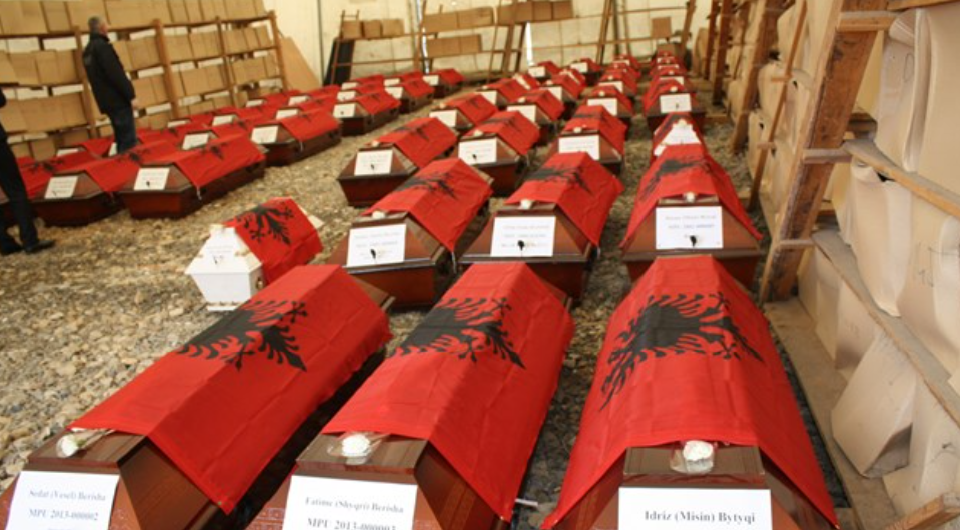
On Monday, Kosovo Police arrested two men on suspicion of war crimes against Albanian civilians in 1999. By the next evening the political representatives of the Serb community had declared them innocent, without asking what they are accused of. A doctrine our colleague described in June has produced its cleanest specimen, dressed in the presumption of innocence, and as a co-drafter of the constitution that guarantees that presumption, I want it back.
Kadri Kryeziu, Publisher | 29 July 2026
On Monday, Kosovo Police carried out an operation in the municipality of Zubin Potok. Five men were taken to Prishtina for questioning by the directorate that investigates war crimes. By the end of a night of interrogation, three of them, from the village of Crepulja, had given statements and gone home. Two, from Donji Jasenovik and Kaludra, were placed under a forty-eight-hour holding measure on suspicion of war crimes against Albanian civilians during the war of 1999. The Special Prosecution has asked a court to order detention. As we publish, a judge in Prishtina is due to rule.
By Tuesday, two statements had been issued: one by Srpska Lista, one by the Serbian government's office for Kosovo. Between them they run to some seven hundred words. They speak of "five honorable Serbs," of "innocent people," of terror, intimidation, reprisal, and expulsion. They describe the arrested as "domaćini," householders who have lived for years, peacefully, on their own doorsteps. They connect the arrests to the demolition of unlawful structures at Ujman (Gazivode) and present the two as chapters of a single campaign. They demand that international representatives involve themselves in proceedings against Serbs. They assert that charges of war crimes have become an instrument for frightening a people rather than a way of doing justice.
Read them twice. Then notice what is not in them.
Not one sentence, in either statement, concerns the year 1999. Not one sentence asks what happened in those villages, or engages with a single alleged fact, or expresses so much as curiosity about the event under investigation. The killings of Albanian civilians that the prosecution says it is investigating appear in the entire corpus exactly once, inside the police wording that the statements quote in order to reject, wearing the word "alleged." Everything else proceeds as if the thing being investigated has no referent. There is a campaign, there are victims of the campaign, and the victims of the campaign are the accused. The people whose deaths occasioned the file do not appear. They have been edited out of a text about their own case.
And yet both statements know the two men are innocent. They know it flatly, without qualification, on the day of arrest, before the detention hearing, before an indictment exists, before anyone outside the prosecution has seen a page of the file. That certainty is worth pausing on, because it is the entire story. How does Srpska Lista know? Its authors have examined no evidence. They engage with no alleged fact. They do not claim an alibi for either man, because an alibi would require knowing what the men are said to have done, and the statements exhibit no interest in that question. There is only one way to know that a man is innocent while knowing nothing of what he is accused of, and that is by category. "Honorable Serbs" is not a description in these texts. It is the verdict. It was issued in Belgrade before the court in Prishtina had convened. Srpska Lista even volunteers, as proof of innocence, that none of the arrested ever sold his property. That is not an alibi. It is tenure offered as exoneration, and it tells you what the category is really made of: not conduct, but ground.
Our colleague Ngadhnjim Brovina described this structure in June, in an essay written before the present case existed, which is precisely the point. Serbs are innocent by virtue of being Serbs, and any accusation directed at a Serb is, by that fact alone, an episode in a campaign against Serbs. He warned that the doctrine is indifferent to the particular case, that Reçak was a token and not the type, and that any prosecution of any Serb, for any conduct, would serve the same function, because the function has nothing to do with what was done. Within six weeks the apparatus selected its next occasion, and the occasion has behaved exactly as the theory predicted. The innocence was declared first. The case will be discovered later, if at all.
I want to add to his analysis the thing that a career in courtrooms makes impossible to miss. Collective innocence is not merely a shield held over the accused. It is denial of the crime, achieved by arithmetic. If no member of the category can be guilty, then the crimes committed against Albanian civilians in 1999 either did not happen or happened without authors, and a crime that can have no author is a crime in the process of being unwritten. The first generation of this product was cruder. It said that nothing happened at Reçak, that the dead were combatants, that the scene was staged by the other side. That version required the denier to make claims about facts, and claims about facts can be tested. The Đorđević trial chamber tested them and said so in a judgment anyone can read: at least forty-five dead, wounds to the head fired at close range, and a false crime scene, staged by the police on the eighteenth of January 1999 for the visit of the investigating judge, built to produce the conclusion it then produced. The refined version has learned from that defeat. It makes no claim about any fact. It simply says "innocent people" about every accused, forever, and lets the denial follow as a theorem. Nothing happened, because no one who could have done it exists.
Now to the borrowed clothes, because this is where the statements are cleverest and where, as a lawyer, I refuse to let them pass. Srpska Lista invokes the presumption of innocence. It complains that in Kosovo, uniquely, the arrested must prove their innocence rather than the prosecutor proving their guilt. I helped draft the constitution of this republic, and I will state plainly what that document guarantees. Every person charged with a criminal offense is presumed innocent until guilt is established at a fair hearing. That presumption belongs, today, to the two men from Donji Jasenovik and Kaludra, individually and in full. It obliges the Special Prosecution to carry the burden at the detention hearing and at every stage after it. It obliges the court to release them if that burden is not met. It resolves doubt in their favor. Nothing in this article, and nothing this publication will ever print, subtracts one gram from it.
But look at what the statements assert under its name, because it is the presumption's opposite. The presumption of innocence is individual: it attaches to a person, not a people. It is provisional: it holds until evidence is weighed, and it yields to proof. It is procedural: it tells a court how to treat an accused, not a nation what to believe about history. What Srpska Lista asserts is categorical, permanent, and irrebuttable. It attaches to the ethnic group. It does not yield to evidence, because evidence against a member of the group is reclassified in advance as an instrument of the campaign. It is not a rule for courts but a verdict on the past. That is not a presumption. It is an immunity, and an immunity of exactly the kind no legal order can contain, because a person whom no evidence can convict is a person the law cannot reach. The statements accuse the prosecution of shifting the burden of proof onto the accused. Their own doctrine shifts it onto the dead, who are required, twenty-seven years after the fact, to prove from their graves that they were civilians, that they were killed, that they existed at all.
The memory argument then falls into place, not as a debating point but as the doctrine's jurisdiction clause. Srpska Lista asks whether it is possible that memories are better twenty-seven years after the conflict than they were immediately after it, and whether Kosovo's prosecutors can really be more capable than the UNMIK and EULEX prosecutors who charged so few. As law, the first question is not serious. No statute of limitations applies to war crimes, in Kosovo's code or in the international law that binds every state in this story, and prosecutions decades late are the norm of this field, not its scandal, for reasons every practitioner knows: archives open, witnesses outlive their fear, forensics improve, and perpetrators stop hiding. As for the second question, I answered it in May, and the answer has a number. When EULEX wound down, it transferred four hundred and thirty-four unresolved war crimes case files to Kosovo's institutions in December 2018: not a verdict of anyone's innocence, but an inventory of work not done. Srpska Lista calls the current tempo of arrests unprecedented. For once the statement is accurate. So was the backlog. Fifty cases in 2025, by the Humanitarian Law Center's own count, is not a campaign discovering victims; it is an archive finally being read. And if the residual complaint is that the defendants in these files are Serbs, the answer remains the one I gave in May: the composition of a docket follows the composition of the graves. The Albanians were not killed by Martians. What the statement performs is the familiar maneuver our colleague named in June: two decades in which accountability stalled are reported as two decades of exoneration, and the absence of a finding is presented as a finding.
But the argument's real refutation is in Belgrade's own conduct toward another massacre of the same war, in the same month. On the twentieth of July, the Basic Court in Prishtina opened proceedings against twenty-one accused for Reçak, in absentia, because the accused are in Serbia and Serbia will not surrender them. Belgrade's answer to that case has never been that too much time has passed. Its answer was pre-stocked three weeks in advance: on the thirtieth of June, the Serbian Church decorated Danica Marinković, the investigating judge whose 1999 findings pronounced the Reçak dead terrorists killed in combat. I wrote about that ceremony at the time. Consider what the decoration asserts. It asserts that a twenty-seven-year-old finding is not merely reliable but authoritative, worthy of an order of the Church, provided it is the finding that acquits. And the file being honored is the very one the Đorđević chamber traced to a staged scene. So Belgrade does not believe that memory decays. Where it holds a counter-story about 1999, it litigates the facts to this day. Where it holds none, as in Zubin Potok, it attacks time itself. Old findings are decorated when they exculpate and inadmissible when they accuse. The valve runs one way. That is not an evidentiary standard. It is the doctrine, writing its own rules of procedure.
One matter in this file must be treated with complete seriousness, and I intend to treat it so. Defense counsel for the arrested men state that on the night of the arrests they traveled to Prishtina and were not permitted to see their clients, and that one of them, an advocate of twenty years' standing, will lay eyes on his client for the first time at the detention hearing itself. If that account is accurate, it describes a violation of the rights of the accused that the constitution guarantees, and it must be corrected and answered for, not explained away. EULEX has confirmed that it is monitoring these cases and will flag irregularities to the authorities. It should, and publicly. I say this without embarrassment and without any sense of contradiction, because it is not a concession to the doctrine. It is the refutation of it. The doctrine needs the process to fail. Its entire narrative requires a Kosovo that persecutes, and every procedural lapse is a donation to that narrative. The republic's answer to collective innocence is not collective anything. It is individual justice, done exactly right, in the open, for these two men and for the dead of 1999 alike, under a constitution that presumes each innocent and permits each to be proven otherwise.
Because that, in the end, is the whole difference on display this week. Innocence, in a state, is something a court finds, case by case, on evidence, with counsel present and the burden on the prosecutor. Innocence, in a doctrine, is something a category confers, in advance, on everyone it covers, forever. The first protects the two men from Donji Jasenovik and Kaludra. The second merely uses them, as it used Reçak, as it will use whatever occasion comes next, to establish that no Serb can be guilty of anything, from which it follows that nothing was ever done, from which it follows, in time, that nothing would be done again. A community told that its accused are hostages of a campaign, and that a householder cannot also be a defendant, is not being defended. It is being conscripted into a version of history in which the last war has no crimes, and a war with no crimes is a war with no lessons, which is the most dangerous thing a region like ours can possess.
This week a court in Prishtina will do what the statements say cannot be done. It will treat two Serbs as individuals. It will presume them innocent, hear evidence against that presumption, and rule. Whatever it decides, that is not persecution. It is the only alternative to it.