Serbia’s deputy prime minister has listed the powers the state stands on. Europe is not among them. The Commission should read it as what it is.
Editorial Board | 20 October 2026
“Our policy should rest on the Serbian tripod, and that is Russia, China and, if it can be done, America.” If it cannot, Ivica Dačić went on, Serbia can manage without the third leg.
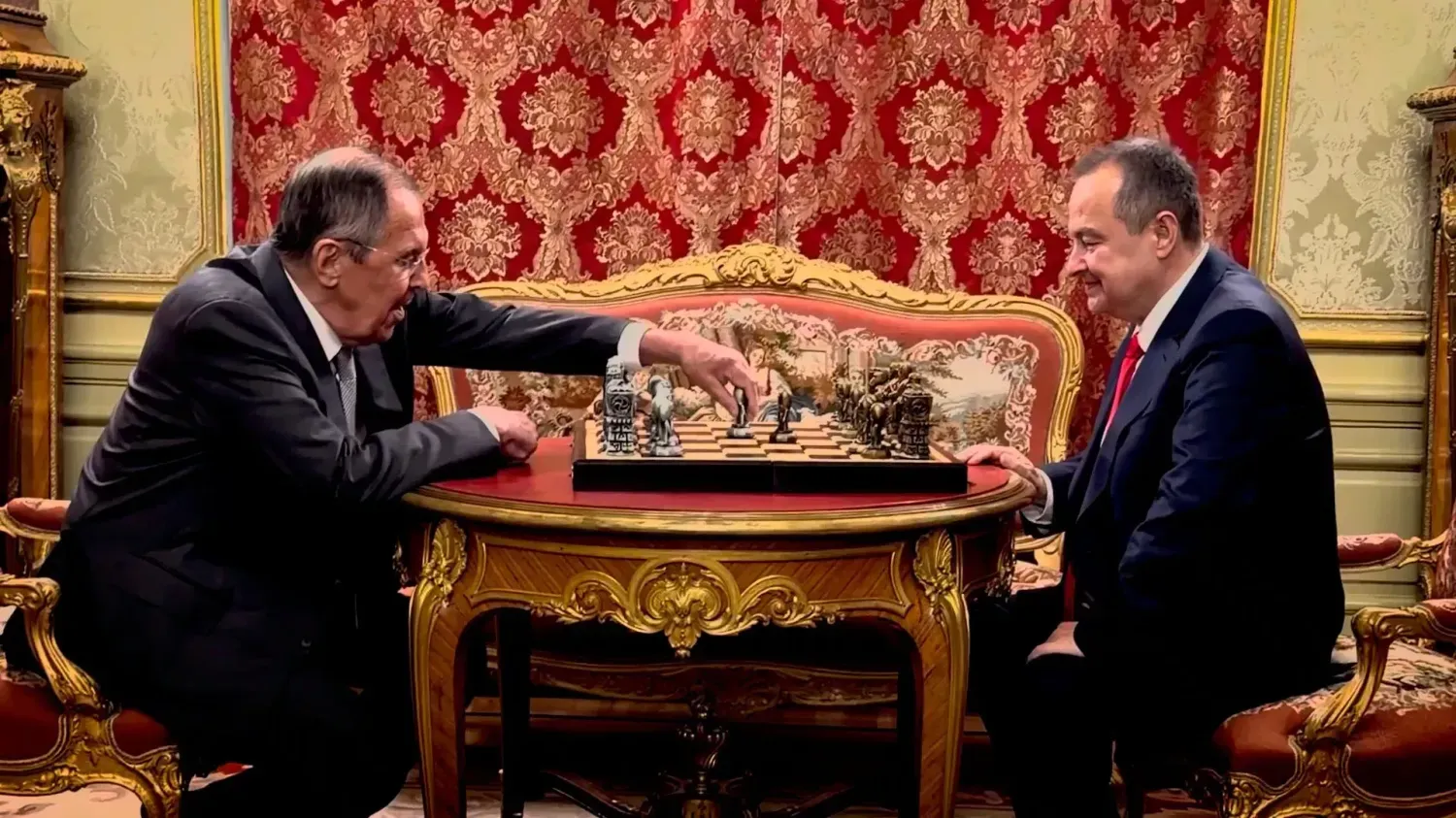
The speaker is the Deputy Prime Minister and Minister of Internal Affairs in Serbia’s caretaker government, the president of the Socialist Party of Serbia, the second party of the governing coalition, and the head of its list on 25 October. The sentence is from the SPS statement of 16 October on his return from Moscow, where he met Dmitry Medvedev, Sergei Shoigu and Sergei Lavrov. Shoigu, the statement records, wished him success in the election.
The European Union is not one of the three legs. It is not the leg that fell off. It is not named as an adversary. It is not named. The minister who commands Serbia’s police described the external support of the state in his party’s official text, nine days before the vote, and Europe did not come up.
A second SPS statement, on 17 October, said what the tripod means in practice. “No sanctions against Russia come into consideration.” Serbia and Russia are “brotherly countries and will be forever.” Alignment with EU foreign policy is the item Brussels has written into every Serbia report since 2014. Dačić has answered it for the coalition in one sentence, and the answer is never.
He also said why. “The people of Serbia must know that I am not a Russophile, I am a Serbophile. I love Serbia. It is because of Serbia that good relations with Russia are precious to us, because that is in Serbia’s interest.” This publication takes him at his word. He is not claiming sentiment. He is claiming interest, and interest is structural. Kosovo appears where it always appears, as the service Moscow renders in return: the Russian delegate who stands up and shouts “against” when Kosovo applies to UNESCO or Interpol.
America is in the tripod on condition, “if it can be done,” and the state can stand without it. This from a government that has spent two years buying Washington’s goodwill, through lobbyists and through the Expo it is selling to American officials. In Belgrade’s own description of its foundations, the United States is the one leg that is optional. China is not. Russia is not.
Three days later, in Čačak, the man at the top of the governing list drew the same map from the other side. “It is enough to look at who supported them: Nataša Kandić, Günther Fehlinger, Albin Kurti, Milojko Spajić, Andrej Plenković. And me, as you have seen, Robert Fico and Vladimir Putin and many other freedom-loving leaders across the world. So you see.” Aleksandar Vučić resigned the presidency on 27 September to run for prime minister. He was listing the backers of his opponents and his own, and elsewhere in the speech he added Milo Đukanović to the first list. On his side: a Slovak prime minister and the Russian president. On the other: a Croatian prime minister, the prime ministers of Kosovo and Montenegro, an Austrian activist and a Belgrade human-rights lawyer. Neither text is an adopted state doctrine. Read together they are the two leaders of the governing bloc, in one week, telling 6,450,523 registered voters the same thing from two directions.
Brussels will want to file this under campaign rhetoric. The statements were written and issued after meetings with the Secretary of Russia’s Security Council and its deputy chairman, by the minister in charge of the police. The list of backers is the frame the government has used since the protests began in November 2024. Nothing in either text will be withdrawn on 26 October.
The record of the money is the record Brussels should be reading. In April 2025 Kaja Kallas told candidate countries that attendance at the 9 May parade in Moscow would not be taken lightly. Vučić went, and a Serbian army unit marched on Red Square. The Commission’s spokesman declined to speculate about consequences. Six weeks later, on 20 June 2025, the Commission transferred the first 51.7 million euros of Growth Plan pre-financing into Serbia’s budget, the rest of the 111 million advance routed through the investment framework. In January this year it approved a further 56.5 million, the first regular release, more than any other country in the region had been granted. Serbia’s alignment with EU foreign policy stood at 51 percent in the Commission’s 2024 report; the 2025 report calls it low. The money moved anyway.
Brussels has shown it can hold the money. Since the judicial amendments of January, Marta Kos said in May, no payment has been made, though no formal decision to stop paying was taken either. The hold exists. It was found for a law on court presidents. It was not found for a parade on Red Square, for “no sanctions,” for a Security Council meeting in Moscow in an election week, or for a deputy prime minister listing the state’s foundations without Europe among them.
Nobody in Belgrade is hiding this. Dačić put it in two statements. Vučić put it in a speech. They say it out loud before the vote because it costs nothing, and because they have read the record above more carefully than the Commission has.
This publication does not ask Belgrade to explain itself. Belgrade has explained itself, twice, in the one week when every voter and every embassy is listening. The question is for the people who keep signing: what they think they are buying from a state that has named the powers it stands on and left Europe off the list. They will say it is electoral noise. It is not just electoral noise. It is the answer.