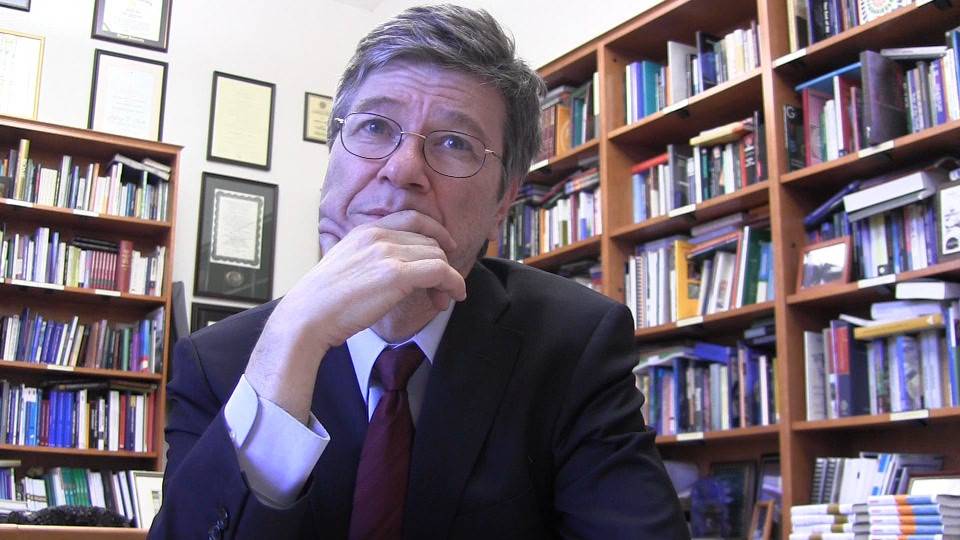
An extensive interview with economist Jeffrey Sachs, conducted in Belgrade, is followed by a response from U.S. analyst Daniel Serwer, offering a contrasting assessment of the war in Ukraine, NATO expansion, sanctions, and Serbia’s strategic positioning between Europe and other global powers.
by the Kosovo Dispatch | 29 December 2025
Recently, Belgrade’s weekly NIN published an extensive interview with Jeffrey Sachs, an American professor of economics. Sachs was in Belgrade at the invitation of the Center for International Cooperation and Sustainable Development (CIRSD), and the interview at NIN’s newsroom was conducted by Siniša Mali, Minister of Finance of the Government of the Republic of Serbia.
Following the publication of the interview, Kosovo Dispatch invited Daniel Serwer to comment on several of the arguments presented, particularly those related to NATO, the war in Ukraine, and Serbia’s foreign-policy positioning. His response is published in full following the transcript.
Mali: If you look at the world over the past five or six years, in my humble opinion, what used to be abnormal has become normal. From COVID-19 and everything that happened then, to the conflict in Ukraine, the 2022 energy crisis, and now tariffs, trade wars… How do you see the current geopolitical and economic situation in the world?
Sachs: Let me first say that it is an honor to be here with you. Thank you for the opportunity to talk. Global turbulence is enormous. And to that list I would add something else, equally shocking—large language models, that is, the fact that artificial intelligence (AI) is suddenly everywhere, and how it is transforming the world. We are living in a time of extraordinary disruptions. Almost nothing seems to make complete sense. But everything we see on the surface has deep underlying causes.
If I may mention one controversial issue—I was the chair of the COVID commission established by The Lancet. I came to the conclusion that the virus almost certainly originated from a laboratory, and, surprisingly, from an American laboratory. Often we do not really understand what is happening in the world. The war in Ukraine should never have happened. COVID was probably a laboratory incident, not a natural disaster. At the moment, we are not taking very good care of ourselves. There are too many disruptions and too little serious, genuine cooperation to sustain stability.
Mali: If we look at geopolitics—everything happening between East and West, the rise of China—where do you see Europe in the next five or ten years?
Sachs: Honestly, I am worried. On the one hand, quality of life in Europe is the best in the world, but the direction of the economy is not good. Europe is inflicting many blows on itself, starting with the war in Ukraine. In my view, that war should not have happened. And it was not caused by Russia alone. It was caused by NATO expansion and a very arrogant U.S. foreign policy that Europe accepted.
We have a war, and Europe keeps imposing sanctions on Russia one after another. And what is achieved by that? Is the Russian economy being destroyed? No—the European economy is being destroyed. We see a boomerang effect, one after another. Russia is treated as something to be discarded, and the consequence for Europe is the loss of a trading partner and access to cheap natural gas. And then we watch German industry sink lower and lower. That is not a strategy; it is a series of mistakes.
Mali: Serbia is part of Europe; our largest trading partner is the EU. That is why understanding where Europe is heading—or should be in five or ten years—is very important for us. We are often criticized for our relations with China. Last year we signed a free trade agreement; we are the only country in Europe without a visa regime for Chinese citizens; we have direct flights to Beijing, Shanghai, Guangzhou. How do you see China’s role in the world, and what do you think of Serbia’s positioning toward China?
Sachs: Congratulations. Your relations with China are extremely positive. I wish the European Union understood that—and the United States as well. China is extraordinarily dynamic and innovative. In purchasing power parity terms, it is the largest economy in the world. I have been going to China for 44 years and observing its development.
For Serbia, having strong economic relations with China is extremely important. Bravo. It is also good for China, because China needs partners in Europe. What Serbia has done is very creative and absolutely correct.
But as you know, the dominant mindset in the U.S., and perhaps even more so in Europe, is: whose side are you on? This one is the enemy, that one is the enemy; you must not deal with these, you must not deal with those. Yet everything we know as economists tells us that broader markets mean higher incomes, because trade is a process in which both sides gain. It is not a zero-sum relationship.
If Serbia trades with China, with Russia, with the Gulf countries, with the European Union—bravo. Brussels’ idea is that you cannot trade with Russia. Are you joking? Russia has the largest territory in the world—17 million square kilometers filled with natural resources—and you say: no, we will not trade. Who will that hurt? Russia? Sorry, no. It will hurt you.
We see European leaders traveling to Beijing and lecturing China on economics. Excuse me—China today is a major player and the most technologically innovative power. In the U.S. we say “Silicon Valley.” Fine, it is exceptional and has transformed the world in the digital era. But on the latest UN list of innovation clusters, Silicon Valley ranks fourth.
The number one innovation cluster in the world is southern China: Shenzhen, Hong Kong, Guangzhou—the Greater Bay Area. What is the difference between that cluster and Silicon Valley? It is fascinating. Silicon Valley has brilliant ideas, abundant venture capital, heavy promotion of AI—but it produces nothing except ideas. It produces designs. It does not produce chips. It does not produce robots. It does not manufacture. It is not a global financial center.
Look at Shenzhen, Hong Kong, Guangzhou—home to cutting-edge companies like Huawei or Tencent. They produce ideas and also lead global manufacturing in robotics, electric vehicles, and all green energy technologies. Financing is integrated—Hong Kong is one of the world’s leading financial centers. They combine everything.
Second in the world are Tokyo and Yokohama; third is Beijing. Silicon Valley is fourth. That is why the American—or American-European—idea that “we are the whole world” is outdated. The world is much larger than we think.
Imagine President Macron going to China to lecture them on economic rebalancing. Excuse me—with all due respect, I am grateful to President Macron for awarding me the Legion of Honor—but frankly, he should first fix his own budget, which is out of control.
Mali: The deficit is close to seven percent.
Sachs: Exactly. That is what he should focus on—not war with Russia and lecturing China.
Mali: When I prepared for this interview, I was told I must be neutral, as a journalist. But I have to agree with some of your views. I want to talk more about Serbia. We have free trade agreements with CEFTA countries, with the European Union, with the Eurasian Union—Russia, Belarus, Kazakhstan—as well as with Turkey, China, Egypt, and the United Arab Emirates. We are currently negotiating with South Korea. If you invest in Serbia, you gain access to a market of 2.8 to 3 billion people. As a small economy, we must open ourselves. Last year we attracted €5.2 billion in foreign direct investment—a record.
Sachs: In the midst of a European economic crisis and wars in the region…
Mali: We have the lowest unemployment rate in history; public debt is around 43% of GDP—half the EU average; Serbia was the third fastest-growing economy in Europe last year. As the world becomes more regionalized and divided into blocs, do you think this can only harm global growth?
Sachs: Next year marks 250 years since the publication of Adam Smith’s The Wealth of Nations. That book is the starting point of the modern world economy. What did Smith say? That world trade promotes prosperity for all. The essence is simple: do not isolate yourself from the world market—especially if you are a small country like Serbia.
If a small country closes itself off, everyone starves. I say the same to the United States: do not close yourselves off. I do not get my morning coffee from Central Park—it comes from Indonesia, Ethiopia, Brazil. And I want my coffee.
Two and a half centuries ago, Europe was politically dominant until around 1950. Then came the American empire. Throughout that time, the Western empire saw itself as ruler of the world. The mindset in the U.S. today—one I consider illusory—is: we run the world. And if we don’t, we should. If China thinks it is something, we will show them. Absurd.
Smith wrote that Europe dominated in his time, but that through trade and technology the world would rebalance. Two and a half centuries later, we are exactly at that moment.
What you described as Serbia’s strategy is correct. Serbia sits at a crossroads—many empires wanted this territory. When you are at a crossroads, you trade with Russia, with Turkey… I am delighted that you have a free trade agreement with Turkey; I did not know that. That is extremely smart. You should trade freely with China as well.
What is wrong is the mindset in Brussels: Russia is the enemy; China is probably the enemy. We must close ourselves off. And what will happen to Europe? It will shrink. It will become pessimistic. It will become protectionist.
I hope you succeed—and that Brussels regains its composure. Europe today is in panic: anti-Russian panic, anti-Chinese panic, anti-American panic, because Donald Trump is also not exactly a friend of the EU. Panic leads to protectionism and putting security above everything. What you are doing is right, and I hope Brussels learns from Belgrade. Europe must be open to the world.
Mali: European countries—and the world more broadly—are investing more and more in security and the military. Two, three, four, even five percent of GDP goes to military spending. You once called this military Keynesianism. The state must have a role in investment, but how large should it be? Is it even good to invest in the military, since it can ultimately be used?
Sachs: First, I am against it. I use the term “military Keynesianism” negatively. Second, diplomacy is not expensive. War is horrific. I wish Europe would return to diplomacy rather than hate speech toward Russia. Europe is in a state of Russophobic fever, which is extremely dangerous.
The EU has effectively outsourced its Russia rhetoric to the country where Russophobia is strongest—Estonia. That is not the right approach. Russia does not plan to attack Europe. That is false. And the idea that the Ukraine war is a war of Russian aggression is a misunderstanding.
The reason for the war is simple: the U.S. turned Ukraine into a battleground between the U.S. and Russia. Zbigniew Brzezinski wrote this explicitly in The Grand Chessboard. He argued that whoever controls Ukraine controls Eurasia. The U.S. strategy after the Cold War was NATO expansion. I was there—I advised Gorbachev’s and Yeltsin’s economic teams. They wanted peace, trade, reform—not empire.
But the American mindset was: you lost, we won, everything belongs to us. Promises not to expand NATO eastward were made—and broken. That led us here.
Instead of building armies for war with Russia, Europe should say: NATO expansion was a deception and a mistake. Ukraine should be neutral. The war would end. Europe would not have to spend trillions on weapons, nor be destroyed.
Mali: Politicians find it very hard to say “we were wrong.” Two major global trends are happening: Trump’s “America First” defense doctrine, and sanctions and tariffs disrupting trade. How do you see these?
Sachs: The U.S. is in a very confused state. I did not like Biden, and I do not like Trump—but some things Trump wants make sense. He may pull the U.S. out of Ukraine, which I hope happens peacefully.
But the new national security strategy is chaotic. It contains hints of realism toward Russia and China—thankfully not calling for war—but it is also grandiose and unrealistic. Trump wants dominance in his hemisphere while avoiding wars with major powers. If he truly avoids direct conflict with Russia and China, the world will be safer.
But even now, the Caribbean is being heavily militarized, possibly in preparation for action against Venezuela. That would be lawless and disastrous. Trump views oil as power. Venezuela has larger reserves than Saudi Arabia. In his mind, Canada is the 51st U.S. state; Greenland should be taken; the Arctic should be controlled. This logic could even lead to a confrontation with Europe. It sounds insane—but it is not impossible.
Mali: And sanctions, tariffs?
Sachs: Sanctions have become a weapon. They are largely illegal under international law, yet the U.S. and EU use them extensively. The dollar has become an enforcement tool—via SWIFT. This pushes BRICS countries to trade in their own currencies. Correctly so.
If you want the dollar to be used, you must treat it as a currency—not as a weapon.
Mali: What about digital currencies?
Sachs: In ten years, the dollar’s role will be much weaker. China has built its own payment system, CIPS. Countries trade in yuan because they know China will not confiscate their assets.
Europe is now debating confiscating frozen Russian assets in Euroclear. Every serious expert warns against this—it would destroy the euro’s credibility. Yet Brussels persists. That path is reckless and desperate.
Mali: Serbia will host EXPO 2027. One hundred twenty-nine countries have confirmed participation. It is a major opportunity for us. We are investing heavily in infrastructure—highways, high-speed rail, capital spending at 7.3% of GDP…
Sachs: Can you build something in the U.S. as well? I have to take Amtrak—you never know if it will arrive.
Mali: We will continue expanding rail links to North Macedonia and Bulgaria. That will be the backbone of trade. Consumption is rising, wages and pensions are increasing in real terms, exports are growing, FDI is strong. We believe we are on the right path. What advice would you give us?
Sachs: Serbia is absolutely on the right path. Maintaining balance while others demand loyalty is not easy. Infrastructure matters—but so do digital networks. Build strong fiber-optic systems, data centers. AI is essential.
But above all, invest in top-tier education. Partner with leading universities—from China, Russia, Europe, the U.S. The true wealth of the future is intellectual capital, educated people, advanced knowledge. That is what attracts investment, creates innovation, and retains intellectual property.
Counterpoint
Following the transcript, Kosovo Dispatch publishes in full the response of Professor Daniel Serwer, who was invited to comment on several of the arguments raised in the interview, including NATO expansion, the war in Ukraine, sanctions, and Serbia’s foreign-policy orientation.
Professor Serwer: Jeffrey Sachs is a serious economist, and I am entirely sympathetic to his general pro-trade views. However, security, COVID-19, and broader geopolitical issues lie well beyond his professional expertise. He is entitled to his view that COVID-19 originated in a U.S. laboratory, but very few infectious-disease experts share that belief.
Nor is there evidence for his claim that NATO expansion caused the war in Ukraine. That argument is a Russian talking point, ungrounded in the facts. There was never a promise to Moscow that NATO would not expand. Moreover, Russia has repeatedly signed agreements explicitly recognizing Ukraine’s right to choose its own international alignments. Ukrainian NATO membership was strongly opposed by several NATO members before 2014 and even as late as 2022. Russia’s unprovoked invasion has fundamentally changed that reality. It has ensured that most Ukrainians now favor NATO membership and has reduced European resistance to it. I hope Ukraine will join NATO after this horrific war; it is the only reliable way to prevent a repetition.
As for sanctions, they undoubtedly impose economic costs on both those who impose them and those targeted, as Sachs correctly notes. But sanctions are an important diplomatic tool for signaling and for weakening an adversary through non-military means. Serbia is entitled to ignore sanctions on Russia, but it should not expect to benefit simultaneously from closer relations with the European Union, which remains its principal trading partner and investor.
Trade with China is unavoidable in today’s global economy. However, Serbia has gone further, allowing China to penetrate its military and security sectors. That is a strategic choice, and it will carry costs for cooperation with both the United States and Europe. In effect, Serbia is choosing alignment with anti-Western forces. This also raises serious doubts about Belgrade’s intentions regarding peace with Kosovo.
I would prefer to see a democratic Serbia pursuing friendly, neighborly relations with Pristina and genuine EU membership. Instead, President Vučić has taken the country in the opposite direction—restoring autocracy, making alternation of power virtually impossible, and aligning Serbia with other authoritarian states. I respect Serbia’s right to make that choice, but choices have consequences. Sachs appears blind to those consequences and resists acknowledging them. That is not realistic.
