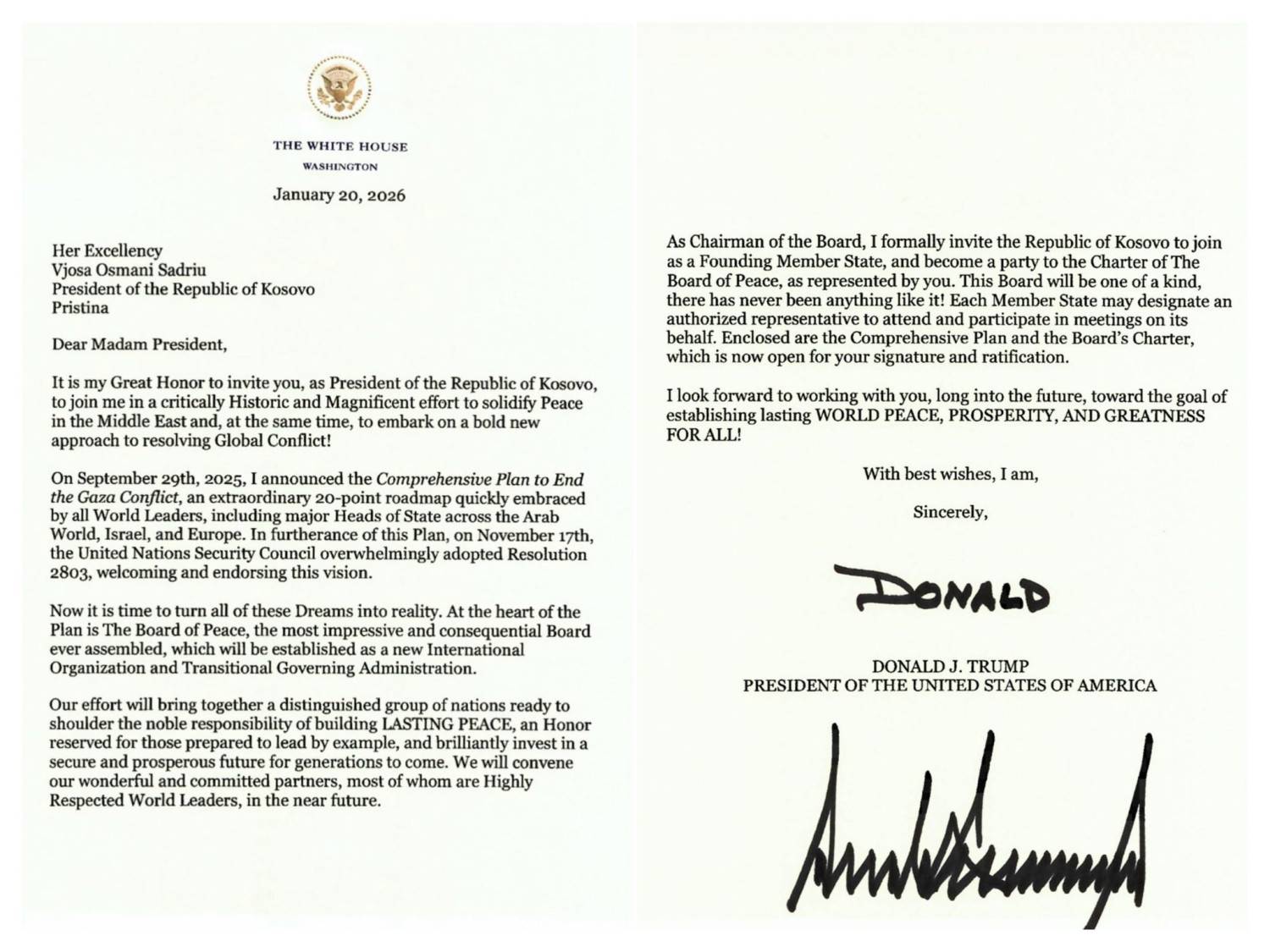
The invitation to Kosovo’s president underscores how Washington now prioritizes consistency and alignment, with Albania and Kosovo emerging as complementary partners.
by Mark Gojcaj | 21 January 2026
On 20 January, U.S. President Donald J. Trump sent a formal letter to Kosovo President Vjosa Osmani inviting the Republic of Kosovo to join the newly announced Board of Peace as a founding member. The invitation, issued directly from the White House, places Kosovo among a limited group of states expected to take part in shaping a new U.S.-backed framework for peace-building and post-conflict stabilization.
On its face, the letter is procedural. In substance, it is not.
The timing and framing of the invitation matter. Kosovo is not being asked to attend, endorse, or observe. It is being invited to participate as a founding member, with the expectation of active contribution. That distinction reflects how Washington is currently sorting partners from sympathizers—and it places Kosovo firmly in the former category.
This development should also be read alongside President Trump’s recent engagement with Albania and Prime Minister Edi Rama, including Albania’s inclusion in discussions tied to Gaza and broader Middle East stabilization efforts. Taken together, these moves point to a quiet but deliberate recalibration: Kosovo and Albania are increasingly being approached as aligned allies, rather than as separate or situational regional cases.
For U.S. policymakers, this alignment is not symbolic. It is functional.
Since late 2023, both Tirana and Pristina have adopted clear, largely unambiguous positions on major international fault lines. Following the October 7 Hamas attacks, both governments condemned terrorism without qualification while supporting a political horizon focused on security, accountability, and long-term stability.
Kosovo’s standing in Washington has also been shaped by a pattern of practical alignment that extends beyond rhetoric. Pristina has consistently supported U.S. positions on sensitive international files, including Iran and Venezuela, and has demonstrated a willingness to translate political alignment into concrete cooperation. Notably, Kosovo agreed to accept a limited number of individuals deported from the United States as part of broader U.S. efforts to manage illegal immigration—an uncommon step globally, and one taken by very few countries. For U.S. policymakers, such actions reinforce the perception of Kosovo as a partner prepared to assume responsibility when alignment carries real political or administrative cost. In a period when many states opted for rhetorical hedging, Albania and Kosovo chose clarity. That choice was noticed.
The language of the January 20 invitation reflects this logic. The emphasis is not on values declarations but on responsibility and contribution. This fits squarely within the Trump administration’s preference for selective, results-oriented partnerships over expansive but diffuse multilateralism. Washington is signaling that reliability matters more than size, and consistency more than diplomatic agility.
President Osmani’s response reinforces this reading. By situating Kosovo’s participation within the historical role of the United States in bringing peace to Kosovo, she frames the invitation as part of an alliance continuum rather than a one-off diplomatic gesture. Kosovo is presented not as a beneficiary seeking recognition, but as a partner prepared to assume responsibility beyond its immediate neighborhood.
For analysts and diplomats, the parallel treatment of Kosovo and Albania is telling. The two states are not being treated as interchangeable, nor are they being folded into a generic “Western Balkans” category. They are being approached as complementary allies—aligned in outlook, coordinated in reflex, and broadly consistent in their engagement with Washington.
At the same time, such positioning carries expectations. Deeper inclusion in U.S.-led initiatives brings increased scrutiny of domestic governance, institutional resilience, and rule of law. Strategic trust abroad inevitably sharpens attention at home. This is not a contradiction; it is the price of credibility.
The invitation to Kosovo, viewed alongside Albania’s recent engagement, does not resolve the region’s unresolved issues. It does not alter recognition realities, nor does it eliminate regional tensions. But it does clarify something important.
In Washington’s current calculus, Albania and Kosovo are increasingly treated not as problems to be managed, but as allies whose value lies in predictability, alignment, and a demonstrated willingness to engage when it matters.
In today’s international environment, that is no small distinction.
About the Author
Mark Gojcaj writes from New York, where he examines the intersection of American conservatism and Southeast European political and security realities. He is a regular contributor to The Kosovo Dispatch’s transatlantic coverage, with a focus on U.S. foreign policy, NATO dynamics, and the Western Balkans.
