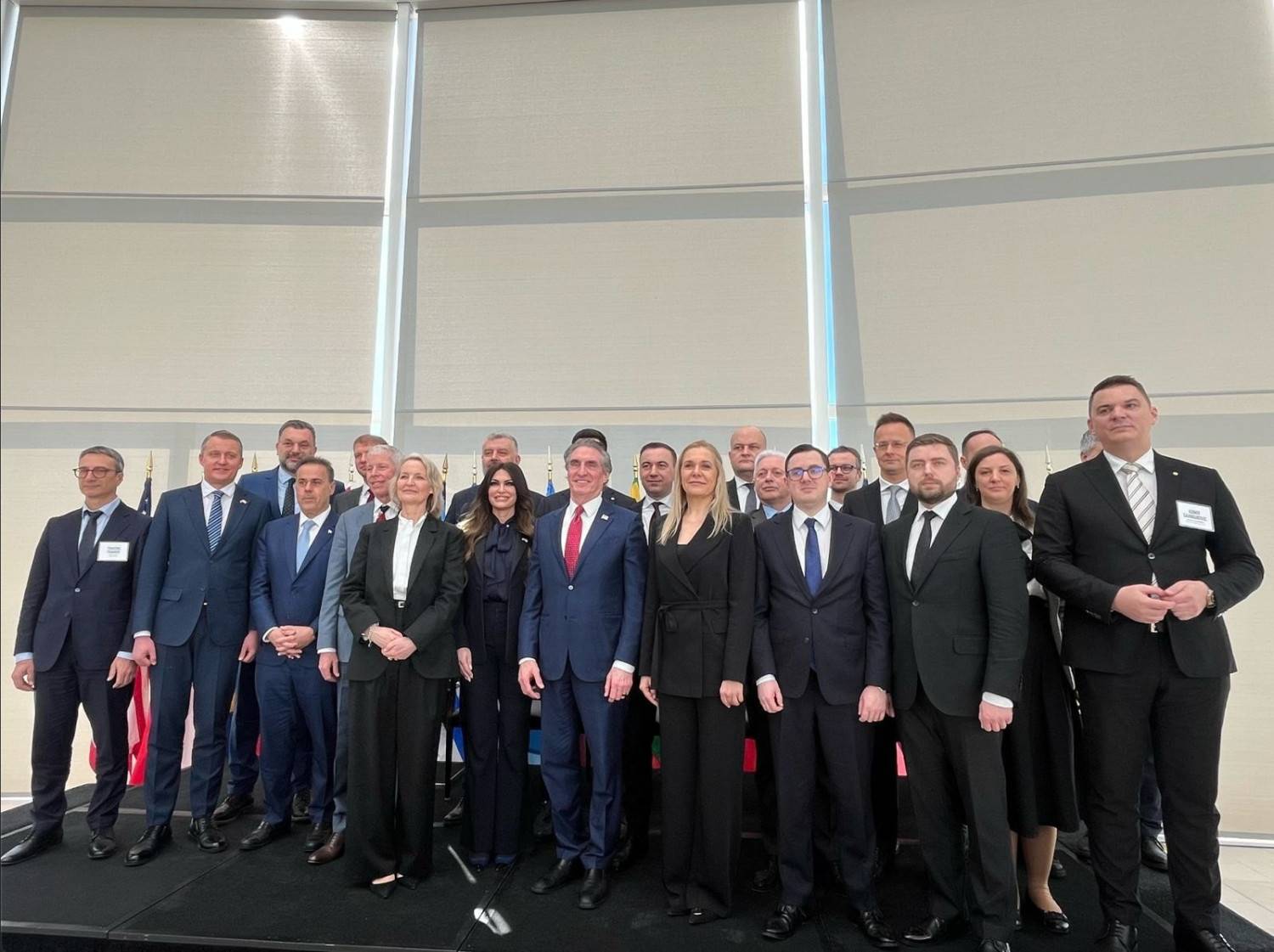
At the Transatlantic Gas Security Summit in Washington, Kosovo signaled something larger than energy cooperation. It signaled strategic clarity.
by Klea Ukaj | 26 February 2026
In Washington this week, amid a sea of European and American flags, the language was technical — infrastructure, LNG cargoes, market liquidity, storage capacity. But the meaning was geopolitical.
The Transatlantic Gas Security Summit, organized under the auspices of the U.S. National Energy Dominance Council, chaired by Doug Burgum with Chris Wright in a leading role, was not merely about molecules of gas. It was about power — the political kind.
For Central and Eastern Europe, energy is no longer a commercial commodity. It is leverage. It is deterrence. It is sovereignty.
Kosovo’s Minister of Economy, Artane Rizvanolli, understood that clearly.
Kosovo does not have gas infrastructure. It does not operate LNG terminals. It does not sit on strategic transit corridors. And yet, its presence in Washington was neither symbolic nor peripheral.
Because Kosovo has already learned what energy coercion looks like.
The Shock That Changed the Calculation
In 2021 and 2022, during the height of Europe’s energy crisis and Russia’s war in Ukraine, Kosovo paid up to ten — even twenty — times the normal price for electricity imports.
Those numbers are not abstract. They translated into fiscal strain, emergency budget reallocations, and vulnerability during winter peaks.
Kosovo may not import gas directly, but it imports exposure to gas volatility.
That is the lesson Washington was built around.
When Rizvanolli said that “the energy security of each state means less scope for malign influence for all of us,” she was articulating something that smaller states understand more acutely than larger ones: instability travels through markets.
You do not need a pipeline to feel pressure. You only need dependency somewhere in the system.
Choosing Alignment Over Ambiguity
The summit also revealed a deeper contrast in the region.
Some states continue to balance between Brussels and Moscow. Some sign declarations while refusing sanctions. Some hedge.
Kosovo does not hedge.
Rizvanolli explicitly thanked the White House’s National Energy Dominance Council and reaffirmed Kosovo’s full alignment with U.S. foreign policy positions.
That matters.
In a region where strategic ambiguity has often been mistaken for cleverness, Kosovo is choosing clarity.
Energy cooperation with the United States is not just about LNG contracts. It is about anchoring Kosovo inside a transatlantic security architecture that treats energy as a strategic asset, not a transactional commodity.
The Regional Architecture Taking Shape
The joint statement emerging from the summit — signed by the United States and twelve Central and Eastern European states — emphasized:
- Diversification of supply routes
- Removal of regulatory barriers
- Infrastructure expansion
- Long-term commercial arrangements
- Protection from coercive market manipulation
This architecture is gradually redefining Europe’s energy map.
Greece, Croatia, Lithuania and Poland are strengthening LNG terminals. Ukraine is being repositioned as a storage hub. The Vertical Corridor concept is gaining traction for north-south interconnectivity.
Kosovo is not yet physically inside that gas network.
But politically, it is positioning itself inside that framework.
And that is not trivial.
The Domestic Balancing Act
Clarity abroad must be matched by discipline at home.
Kosovo remains heavily reliant on lignite. Its aging power plants continue to carry the burden of baseload generation. Renewables expansion is accelerating, but structural transformation takes time.
Washington alignment does not solve domestic modernization.
It creates opportunity.
Rizvanolli’s emphasis on cooperation with American companies — including exploration of cleaner coal technologies such as gasification — suggests that Kosovo wants transitional security without surrendering long-term decarbonization goals.
That is a difficult balance.
But energy policy today is not a purity contest. It is a stability test.
The Larger Signal
The real message from Washington was simple.
Energy security is no longer a technical portfolio. It is statecraft.
For Kosovo, the choice is clear: align with the system that reduces coercion, stabilizes markets, and treats energy independence as a pillar of political independence.
The era of energy weaponization has forced every state to choose.
Kosovo had already chosen long before everybody else did.
Now the harder task begins: building the infrastructure, reforms, and resilience to make that choice irreversible.
About the author:
Klea Ukaj writes from Michigan and contributes to The Kosovo Dispatch’s trans-Atlantic coverage.
