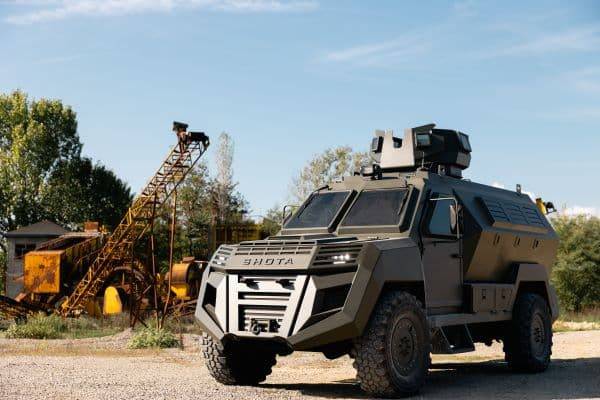
Kosovo’s tentative move toward co-producing the Albanian-designed SHOTA armored vehicle reflects a broader shift toward regional defense cooperation with NATO partners Albania and Croatia — a step that signals intent and alignment, even as key details about scope, timing, and implementation remain unresolved.
by Fatos Kabashi | 11 January 2026
PRISHTINA — Kosovo’s acting minister of defense, Ejup Maqedonci, says the Albanian-designed armored vehicle known as SHOTA is expected to be produced in Kosovo as part of a broader defense-industrial cooperation with Albania and Croatia. The remarks, first reported by Koha and later picked up across regional media, place Kosovo inside an emerging framework of regional military coordination — while also leaving key questions unanswered.
According to Maqedonci, the three countries have reached a principle-level understanding on joint development and production. The next step, he said, would be a bilateral agreement between Kosovo and Albania, with Croatia expected to join at a later stage. Kosovo’s Ministry of Defense has since stressed that the project remains in a logistical and preparatory phase, rather than active serial production.
What SHOTA Is — and What It Is Not
SHOTA is an MRAP-type (Mine-Resistant Ambush Protected) armored vehicle developed in Albania by TIMAK Defence, and publicly presented since 2023. It has been shown at international defense fairs, including Eurosatory 2024 in Paris, and is promoted as a protected mobility platform designed with NATO compatibility in mind.
According to manufacturer materials, the vehicle is intended to carry two crew members and up to eight troops, with a V-shaped hull, ballistic protection marketed at BR7 level, and blast resistance typical of the MRAP category. These specifications are manufacturer-stated claims. To date, no independent certification or publicly released NATO STANAG test documentation has been published.
In Albania, SHOTA has already entered limited service. For Kosovo, however, the significance lies less in the vehicle itself than in the model of cooperation now being discussed.
What Is Actually Confirmed About Kosovo’s Role
At this stage, several points can be stated clearly.
Kosovo’s defense leadership has publicly expressed intent to participate in SHOTA’s production. The project is linked to a 2025 trilateral defense cooperation framework between Kosovo, Albania, and Croatia. And the Ministry of Defense describes the current phase as logistical preparation, not manufacturing.
Beyond that, much remains undefined.
There is no public information on where production or assembly would take place in Kosovo, whether the country’s role would involve full manufacturing, final assembly, component production, or maintenance, or whether the Kosovo Security Force has committed to a binding procurement order. No timeline has been formally announced.
In practical terms, the project is politically real, but still industrially open-ended.
Why This Matters — Even Now
For Kosovo, participation in a joint defense-industrial effort serves several strategic purposes.
It tightens alignment with Albania and Croatia, both NATO members, and reinforces interoperability standards. It signals an ambition — however gradual — to move beyond simple procurement toward limited defense-industrial participation. And it embeds Kosovo’s security development within a regional framework built on cooperation rather than unilateral escalation.
That distinction matters. Claims from Belgrade and its aligned media frequently frame Kosovo’s security development as “offensive militarization.” A project rooted in regional cooperation, allied standards, and phased implementation tells a different story: one of institutional normalization, not destabilization.
A Project Worth Watching — Carefully
The SHOTA initiative should neither be dismissed nor overstated. Kosovo is not yet producing armored vehicles, and there is no evidence of an operational production line on its territory. But the direction is clear: Kosovo intends to anchor its defense development within regional partnerships, allied frameworks, and incremental capacity-building.
Whether SHOTA becomes a concrete industrial project will depend on what comes next — signed agreements, defined workshares, procurement decisions, and verifiable standards. Until then, it remains what it is today: a serious declaration of intent, still waiting to be tested by practice.