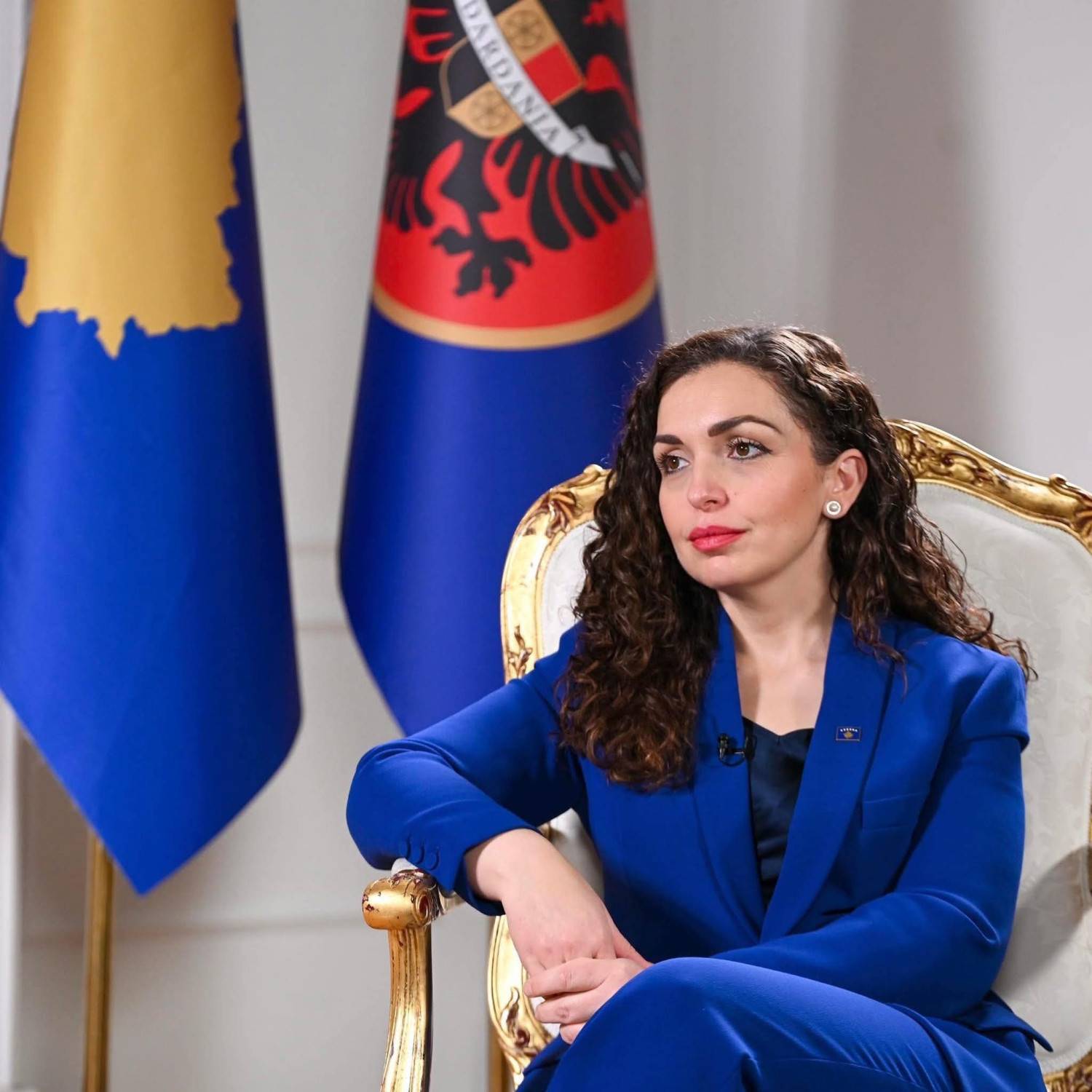
In an exclusive interview for The Kosovo Dispatch, President Vjosa Osmani speaks with unusual candor about Kosovo’s position in a harsher, more transactional international order—one in which power increasingly outweighs principle and compliance does not guarantee reward. Moving beyond post-conflict narratives, she addresses Kosovo’s strategic value to Western security, the erosion of EU credibility, the structural asymmetry of the Serbia dialogue, and the non-negotiable red lines Prishtina will not cross. This is not a conversation about symbolism or reassurance, but a test of clarity in a system that too often punishes it.
Interview conducted by The Kosovo Dispatch | 13 Januar 2026
Kosovo is no longer operating in the afterglow of post-conflict optimism. The international environment it faces today is colder, more transactional, and less forgiving—defined by great-power competition, eroding faith in multilateral guarantees, and renewed instability across Europe’s eastern and southeastern flanks.
President Vjosa Osmani’s tenure has unfolded squarely within this shift. Her presidency coincides with rising pressure from allies, persistent challenges to Kosovo’s sovereignty, and growing doubt about the effectiveness of diplomatic frameworks that once promised linear progress toward normalization and integration. Dialogue with Serbia remains unresolved. EU enlargement is rhetorically affirmed but procedurally stalled. NATO membership remains distant.
This conversation moves beyond familiar appeals to moral legitimacy or historical sympathy. It focuses instead on leverage, deterrence, asymmetry, and red lines—on what Kosovo contributes to Western security, what it can realistically expect in return, and where compromise ends.
Kosovo is treated here not as a case study in post-conflict management, but as a strategic actor operating in a system that increasingly rewards ambiguity and penalizes enforcement.
What follows is not an exercise in symbolism. It is an exercise in clarity.
Kosovo’s Strategic Value
President Osmani, the international system has shifted from values to power. Beyond moral legitimacy, what is Kosovo’s strategic value to Western security today?
Kosovo sits at a critical geopolitical crossroads, and we are very much a frontline security partner. We help anchor NATO’s presence in the Western Balkans, prevent the spread of hostile influence, and bring stability to a region that has long been volatile, connecting Eastern and Southeastern Europe. Today, Kosovo is no longer just a post-conflict story—it’s a strategic security asset.
We are fully aligned with U.S. and EU foreign and security policies, including sanctions against Russia, international cartels, and other actors who challenge the rules-based order. But let me be frank: if the West doesn’t maintain its influence here, someone else will step in—not out of goodwill, but because they have clear strategic interests. Serbia, acting as a proxy for Russia, uses destabilizing tactics that threaten the broader Euro-Atlantic security framework. In that context, Kosovo isn’t just a partner—it is the frontline defense against these threats.
What does Kosovo deliver—security, intelligence, regional leverage—that others cannot.
Kosovo provides strategic clarity and operational reliability—qualities that are increasingly rare in this region. We host NATO forces, with Camp Bondsteel standing as the largest U.S. military base in the Balkans. Our intelligence services deliver high-quality information on malign actors operating nearby, while the Kosovo Security Force trains to NATO standards and participates in international peacekeeping missions. Last year, we also hosted Defender Europe 2025, welcoming troops from 29 allied countries.
What truly sets Kosovo apart is our absolute strategic reliability. Support for the United States runs at 97% among the public, and President Trump enjoys the highest approval ratings in Kosovo compared to any other country in the region. Unlike some regional actors who hedge between East and West, maintain parallel ties with Moscow or Beijing, or shift positions based on short-term interests, Kosovo has no strategic ambiguity. We are decisively pro-Western and act as a counterweight to destabilizing efforts by Serbia and Russia.
If you had to explain Kosovo’s value in one sentence to a U.S. defense planner, what would that sentence be?
Kosovo stands almost alone in the Western Balkans as unconditionally pro-American. In a corridor where Russian influence spreads through proxies, we offer forward positioning, NATO-standard forces, and rock-solid alignment against adversaries—with none of the hedging or ambiguity that marks some other regional partnerships.
EU Credibility and Enlargement
The EU insists Kosovo’s future lies in Europe, yet it has repeatedly delayed, conditioned, or reversed commitments. Do you believe the EU enlargement process toward Kosovo is still credible?
I firmly believe that Kosovo would lead the pack if EU accession were based purely on merit. We’ve implemented more EU-related reforms than many of our Western Balkan neighbors, and our alignment with the EU’s common foreign and security policy is complete. Yet progress remains stalled, blocked by political complications that have nothing to do with our performance.
Few weeks ago, I publicly pointed out that our December 2022 membership application is still sitting unreviewed in Brussels’ drawers. The alignment, hard work, and reforms we’ve delivered are largely taken for granted. This lack of recognition isn’t just frustrating—it undermines the credibility of the process itself.
Credible in principle, or credible in practice? Please choose one.
The process is credible in principle only. I don't see it happening in practice. Kosovo remains the only potential candidate without actual candidate status, despite being a champion in reforms and alignment. The gap between rhetoric and reality has become impossible to ignore.
What specific EU action in the last two years most damaged trust in Brussels among Kosovo’s institutions?
In June 2023, the EU imposed punitive measures on Kosovo—suspending funding and freezing aspects of the Stabilisation and Association Agreement. These actions cost us hundreds of millions in delayed projects, such as projects on drinking water, waste management, environmental protection, rule of law and minority protection. What is particularly striking is that these measures were applied exclusively to Kosovo, despite our full alignment with EU foreign policy, while Serbia maintains close ties with Russia without facing comparable consequences.
I have consistently called these measures unjust—and they were. I am glad they have finally been lifted, but this should serve as a lesson. These actions reward the wrong actors, sending a troubling signal, one according to which compliance with the EU brings punishment, while non-compliance and even acts of aggression lead to rewards. That is not a credible or sustainable basis for enlargement policy.
Dialogue With Serbia — Structural Asymmetry
Has the Kosovo–Serbia dialogue become a system that disciplines Kosovo more than Serbia?
Yes, absolutely. I have been very clear that the dialogue has stalled because the two countries are not treated equally. Serbia has failed to fulfill its commitments and has carried out acts of aggression against us reminiscent of Russian tactics. Kosovo, on the other hand, has fully complied. Yet it was Kosovo—the side that is 100% aligned with the EU—that faced punitive measures.
Let’s be precise. In the past five years, which side has faced consequences more often for non-compliance—Belgrade or Prishtina?
Prishtina, by a significant margin, has faced consequence, but not for its non-compliance, but rather as a result on an unbalanced approach in the dialog. Kosovo has faced immediate political and economic pressure, while Serbia’s non-compliance has often been met with delay, ambiguity, or symbolic responses.
If the structure itself is asymmetric, why should Kosovo continue participating without renegotiating the framework?
It should—but only with adjustments. Continued participation without structural correction risks normalizing asymmetry, weakening Kosovo’s sovereignty, and turning the dialogue from a genuine normalization process into a tool of strategic containment.
I have spoken out publicly against this imbalance. The citizens of Kosovo should not be held hostage by measures that serve neither peace, dialogue, nor our European future. The reality is clear: Kosovo has no viable alternative to Euro-Atlantic integration, while Serbia does. My approach has been to highlight the framework’s unfairness while remaining engaged, because engagement remains the only path to membership. But I will not pretend the system is fair—it was not, for many years. And especially it was not fair since 2023, with Serbia still protecting the terrorists that have committed the acts of aggression against Kosovo, giving full impunity to those who attacked NATO soldiers, journalists, police officers and citizens and carried out constant aggression against our country.
Northern municipalities — Naming the Reality
International actors often describe north of Kosovo as a governance challenge. Is that accurate—or is this primarily a geopolitical problem created by Serbia and tolerated by the West?
The situation in the north of Kosovo was primarily a geopolitical and security issue, not a genuine governance problem. The governance challenges that existed there were largely the result of deliberate political interference, parallel structures, and coercion orchestrated by Serbia. If Belgrade had ceased meddling, pressuring, and threatening local Serbs, these challenges would have largely disappeared—as we see in other Serb-majority municipalities across Kosovo, where such problems were minimal precisely because Serbia’s influence is limited.
Under the 2013 Brussels Agreement, illegal structures were supposed to be dismantled. Instead, over the past decade, Vučić sought to strengthen these networks, turning them into organized crime groups that directly threatened Kosovo’s security and sovereignty. Russia, working in concert with Serbia, benefited from the ongoing tensions in the north, using them to expand instability across the region. This, as you know, culminated with acts of aggression against Kosovo, which were organized and ordered by Serbia, but carried out by these organized crime groups- turned into terrorist paramilitaries. We managed to successfully thwart these attacks, but Serbia continues its destabilizing behavior.
Which factor matters more: municipal capacity, or deliberate political interference from Belgrade?
This was a case of deliberate political interference. Capacity can be built, but systematic destabilization cannot simply be managed away without enforcement.
Serbia’s closest allies are Russia and China, and it has been arming itself aggressively. Its aim is clear: to serve Russia’s interests through destabilization. The parallel structures in northern Kosovo were never a governance deficit—they were an instrument of Serbian state policy, effectively acting as a proxy mechanism for Russia’s broader destabilization strategy.
Security Without NATO
Assume NATO membership is blocked for the next ten years. What concrete security guarantees must Kosovo secure now to avoid strategic vulnerability?
For Kosovo, NATO membership is a strategic imperative. NATO represents a system of values that Kosovo not only shares but actively contributes to. Membership is ultimately about security, which is why I view NATO accession as even more urgent than EU integration.
At the same time, Kosovo is taking concrete steps to strengthen its defense posture: securing binding bilateral defense guarantees, establishing advanced intelligence-sharing arrangements, engaging in joint military planning and exercises, conducting sustained training missions, and ensuring access to modern defensive capabilities aligned with NATO standards.
We are not asking about aspirations. I’m asking about mechanisms: bilateral defense treaties for mutual military assistance in case of an aggression, intelligence integration, force posture.
Kosovo has increased its defense budget to 2% of GDP and is actively working to expand it further, with plans to double the budget and reach 4% of GDP within four years, in line with NATO membership requirements. We prioritize the U.S.–Kosovo Strategic Dialogue and hold regular bilateral consultations between the U.S. Department of Defense (War) and our Ministry of Defense, while maintaining similar engagement with the United Kingdom and other NATO partners.
At the same time, we have expanded the scope and effectiveness of our defense acquisitions and are investing in smart defense technologies, with a focus on ramping up production, innovation, and technological sophistication in the coming years. Kosovo’s armed forces are being developed to deter and sustain firepower against those that might challenge our territorial integrity. Beyond our own capabilities and the NATO presence on the ground, the people of Kosovo can feel secure knowing that strong assurances have been obtained from key allies, even though the details of these commitments remain confidential.
The U.S. is Kosovo’s most important ally. Mature alliances allow disagreement. What current U.S. expectation toward Kosovo do you believe is strategically misguided?
None—particularly under the current Trump Administration. We share closely aligned strategic objectives regarding the role of the United States in the region, Kosovo’s security, and broader regional stability. President Trump’s “peace through strength” approach is well suited to the realities of our region, where credible deterrence is essential to lasting peace. Our goals are more peace, greater economic development, and a better quality of life for our citizens—precisely the outcomes the United States seeks for the Western Balkans.
Respectfully, lets differentiate alliance etiquette from alliance honesty.
Alliance etiquette is about tone and diplomacy; alliance honesty is about facts and record. On that basis, the United States and NATO have no more loyal or reliable ally in the region than Kosovo. This loyalty is not rhetorical—it has been demonstrated consistently through concrete actions. Despite our size and limited resources, Kosovo has often been among the first countries globally to respond positively to requests from the United States, whether by waiving tariffs on U.S. products, cooperating on issues related to third-country nationals, or joining international efforts against narco-cartels in the Western Hemisphere.
By contrast, Serbia has pursued the opposite course. It has deepened political, military, and economic ties with U.S. and NATO adversaries—including Russia, Iran, Belarus, Venezuela, Cuba, and China—while simultaneously voicing open criticism of U.S. policies, President Trump, and the NATO alliance itself. Alliance honesty requires acknowledging this divergence clearly: Kosovo has aligned its actions with Western strategic interests, while Serbia has consistently hedged against them.
State Symbols and Sovereignty
Kosovo municipal officials have participated in high-level meetings without Kosovo state symbols present. Does this matter? If symbols don’t matter, as some suggest, why do all established states insist on them?
That question answers itself. Symbols matter because sovereignty is not just legal—it is also visual, ceremonial, and institutional. I have not addressed this issue extensively in public, but it is worth noting that when the Serbian List returned to office in the northern municipalities in December 2025, their representatives took their oaths alongside Kosovo state flags, the coat of arms, and other state symbols. I welcomed the orderly and peaceful transition of power in all four northern municipalities.
At the same time, more remains to be done. Municipal officials are elected to serve their citizens in their respective municipalities—to care for services, primary health care, and elementary education—not to engage in geostrategic maneuvering or other political agendas.
At what point does flexibility on symbols become normalization of contested sovereignty?
There is no longer any question about the exercise of sovereignty in the north. It’s been a path with lots of challenges, but Kosovo’s institutions have succeeded in establishing full control and exercising sovereignty—and through that, the lawful authority of the state to govern, enforce its laws, and provide security equally to all citizens, throughout all our country’s territory. Enforcement of laws includes the enforcement of legal requirements with respect to state symbols, which must be respected by each municipality, and each mayor. Therefore, the absence of state symbols should never go unchallenged through lawful means, because otherwise it risks normalizing practices that subtly undermine that sovereignty over time.
Recognition Strategy
Kosovo often celebrates new recognitions. But recognition without leverage is symbolic. Is Kosovo now targeting recognitions that change voting behavior in international institutions?
In 2025, Kosovo gained four new recognitions—Kenya, Sudan, Syria, and the Bahamas. I celebrated these milestones as important steps in strengthening our international standing.
Each recognition carries its own significance. Kenya is a major African country with substantial regional influence, while Sudan, despite its internal security challenges, remains an important player on the continent. Syria, meanwhile, is a large and important Middle Eastern state navigating through many challenges in the processes of state rebuilding. Having faced similar challenges not long ago, Kosovo offered its support and experience, signaling our readiness to engage constructively in emerging regional dynamics. With the Bahamas, my office has worked consistently, culminating in the formal recognition earlier this year. Taken together, these recognitions show that Kosovo is securing meaningful support across diverse regions, and we expect this momentum to continue into 2026 and beyond.
Name one recognition you are actively pursuing because it would alter Kosovo’s position in a specific international vote.
We are not pursuing just a single recognition, but a dozen carefully selected ones. However, given the sensitive nature of diplomatic negotiations—which require discretion to preserve trust and strategic leverage—I cannot go into further details. Kosovo now has a clear approach to recognition and will continue to apply it throughout 2026 and beyond. I remain very optimistic about the outcomes.
The Red Line
Every Kosovo leader is told that one final compromise will unlock stability. What is the one demand—territorial, constitutional, or symbolic—you would refuse even under Western pressure?
Any arrangement that creates mono-ethnic executive authority within Kosovo's constitutional order that would make our country non-functional—or any compromise on territorial integrity and constitutional sovereignty.
History will not remember nuance here. Please complete this sentence: “Kosovo will never agree to…”
…to arrangements that compromise its territorial integrity, sovereignty and constitutional order. There is no nuance here, but clarity and conviction. Additionally, we will not abandon our alliances, nor will we turn from our Euro-Atlantic path, no matter how difficult the journey. Our people have shown resilience, courage, and fortitude for centuries, and today, our children are the first generation ever to grow up in peace. We must keep it that way.
Kosovo’s freedom is non-negotiable, our sovereignty is unconditional, and our future is not for sale. We will defend our nation, our values, our alliances, and our destiny with unwavering resolve—today, tomorrow, and for generations to come.
