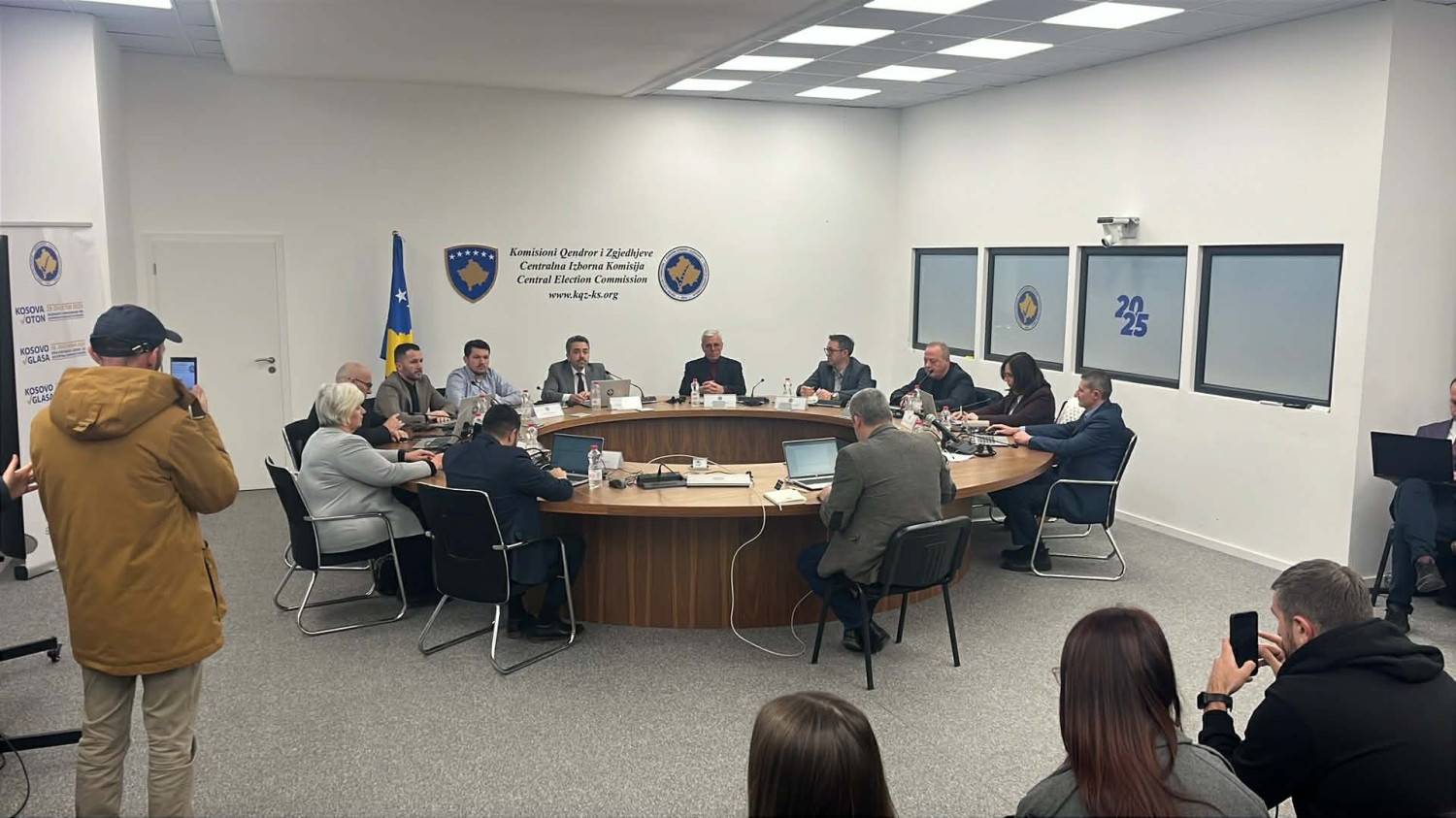
A nationwide recount aimed at correcting candidate-level vote discrepancies is pushing Kosovo’s election calendar into uncertainty — testing the resilience of its electoral institutions without overturning party results.
by Dren Kryeziu | 19 January 2026
PRISTINA — Kosovo’s Central Election Commission (KQZ) has ordered a full recount of all ballots across 28 municipalities after uncovering systemic discrepancies in the tallying of candidate votes — a decision that has pushed the country’s post-election timeline into uncertainty and triggered the opening of nationwide prosecutorial investigations.
The decision follows an internal review of more than half of the polling stations already recounted, which revealed that while party-level vote totals were largely accurate, candidate votes within party lists were not. According to KQZ chair Kreshnik Radoniqi, the recount process so far has resulted in 36,007 candidate votes being removed from preliminary results and 20,978 votes added, exposing widespread errors at the level of municipal counting centers.
The most severe irregularities were identified in Prizren, Kosovo’s second-largest municipality, where the recount stripped 29,343 votes from candidates previously credited at the local Municipal Election Commission (KKN), while 16,366 votes were added following re-evaluation.
“These figures demonstrate that the process of counting candidate votes within political entities suffered from serious inaccuracies,” Radoniqi said, adding that the KQZ will formally refer its findings to the State Prosecutor’s Office.
A recount that changes little — and everything
Crucially, the recount has not altered party rankings. KQZ officials stress that vote totals for political entities remain “minimal and almost negligible” in terms of change. But in Kosovo’s open-list electoral system — where candidate ranking determines parliamentary mandates — the discrepancies could reshape the internal composition of the Assembly, even if party seat totals remain unchanged.
That distinction matters.
What initially appeared as a technical recount has now exposed a structural weakness: Kosovo’s election administration has proven capable of counting party votes accurately, yet struggles with the far more complex task of candidate-level tabulation — the very mechanism that gives voters influence over who actually enters parliament.
Prizren: an institutional red flag
The KQZ’s analysis singled out Prizren as an outlier — not just statistically, but institutionally.
On the recommendation of its Election Operations Council, the KQZ voted to terminate the mandates of political party representatives serving on Prizren’s Municipal Election Commission, citing the scale and concentration of errors. It is an extraordinary measure, signaling that what occurred there cannot be dismissed as isolated clerical mistakes.
Radoniqi was explicit: while other municipalities showed sporadic discrepancies, Prizren represents the most extreme breakdown of counting integrity.
Prosecutors step in
The institutional response escalated quickly.
National Election Coordinator and chief prosecutor Laura Pula confirmed that prosecutors across Kosovo have been instructed to begin preliminary investigations in all municipalities where recounts have concluded. The aim: to secure documentation, collect evidence, and determine whether criminal offenses related to the electoral process were committed.
The Kosovo Police, according to Deputy Director General Colonel Fehmi Hoti, has pledged full operational support.
This dual-track response — administrative correction by the KQZ and criminal inquiry by prosecutors — reflects growing concern that procedural failure may shade into legal liability.
The calendar problem
Beyond institutional credibility, the recount has created a timeline dilemma.
According to election analyst Eugen Cakolli of the Kosovo Democratic Institute (KDI), even under an accelerated scenario, certification of final results is unlikely before mid-February. In a worst-case scenario — factoring in appeals to the Electoral Complaints and Appeals Panel (PZAP) and the Supreme Court — certification could slip to late February or early March.
Even after recounts conclude, Kosovo’s legal framework mandates multiple appeal windows:
– 48 hours to file complaints to PZAP
– three days for PZAP rulings
– another 48 hours for Supreme Court appeals
– up to five days for Supreme Court decisions
Final results themselves can then be appealed again — extending uncertainty by nearly two more weeks.
A stress test for Kosovo’s democracy
For a country that has worked for years to project electoral credibility to Brussels and Washington, the episode is a stress test — not of voter intent, but of institutional execution.
The recount has reinforced one reassuring conclusion: there is no evidence of systemic manipulation of party outcomes. But it has also revealed something more troubling — a fragile administrative layer where human error, inadequate controls, or possible misconduct can distort candidate-level representation at scale.
In open-list systems, that vulnerability cuts to the heart of democratic accountability.
Kosovo’s institutions are now racing not just to finish a recount, but to prove that transparency can outpace suspicion, and that correction mechanisms are strong enough to contain damage before legitimacy erodes.
Whether this episode becomes a footnote of administrative correction — or a catalyst for deeper electoral reform — will depend less on how many ballots are counted, and more on what Kosovo chooses to fix once the counting ends.