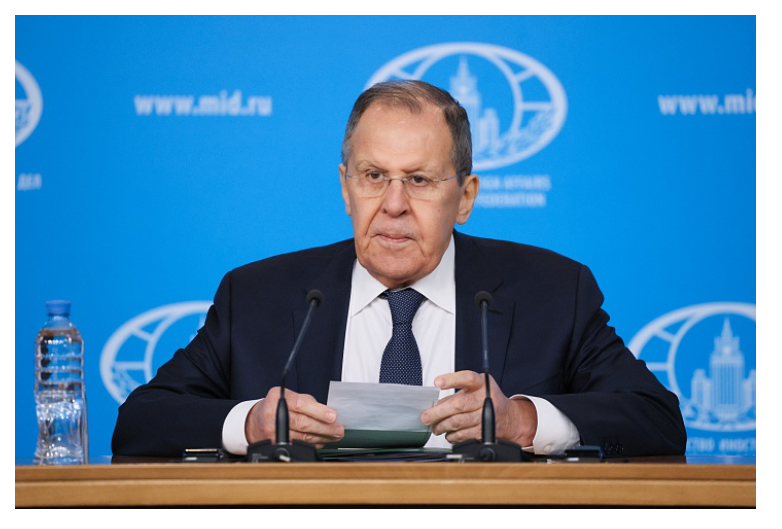
In Lavrov’s worldview, Kosovo is not a problem to be solved but a condition to be maintained—unfinished enough to preserve leverage, and stable enough to keep the West negotiating rather than closing the file.
by Mark Gojcaj | 21 January 2026
Sergey Lavrov’s annual press conference is usually treated as background noise—long, technical, and aimed inward. This one should not be.
On January 20, 2026, Russia’s foreign minister spoke for more than three hours about the state of global diplomacy. Ukraine dominated the headlines, as expected. But tucked deep inside the transcript is something that matters just as much for Southeastern Europe: a clear restatement of how Moscow still views the Balkans—and why Kosovo remains central to that view.
This was not a threat. It was not a warning shot. It was something quieter, and more durable: an explanation of how Russia believes leverage is preserved without escalation, influence maintained without ownership, and outcomes delayed without open confrontation.
Kosovo, in Lavrov’s telling, is not a crisis. It is an unresolved condition—and that is precisely its value.
Kosovo Spoken Around, Not To
Lavrov barely mentions Kosovo directly. When he does, it is never as a country.
Kosovo appears only as a requirement imposed on Serbia, a condition attached to Europe’s promises, a demand framed as humiliation rather than reconciliation.
“First recognize the independence of Kosovo,” Lavrov said, paraphrasing Brussels. “That is, you must humiliate yourself.”
The choice of words is revealing. Kosovo is not treated as a democratic polity, a post-war society, or a political reality. It is reduced to a test of Serbian dignity. Recognition is not presented as normalization, but as submission.
This framing does important work for Moscow. It allows Russia to oppose Kosovo’s independence without engaging Kosovo at all. The argument is shifted away from Pristina and onto Brussels. Kosovo becomes a symbol, not a subject.
It is not discussed because, in this logic, it does not need to be.
Why Incompletion Matters
Lavrov’s remarks make one thing clear: Russia is not pursuing reversal in the Balkans. It is pursuing delay.
There is no suggestion that Kosovo can be reintegrated into Serbia or that borders will be redrawn. The objective is simpler, and more sustainable—preventing closure.
Kosovo must remain legally contested, diplomatically incomplete, and permanently debatable. Not frozen in conflict, but suspended in ambiguity.
This fits neatly into Lavrov’s broader worldview. Throughout the press conference, he speaks of multipolarity not as shared responsibility, but as shared veto power. In his version of international order, no actor has the authority to close files unilaterally. Every settlement is provisional. Every outcome reversible.
Kosovo, in this framework, is not a problem to be solved. It is leverage to be preserved.
Serbia’s Role—and Its Own Choices
Lavrov’s treatment of Serbia is careful and paternalistic. Serbia is portrayed as rational, dignified, and under pressure—not from Moscow, but from Europe.
“I hope our Serbian friends are fully aware of where they are being dragged,” he said.
The phrasing matters. Serbia is not choosing. It is being dragged. The agent is Brussels. The cost is humiliation.
What this framing obscures is Serbia’s own agency. Belgrade has actively cultivated strategic ambiguity—keeping EU accession alive rhetorically while resisting alignment on Kosovo and Russia. President Vučić himself has described 2026 as a “pivotal year,” even as Serbia continues to balance four pillars at once.
Kosovo is the brake that makes this balancing act possible. As long as recognition is framed as humiliation rather than normalization, Serbia’s European path can be slowed without being formally abandoned.
For Moscow, this ambiguity is ideal. It requires no escalation, no troops, and no dramatic intervention. It only requires that Kosovo never be allowed to become normal.
Law as Instrument, Not Constraint
Lavrov’s legal arguments are consistent—if selectively applied.
He repeatedly invokes the UN Charter, territorial integrity, and self-determination, but always conditionally. Territorial integrity applies, he argues, only when governments “represent the entire population.” When representation fails, borders lose protection.
This logic is used to justify Crimea and Donbas, reject Kosovo’s independence, and later draw explicit parallels with Greenland. “Replace ‘people of Greenland’ with ‘people of Crimea,’” Lavrov suggested.
Kosovo’s legal status is never assessed on its own merits. It is treated as precedent—useful when it supports Moscow’s position, dismissible when it does not. UNSC Resolution 1244 is presented as untouchable, while other UN principles are treated as flexible.
What emerges is not legal chaos, but hierarchy. International law, in this view, applies fully only when it aligns with the interests of recognized great powers.
Talking to Washington, Not Brussels
Perhaps the most revealing part of Lavrov’s remarks has little to do with Kosovo itself.
Repeatedly, he emphasized that Russia sees more opportunity for engagement with the United States in the Balkans than with the European Union. Contacts exist, he said. They have not yet produced results, but both sides are open.
The EU, by contrast, is portrayed as ideological, binary, and coercive—trapped in “with us or against us” thinking.
This is a deliberate downgrade of Brussels’ relevance. Moscow is signaling that Europe is no longer the primary interlocutor on European security questions. The real conversation, Lavrov implies, should be between major powers.
That framing is self-serving—but not uncontested. The EU still holds structural leverage: enlargement conditionality, economic integration, and funding instruments that Russia cannot match. Recent diplomatic activity suggests Brussels has not stepped aside, even if its authority is increasingly challenged.
The Balkans are becoming a test case—not just for US–Russia engagement, but for whether EU leverage can still translate into closure.
Influence Without Ownership
Lavrov’s comments on Serbia’s energy sector reinforce the same theme: adaptation without retreat.
Discussing Russia’s shifting stake in Serbia’s NIS refinery, he was blunt. No deal would have gone through, he said, if it harmed Russian interests. Ownership may change; influence remains.
For Kosovo, this matters indirectly. It shows that Moscow no longer needs visible control to maintain leverage. Proxies, intermediaries, and unresolved files are enough.
Influence now flows less through assets than through persistence.
What This Means for Kosovo in 2026
Lavrov is not threatening Kosovo. He is attempting to marginalize it.
Kosovo is being repositioned as something to be discussed among others, rather than a participant with agency. Yet this narrative increasingly collides with local realities. Pristina’s post-election consolidation and institutional assertiveness challenge the idea that Kosovo can be permanently unfinished—even as unresolved issues remain.
The real risk in 2026 is not inevitable stalemate. It is the quiet acceptance of stalemate—sold as stability, defended as realism, and justified as pragmatism.
That outcome is not preordained. It depends on whether external actors are willing to move from managing ambiguity to enforcing closure.
Kosovo Dispatch Assessment
Lavrov’s January 20 press conference confirms a familiar Russian approach to the Balkans: controlled incompletion. Kosovo is valuable because it remains unresolved. Serbia is valuable because it delays choosing. The EU is portrayed as procedural and bypassable, even as it retains real leverage.
The central question raised by this transcript is not what Russia wants. That part is clear.
The question is whether the West allows stalemate to harden into acceptance—or whether it uses the tools it still has to finish the job.
In Moscow’s logic, unresolved stability is success.
Whether it becomes reality will be decided not in Moscow, but in Brussels, Washington—and the region itself—over the course of 2026.
About the Author
Mark Gojcaj writes from New York, where he examines the intersection of American conservatism and Southeast European political and security realities. He is a regular contributor to The Kosovo Dispatch’s transatlantic coverage, with a focus on U.S. foreign policy, NATO dynamics, and the Western Balkans.
