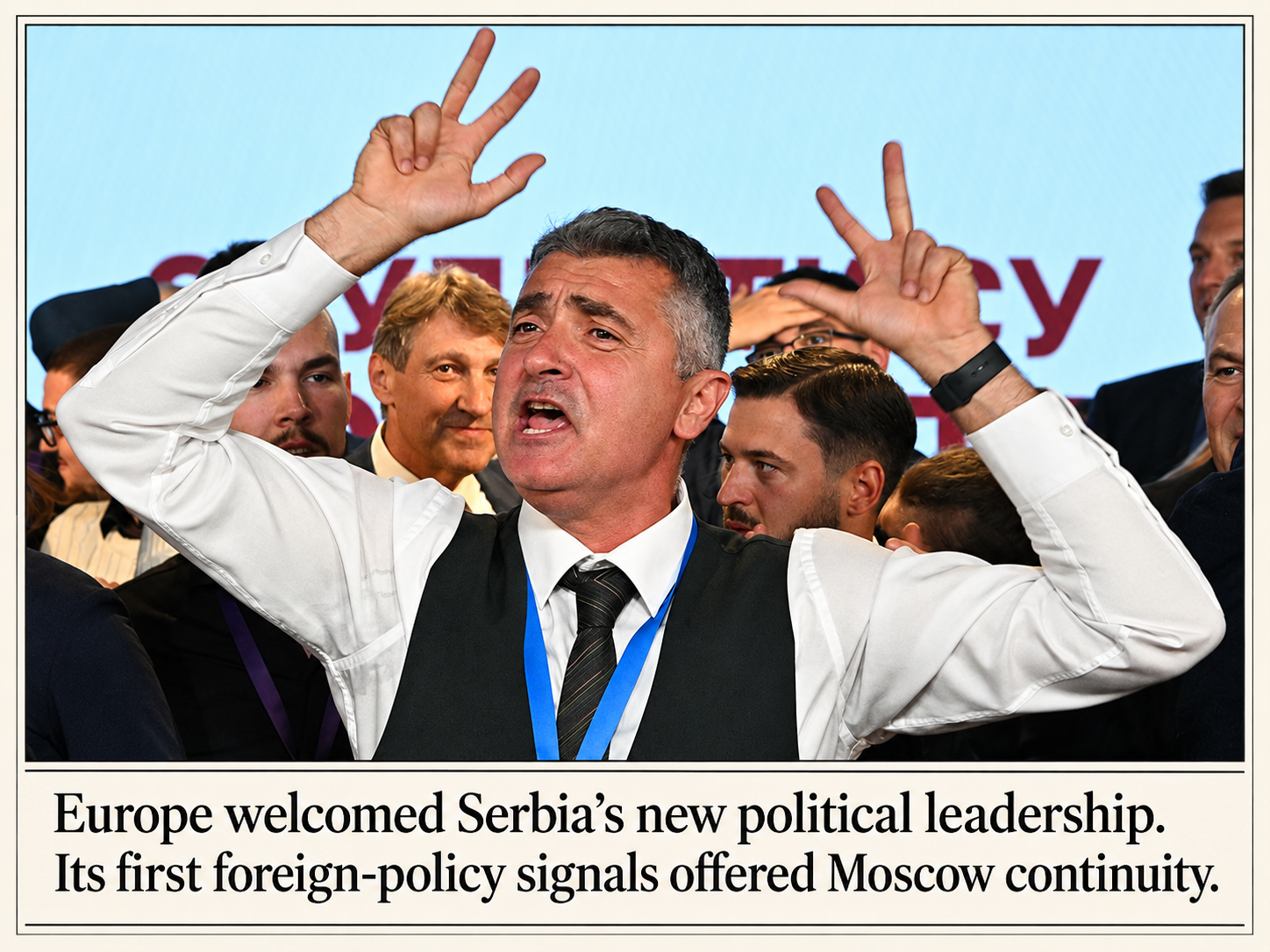
Four Western institutions courted the Student List in a day. The list answered Brussels with manners and Moscow with policy: no sanctions, thanks for the gas, no more Serbian shells for Ukraine.
By Ngadhnjim Brovina | 27 October 2026
What does Europe believe it won in Serbia on 25 October? Friedrich Merz wrote that the Student List had reached the people with its demands for rule of law, anti-corruption and fundamental freedoms, and that Germany would actively support Serbia’s European path. Ursula von der Leyen and António Costa posted jointly about record turnout and a future inside the Union. Marta Kos declared the door to the EU open, then telephoned Ilija Srdanović, who heads the list, and reported afterwards that they had discussed how important it is to build trust. Viktor Orbán telephoned as well. Four institutions and two phone calls in a day, all addressed to a change of orientation that nobody on the winning list had announced.
They had the list’s positions before the vote. Srdanović said in September that foreign policy was not a priority of the list’s plan, that it would be guided by good-neighbourly relations and respect for sovereignty, and that the final decision on EU membership would be taken by the citizens after all chapters were closed and an exhaustive public debate had been held. A referendum at the end of the road, the formula Aleksandar Vučić used for twelve years to keep the road from ending. After the vote Srdanović told the Croatian portal Index that he saw no obstacle to continuing European integration. That sentence, and the courtesy of taking Kos’s call, is everything Brussels received.
Moscow received more, on its own channel, within the same twenty-four hours. Jovo Bakić, candidate number seventy-six, told RT Balkan on 26 October that the new government would not sanction Russia, whatever Vučić had said about sanctions coming within months; Russia was a great power, a historic partner and in many cases a protector, and nothing in that would change. The list, he said, was not there to satisfy foreigners. Vladan Kuzmanović, the professor the list fielded against Ana Brnabić in the RTS debates, told the same channel that Serbia was grateful to the Russian Federation for its gas arrangement and for its cooperation over NIS, that Vučić’s policy toward Russia had been passive and, if you like, dishonest, serving his survival rather than Serbia’s interest, and that the new government would be more honest with its partners. He asked why Serbia should be a hostage to MOL’s negotiations, meaning the Hungarian buy-out of the Russian stake in NIS that would lift American sanctions from the company.
Leading candidates of the list told Reuters that a future government would halt Serbian arms exports to war zones, including sales to the Western intermediaries who forward those weapons to Ukraine. Candidates stated it; no government has yet decided it; and it remains the most consequential sentence anyone on the list has spoken. Moscow has complained since 2023 that Serbian ammunition reaches the Ukrainian front through NATO intermediaries, naming the Czech Republic, Poland and Bulgaria as the routes. Vučić denied it, promised a working group and let the shells move. He refused sanctions and kept Gazprom, but he also sold to the West and let Western brokers do what they liked with the goods. The movement that removed him proposes to keep the first half of that arrangement and end the second. If it does, Russia obtains from a democratic government the one thing it could not obtain from Vučić. Volodymyr Zelensky congratulated the list that evening and thanked Serbia for respecting Ukraine’s people, state and independence. He was thanking the country for the half its new leaders have said they will close.
The Kremlin congratulated no one. Dmitry Peskov said Moscow had taken note of the result, greatly valued Vučić’s contribution to bilateral relations and hoped he would go on contributing from opposition. Of the new force, he hoped its actions would be directed constructively toward developing relations, which were in Serbia’s own interest; Russia would do everything possible on its side, “but, as you know, it takes two to tango.” A tribute to the loser and a condition for the winner. Bakić and Kuzmanović were on Russian television the same day. Whether they were answering Peskov or speaking their own minds makes no difference in Moscow, which heard the answer either way.
Beijing asked nothing, because it needed nothing. China’s position in Serbia is not a relationship that requires reassurance; it is property. Zijin owns the Bor copper complex. HBIS owns the Smederevo steelworks. Linglong’s tyre plant stands at Zrenjanin. The Belgrade–Budapest railway runs on Chinese loans, the cities are watched by Huawei cameras, the army flies Chinese drones and shelters under Chinese air defence, a free-trade agreement has been in force since 2024, and in May Vučić came home from Xi Jinping with more than twenty new agreements and a friendship medal. A new government can decline to sign the next contract. It cannot unsign Bor. The foreign ministry’s spokesman said on Monday that China respects the independent choice of other peoples and is ready to continue cooperation and the traditional friendship, and that was all the attention the election required of him. Russia wanted political assurances and had them in a day. China wanted its assets left where they are and has no reason to think they will move.
The Union offered a future: a door, a path, trust to be built. It has not yet asked for the normalisation with Kosovo on which that future legally depends, and this publication has set out elsewhere what that silence costs. Of the three outside powers with a stake in Serbia, Russia had its commitments by nightfall, China kept its position without lifting a finger, and Brussels holds a referendum promise with no date. The congratulations were written as though the vote had moved Serbia west. The people who won it spent the next day explaining, in detail and in Russian company, that it had not.