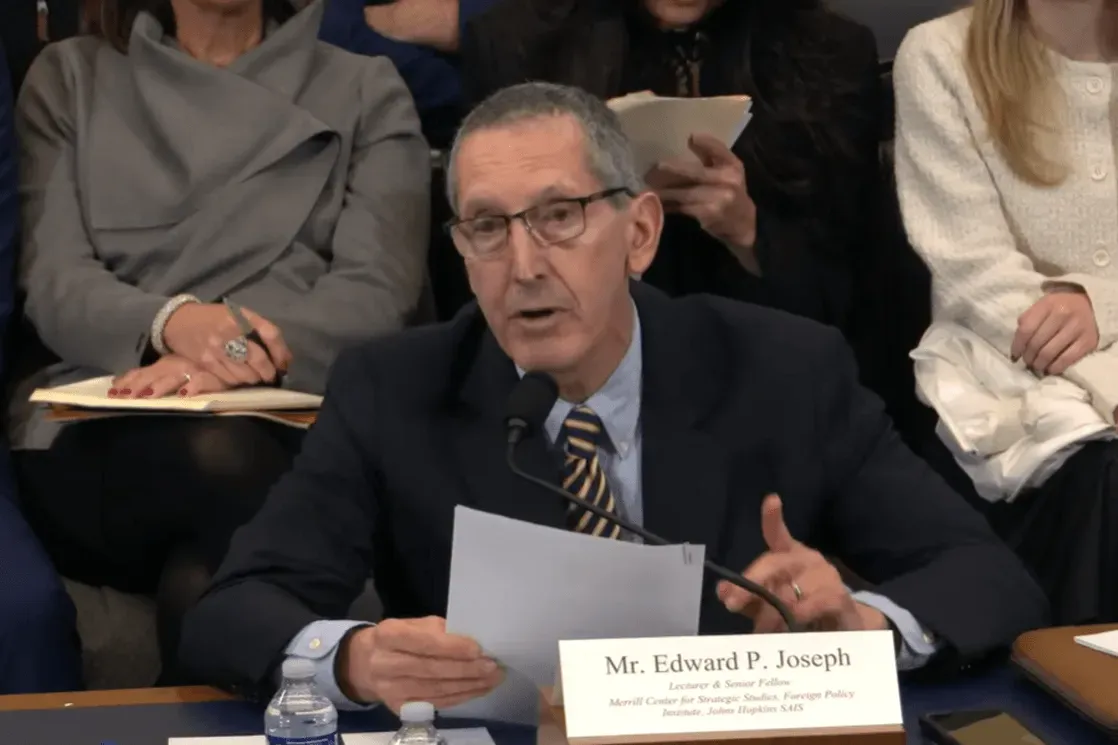
In a wide-ranging interview originally published by Portal Analitika, U.S. Balkans analyst Edward P. Joseph argues that Montenegro stands closer than ever to EU membership yet faces a paradoxical surge of internal division, malign external narratives, and symbolic provocations that make little sense unless they are deliberate, warning that accession would constitute an ideological shock to Serbian nationalism, expose the limits of Belgrade’s regional posture, and test whether Podgorica can translate formal progress into real rule-of-law reform, political cohesion, and strategic alignment with NATO at a moment when European credibility, Balkan stability, and the wider confrontation with Russia intersect more sharply than at any point since the end of the Yugoslav wars.
by Rosanda Mučalica (ANALITIKA) | 9 January 2026
The following interview with U.S. Balkans analyst Edward P. Joseph, originally published by Portal Analitika on 7 January 2026, is republished in full and in faithful English translation for readers who follow the Western Balkans’ Euro-Atlantic trajectory as a single strategic file.
Joseph’s remarks matter beyond Montenegro’s domestic debate because they link EU enlargement credibility, NATO anchoring, and malign influence narratives across the region—explicitly referencing Belgrade’s posture, identity polarization dynamics, and the wider security environment shaped by Russia’s war against Ukraine.
This republication is intended to inform, not to editorialize. The interview is presented without alterations to meaning, and attribution remains with the original publisher. Republishing does not imply endorsement of every characterization or policy recommendation; it reflects an editorial judgment that the arguments raised are relevant to diplomats, analysts, and decision-makers tracking the region’s stability and integration path.
Analitika: How do you assess Montenegro’s current prospects for near-term accession to the European Union, especially in light of your recent statement that this represents a “good opportunity” for our country?
Joseph: The answer is a classic “Tale of Two Cities.” On the one hand, Montenegro emerges from the most recent EU–Western Balkans Summit with strong support from Brussels and other European capitals. The closure of five negotiating chapters this year—twelve in total—is widely recognized as a significant achievement.
European Commissioner for Enlargement Marta Kos has openly stated that “Montenegro is the frontrunner” in the EU accession process. The European Parliament has adopted an important resolution of support. Austrian Chancellor Stocker recently told Prime Minister Spajić that “the EU must reward Montenegro.” Geopolitically speaking, thanks to Vladimir Putin, the EU has finally recognized the importance of tangible progress in Balkan enlargement—with Montenegro emerging as the most realistic new member. Brussels will even hold the next EU–Western Balkans Summit in Montenegro, in June.
Domestically, all key political actors—from President Milatović, to Parliament Speaker Mandić, to former President Đukanović—publicly support the ambitious but achievable goal of Montenegro becoming the EU’s 28th member by 2028. At the same time, there is an unusual subtext throughout the process that calls this positive rhetoric into question. Brussels appears aware of this, which is why Marta Kos emphasized that “Montenegro will need national unity to achieve its goals.” The European Commission’s progress report reflects precisely this cautious tone.
The closer a country gets to real membership, the more serious the scrutiny becomes, and reforms therefore grow politically more difficult. The rule of law and the fight against corruption require genuine commitment, not merely what is often described as formal reforms reduced to “box-ticking.” Instead of political unity, I see troubling signs of division, both in day-to-day politics and in the public sphere. This makes no sense—unless these are deliberate attempts to sabotage the European path.
All the benefits of EU membership are visible in neighboring Croatia: billions of euros from EU funds for key infrastructure projects, many of which boost tourism, increased investment, and an unemployment rate at least ten percentage points lower. With such potential benefits for Montenegro, why would anyone promote the erection of a monument in Berane to a Chetnik commander from World War II, Pavle Đurišić? According to sources, in his own writings he boasted of the “complete destruction of the Muslim population (in parts of Bosnia and Herzegovina)… regardless of gender or age.”
What would also motivate someone to spray graffiti glorifying Ratko Mladić for Srebrenica on the wall of the Embassy of Bosnia and Herzegovina? Even if you are a hardline Serbian nationalist, why would this be your priority at a moment when your country has a historic opportunity? Allow me to add, as someone who had contact with Ratko Mladić during the Bosnian war, that those fools who glorify him do not even know the basic facts. Mladić enjoyed all material advantages during the war and still failed to capture isolated, small towns such as Goražde, Žepa, and Srebrenica—even at moments when it was clear that NATO would not intervene.
For me, these recent events in Montenegro, including the shameful attacks on Turkish businesses following the alleged “incident” in October, are deeply troubling signals. It would not be surprising if they had a political background, although I must clearly state that I have no evidence for this.
Analitika: You have also stated that Russian narratives remain present in Montenegro and contribute to internal divisions. What makes Montenegro particularly vulnerable to such influence, and what are the most effective ways to counter it?
Joseph: Before discussing Montenegro’s vulnerability, it is important to highlight the strong barrier to Russian influence represented by NATO membership. Montenegro’s accession to NATO in 2017, during President Trump’s first term, is a far stronger pro-Western “plus” than anything Russia, Serbia, or others can offer as a “minus.” For the first time in its history, as one wise former senior Montenegrin official told me, Montenegro has “formally and institutionally become part of the West.”
You know this far better than I do: continuous sources of pro-Russian narratives come from Belgrade and are further reinforced through the Serbian Orthodox Church. When I am in Belgrade, I tell my interlocutors there that I struggle to recall a single Montenegrin who identifies as such and discusses politics without expressing serious concern about the malign political influence of the Serbian Orthodox Church. I encourage analysts and think tanks to document this influence through carefully researched reports.
This struggle is an integral part of internal identity divisions between those who identify as Serbs and those who identify as Montenegrins. Pro-Belgrade actors promote narratives rooted in historical, religious, and emotional patterns. When the issue of Russian connections arises, I always remind people that in Tolstoy’s masterpiece Anna Karenina, the tragic officer Vronsky vows to fight the Ottomans in Montenegro.
There is no need to list the usual ways of countering pro-Russian narratives. Instead, I offer a concrete proposal: share and discuss this recent New York Times article—based on testimonies from Russian soldiers and their families—about the horrific way Russian commanders treat their own troops.
There are many other examples that vividly illustrate what “values” guide today’s Russia. These values have nothing to do with Tolstoy or with the martial honor of a tragic figure like Vronsky. I am completely serious—for anyone who has served in the military, as I have, these credible allegations are revolting. In multiple cases, Russian maniacs demand bribes from soldiers—or else send them on deadly missions. And that is just one category of allegations.
Members of parliament, journalists, public figures, and yes, even Orthodox priests, should speak about this: if Russians treat their own soldiers this way, how do you think they treat Ukrainians? Do these modern “Putinist values” inspire pride in anyone in Montenegro who supports Russia?
Analitika: To what extent does internal political dynamics in Montenegro amplify external interference, and how important is political cohesion for the country’s Euro-Atlantic future?
Joseph: I believe the situation is reversed: external interference amplifies internal, divisive political dynamics in Montenegro. That is why the negative narratives coming from Serbia are such a problem. They are spread primarily through official, formal and informal channels, as well as through the media.
And of course, political cohesion—genuine consensus around Euro-Atlantic values—is essential. As already noted, Commissioner Marta Kos specifically emphasized how important unity will be this year in order to achieve EU accession.
Analitika: You have noted that Belgrade does not want Montenegro to join the EU. How does this affect Montenegro’s strategic orientation?
Joseph: You are referring to my testimony before the U.S. Congress on the Balkans last month. That hearing demonstrated that congressional interest in the region persists, despite the strong focus on Ukraine, the Middle East, and now Venezuela, as well as other major global issues.
I had the opportunity to pose a key question to members of the Foreign Affairs Committee: why is the Balkans still unstable 35 years after the violent breakup of Yugoslavia began? And I gave the fundamental answer: because Serbia has not accepted the Western order for the region.
Belgrade’s continued, bitter attitude toward Podgorica’s progress toward the EU reflects precisely this. After all, what kind of “Serbian world” allows Montenegro—a country close to Serbia, unlike Croatia, Bosnia and Herzegovina, or Kosovo—to enter the EU before Belgrade? NATO membership does not affect Belgrade in the same way, since Serbia is formally neutral and has no interest in joining NATO. Montenegro’s early entry into the EU would represent an ideological blow to Serbian nationalism and a political blow to the regime of Aleksandar Vučić.
Unlike in 2013, when Croatia joined the EU, Montenegro’s accession now would raise an uncomfortable question in Serbia: why has Serbia, with its dominant position and much larger economy, fallen so far behind? This is similar to the reason why Moscow was—and remains—deeply disturbed by Kyiv’s progress toward the EU: because of historical closeness, Putin cannot avoid the comparison that Russians themselves make. Likewise, Vučić cannot avoid comparison with Montenegro—so he imposes it himself.
The bitterness of this stance is evident in Vučić’s recent statement about Serbia’s stagnation in the EU accession process:
“...For four and a half years we haven’t opened a single chapter, a single cluster. Do you think Montenegro is a much more orderly state?”
Analitika: How do you interpret Vučić’s recent statement that he intends to propose to Ursula von der Leyen that the entire Western Balkans region enter the EU together? Given that Montenegro is already at the threshold of membership while Serbia lags behind—even behind Albania—does this message effectively reveal an intention to undermine Montenegro’s European path?
Joseph: This only further confirms my answer to the previous question. I immediately interpreted Vučić’s proposal that all Balkan countries enter the EU together as so unrealistic that it can only serve a domestic purpose: to convince Serbian citizens that the progress of Albania and Montenegro is exclusively the result of the injustice of the entire Brussels-led process. Vučić recently also asked: “Do you think life in Albania is much better?”
Analitika: How do you currently assess Montenegro’s position within NATO? Is it using its membership to full strategic capacity? Given that EU enlargement stagnation has opened space for Russia and China in the Western Balkans, how urgent is it for Brussels to take a stronger stance toward Montenegro and the region?
Joseph: Montenegro could play a significantly more important role within NATO, and NATO—encouraged by Podgorica—could also play a more visible role in Montenegro. As in North Macedonia, the Orthodox majority in Montenegro, combined with even stronger cultural-historical ties to Russia, gives particular weight to Montenegro’s visible alignment with NATO.
Unfortunately, the delay in sending even a small team to support NATO training for Ukrainian soldiers sends a weak message. This contrasts with the Macedonian position, which—under both SDSM governments and now VMRO—has been consistently, visibly, and unequivocally pro-Ukrainian in defending against Russian aggression. The comparison between Montenegro and North Macedonia is useful because both face attempts at identity subversion by a larger, dominant neighbor that likes to assume “we are essentially the same people.” This again recalls Russia’s patronizing and subversive attitude toward the “artificial state of Ukraine.”
What, then, explains the difference in approach between Podgorica and Skopje when it comes to NATO and Russia? The answer is obvious: very few Macedonians identify as Bulgarians, while a large number of Montenegrin citizens identify as Serbs. Precisely because of these divisions, subversive narratives, and intermediaries in Montenegro, Podgorica should further strengthen its ties with NATO. Across almost the entire political spectrum in North Macedonia, there is awareness that NATO plays a key role in internal stability. The same applies to Montenegro—and both government and opposition leaders should regularly emphasize this.
One area particularly suitable for visible cooperation between Montenegro and NATO is the Western Balkans Cyber Capacity Centre (WB3C). Given serious cyberattacks in neighboring Albania and the vulnerability of the entire region, this center plays an extremely important role. Cooperation with NATO’s Cooperative Cyber Defence Centre of Excellence in Tallinn, Estonia, could significantly increase WB3C’s visibility and impact in Podgorica.
Montenegro could also leverage its compact size and geographic position to host more military exercises with NATO members, using both its coastline and mountainous terrain. Such exercises, including those with U.S. forces, confer prestige on Montenegro and strengthen public support for Alliance membership. At the same time, they clearly differentiate Montenegro from Serbia, which squanders such opportunities while continuing senseless military cooperation with compromised partners such as Russia and Belarus.
Analitika: How much attention are the United States currently paying to Montenegro and the Western Balkans? Has Washington’s strategic interest declined, increased, or merely changed in character?
Joseph: Congressional hearings last month showed that U.S. interest in the Balkans persists. The Donald Trump administration has taken steps in Bosnia and Herzegovina, in Kosovo, and especially toward Serbia, all of which indicate continued engagement in the region. The surprising factor has been the relatively unfavorable treatment of Belgrade and President Vučić.
As I stated in Congress, Vučić is growing weaker due to months-long protests and is no longer able to deliver what he promises. I specifically noted that the “Trump Hotel” project in Belgrade has been seriously called into question. Several days after the hearing, Jared Kushner announced that his firm was withdrawing from the project. Vučić and his associates, such as Siniša Mali, were embittered by this new sign of disfavor from the Trump family.
As Vučić himself has increasingly acknowledged, he is disappointed by the indifference shown to him by Washington under Trump, despite his servile support for the U.S. president. Pressure to remove Russians from the Oil Industry of Serbia (NIS)—without extending its operating license—has pushed Vučić into a dead end with Moscow. He repeatedly mentions the January 15 deadline, while Serbia’s oil reserves continue to decline.
Supporters of Russia in Montenegro should take note of how uninterested Moscow is and how exclusively it pursues its own interests. Instead of selling NIS back to Belgrade, which it could do, Russia is dragging out the process, increasing risks for Serbia. At a time when the administration is focused on Venezuela, as well as Ukraine, Russia, the Middle East, and China, the Balkans inevitably fall lower on the priority list.
But it is wrong to say there is no interest or engagement from Washington in the region. On the contrary, it is encouraging to see the Trump administration’s interest in fully removing Russia from NIS, which I hope can evolve into a broader process of pushing Russia out of the region.
Analitika: What would be your recommendations to the new administration regarding U.S. engagement in Montenegro and the region?
Joseph: As I testified before Congress last month, the path forward for the region runs through NATO. Congress included my recent work from SAIS Review—“A Balkan Breakthrough for Ukraine”—in my written testimony. In that article, as well as in my testimony, I explain that finally compelling Belgrade to clearly articulate its Western strategic orientation through a bid for NATO membership would be a major blow to both Russia and China.
Serbia’s acceptance of NATO would deal a psychological blow to Putin, similar to the sinking of his favorite warship—the Moskva.
I also explain why Trump is the only American president who could persuade Vučić to accept NATO, largely by opening a path to NATO membership for Kosovo. Once Pristina has a clear path to NATO, Belgrade’s entire “balancing” strategy collapses. NATO is far more important to Kosovo than United Nations membership, which means Russia and China become significantly less important to Serbia.
In short, NATO for Kosovo represents “the endgame” for Serbia and forces Belgrade to finally confront the reality of its geostrategic position. As I said in Congress: “Serbia cannot become the Belarus of the Balkans.”
Analitika: Based on your experience in peace missions in the region, what similarities and key differences do you see between the current situation in the Western Balkans and the 1990s? How realistic is a unified Euro-Atlantic path for all Western Balkan countries today? Do you expect long-term geopolitical fragmentation under the influence of Russia or other external actors?
Joseph: Having worked during the 1990s in all the conflict countries of the Balkans, I regret seeing the overall regression the region has experienced since Russia’s invasion of Ukraine. As I have written and said publicly, the opposite should have happened: with Russia weaker and more isolated, and the West stronger and more united, the Balkans should have become more stable and more Western-oriented.
Instead, we are witnessing divisions, confrontations, and crises. The operation in Banjska, in northern Kosovo in September 2023—clearly carried out with extensive support from Serbia—is one key example. Another is the artificially induced crisis in Bosnia and Herzegovina initiated by Milorad Dodik.
Senior officials in the Joe Biden administration bear the greatest responsibility for this entirely unnecessary regression. They failed to grasp the opportunity and necessity for a dramatic policy shift toward Belgrade after Putin’s invasion of Ukraine. Europe found itself in a new, dramatic security environment. Instead of decisive action and demands that Vučić abandon manipulative “balancing” and choose between Russia and the EU and the U.S., experienced Biden administration officials did the opposite. They indulged Belgrade out of fear and illusion. The EU largely followed them. More than any other factor, this timidity of the Biden administration toward Belgrade is the reason the Balkans unnecessarily moved backward after February 2022.
Following the astonishing mass protests in Serbia since November 2024, I would caution observers in Montenegro against excessive cynicism. Although nationalist elements exist within the protests—as is common in mass movements—their core demand is for the restoration of state accountability to citizens and the rule of law. This is a powerful and legitimate demand that deserves support in Montenegro as well.
As for Bosnia and Herzegovina, I sincerely hope that pro-Serb leaders in Montenegro understand how humiliating it was that the National Assembly of Republika Srpska had to meekly withdraw defiant secessionist laws in October and November. Although Dodik personally benefited from the easing of sanctions, Republika Srpska appears as a unserious entity, akin to a staged judicial system—a “kangaroo court,” as it is called in the United States. If this is what the so-called “Serbian world” looks like, I do not know why any Serbian nationalist would want it.
Analitika: What concrete steps should Montenegro take to strengthen resilience against attempts at societal polarization and hybrid influence? What role do civil society, independent media, and especially young people play in protecting democratic processes and European values?
Joseph: I have a very clear example of the constructive role of youth in the Balkans through the NATO project I lead—“Seeing is Believing.” Together with SAIS students, young leaders from across the WB6 region, including Kosovo and Serbia, gathered to develop sustainable recommendations for NATO to stabilize the region. Some of the most developed recommendations came precisely from young leaders from Montenegro.
NATO invited our young leaders twice to present these recommendations in detail at NATO headquarters in Brussels, including meetings with Secretary General Mark Rutte and Deputy Secretary General Radmila Šekerinska. In addition, our young leaders participated in the NATO Youth Summit and the 2BS conference in Budva last year.
Analitika: If you had to send one key message to Montenegro’s political elites at this moment, what would it be?
Joseph: I would direct that message to Montenegro’s voters, who actually hold the key to the country’s future.
My message is this:
“You have a real—not artificial—opportunity to significantly improve how you and your children will live. This is not mere rhetoric you have heard for years; EU membership is a serious possibility and would have a serious, positive impact. You must now hold your leaders accountable. Tell them you will punish at the polls those who fail to show the leadership Montenegro needs. Make it clear that you understand political games.
Demand the rule of law and the fight against corruption—or let them bear the consequences. Be clear: you can be proud Serbs, Montenegrins, Albanians, Bosniaks, or Croats and still live better—in a Montenegro that is a member of the European Union.”
the original publication:
