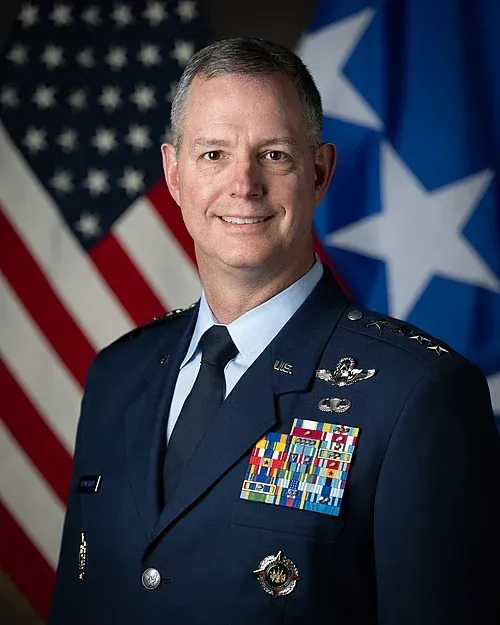
Speaking on 11 January 2026 in Sälen, Sweden, NATO’s Supreme Allied Commander Europe, General Alexus G. Grynkewich, outlined the Alliance’s assessment of growing strategic coordination among Russia, China, Iran, and North Korea, warned of escalating hybrid and Arctic-based challenges, and emphasized the centrality of deterrence, readiness, and industrial capacity for NATO’s security — themes with direct relevance for Europe’s periphery and for states whose stability depends on the credibility of the transatlantic alliance.
by Mark Gojcaj | 11 Januar 2026
The address is significant for The Kosovo Dispatch because it speaks directly to the strategic environment that shapes Kosovo’s security, sovereignty, and Euro-Atlantic future. As a country whose stability rests on NATO’s deterrence posture, transatlantic cohesion, and the credibility of collective defense, Kosovo is directly affected by the assessments and priorities articulated by NATO’s highest military commander in Europe.
General Grynkewich’s remarks place the Western Balkans within a broader strategic picture: a Europe facing coordinated pressure from Russia, China, Iran, and North Korea, intensified hybrid threats, and a renewed focus on the Alliance’s northern and eastern flanks. His emphasis on deterrence, readiness, defense-industrial capacity, and alliance unity provides essential context for understanding NATO’s long-term posture in regions where security remains contested and political pressure persists.
The publication of these remarks also matters at a moment when questions about NATO’s future direction, U.S. leadership, and Alliance cohesion are increasingly present in European public debate. For Kosovo — a country outside NATO but dependent on its presence and guarantees — clarity from NATO’s operational leadership is not abstract. It is foundational.
This document is published in full and without substantive alteration to preserve accuracy and provide readers with direct access to NATO’s current military assessment, as articulated on 11 January 2026, by the Alliance’s Supreme Allied Commander Europe.
_________________________________
Opening Remarks
When I look around the globe, Russia, China, Iran, North Korea, and others are increasing their collaboration and cooperation as their interests align against us. We see this clearly in Ukraine.
While President Trump pushes for a peaceful resolution to a horrible war, China continues to fund Putin’s war machine. Iran continues to supply technology and weapons, and North Korean combat troops remain in Russia, on Ukraine’s border. There is also a confluence between Russia, Iran, and Venezuela and their so-called dark fleet of oil tankers, which is helping to fund the war.
In the Arctic, in the High North, we see a similar trend. Russian and Chinese vessels are conducting more and more joint patrols. Chinese icebreakers and research vessels are operating in Arctic waters—and their research is not for peaceful purposes. It is to gain a military advantage.
Russia, meanwhile, continues testing advanced capabilities in the Barents Sea. As new shipping routes emerge and new resources are discovered, the Arctic only grows in strategic importance. All of this comes amid an increasing hybrid threat: airspace violations, GPS and GNSS interference, and shadow-fleet activity in the Baltic Sea threatening critical underwater infrastructure.
In short, the Arctic—and Northern Europe by extension—has become a frontline for strategic competition.
Within NATO Allied Command Operations, the command I oversee as SACEUR, we have taken steps to strengthen our deterrence posture, much of it oriented toward the northern region.
Just over a year ago, we established Baltic Sentry, an activity designed to protect critical underwater infrastructure. This past fall, we developed Eastern Sentry to increase our agility and further integrate air and missile defenses on the eastern flank. More recently—just in the past month—we realigned the boundaries of our joint commands. Joint Force Command Norfolk now brings together NATO’s activities in the Arctic under one command, allowing us to better defend all Allies in Europe, the Arctic, and the strategic approaches to North America.
Allies are also working closely together on Arctic issues. At a recent Arctic Chiefs of Defence conference, we agreed to improve our understanding of activity in the region, enhance domain awareness, and increase our own operations and exercises in the High North. Military cooperation in this region has never been stronger.
Looking ahead, we intend to expand our intelligence, surveillance, and reconnaissance capabilities; improve infrastructure and logistics for military mobility; and strengthen our presence with Arctic-capable forces—many of them here in Sweden.
With seven of the eight Arctic nations now inside the Alliance—the other being Russia—we can and we will get this right.
Sweden’s Role in NATO
As our newest Ally, Sweden is instrumental. Two years into membership, you have already demonstrated exceptional commitment.
You are the framework nation for forward land forces in Finland. You are filling key staff roles throughout my command, including critical positions at Joint Force Command Norfolk and within our training and assistance command for Ukraine. You have contributed capabilities to NATO operations and vigilance activities across the entire European continent.
Sweden is also a model for societal resilience and among the Alliance’s strongest supporters of Ukraine through the Prioritized Ukraine Requirements List and other mechanisms. In short, Sweden is setting an example for all of us.
Strengthening deterrence requires resources—significant resources. The defense investment pledge at the Hague Summit in 2025 was historic, but money alone is not a deterrent. We need equipment, weapons, and munitions to show up in Allied inventories.
This is where Sweden truly stands apart. You have an exceptionally strong defense industrial base. As governments remove barriers to working with industry, Sweden is showing how this can be done. As you build transatlantic, pan-European, and global partnerships, and as you pursue co-production and co-development, you are demonstrating what success looks like.
I recently heard the phrase “Made with Sweden,” rather than “Made in Sweden.” That mindset matters. A rising tide lifts all boats.
Everything I see here—collaboration, modernization, defense investment, industrial strength—suggests that someone gave you a checklist for being a model Ally, and you decided to check every box.
It is a privilege to be here with you today, and I look forward to your questions.
Questions and Answers
Question: Is there an immediate threat to NATO territory right now?
Grynkewich:
I do not believe there is an immediate threat to NATO territory. There are a couple of reasons for that. First, Russia is deeply committed in Ukraine. The vast majority of its forces and its war economy are dedicated to that effort. That is one of the reasons we owe so much to Ukraine—they are standing on the front lines of European defense.
Second, Russia understands the power of the Alliance. NATO has deterred conventional attack for 76 years and will continue to do so. Russia knows it cannot afford to take us on.
Question: We’ve seen activity from Chinese and Russian vessels close to NATO territory. Should this be seen as an immediate threat?
Grynkewich:
It will grow into more of a threat over time. As ice recedes and access increases, we see Russia and China working together. Chinese vessels have patrolled with Russia not only along Russia’s northern coast, but also north of Alaska and near Canada.
They are not studying seals and polar bears. They are conducting bathymetric surveys—trying to understand how to counter NATO capabilities on and under the sea. That activity could grow very quickly, and we need to be ready for it.
Question: Has recent rhetoric from President Trump changed U.S. priorities within NATO?
Grynkewich:
I won’t comment on political rhetoric. That is not my role as a military officer. What I will note is the readouts from the North Atlantic Council, where all 32 permanent representatives meet to discuss difficult issues. Those discussions continue in Brussels, and by all accounts they are healthy.
What matters most is that Allies who have worked together for decades continue to talk openly and work through challenges together.
Question: You have been in this role for about six months. Have your priorities changed?
Grynkewich:
It has been a fantastic six months—one of the best jobs on the planet. My priorities have remained consistent.
First, taking care of our people. The men and women our nations contribute to NATO are the foundation of everything we do. Yesterday, I visited Swedish Marines—among the most impressive young service members I have encountered in nearly 33 years of service. You should be proud of them.
Second, warfighting readiness. The Alliance is ready to fight tonight, but we must continue to sharpen that readiness every day—at headquarters level and at unit level. Readiness is how we sustain deterrence.
Question: Given the enormous demand for military equipment, can industry deliver in time?
Grynkewich:
It is a significant challenge. For the first time in NATO, money is not the main problem—capacity is. Funding is a prerequisite to signal industry to invest in production, but capacity must follow.
Sweden is a strong example of how to build a defense industrial base that works across Europe, across the Atlantic, and with partners such as Japan and South Korea. Resilient supply chains and cooperative production benefit all of us.
Question: NATO capability targets operate on long cycles. How do you reconcile that with the pace of innovation shown in Ukraine?
Grynkewich:
Ukraine shows us that adaptability itself must be a capability. We need programs that can evolve, modify, and innovate over time.
Capability targets operate on four-year cycles, but nations have flexibility in how they meet them. A mechanized brigade in 2026 does not look like one in 2016 or 2006. Technology, composition, and doctrine must evolve—and NATO will work with Allies to ensure they do.
Editorial note:
For Kosovo, where NATO’s presence is not a strategic abstraction but a daily guarantee of security and political space, the assessments of the Alliance’s Supreme Allied Commander are not commentary on distant fronts — they are signals of the environment in which Kosovo exists.
General Alexus G. Grynkewich is NATO’s Supreme Allied Commander Europe (SACEUR) and Commander of U.S. European Command. These remarks were delivered at the Folk och Försvar National Conference in Sälen, Sweden, 11 January 2026.
