Kosovo is overwhelmingly Muslim. On Wednesday morning it elected its first Catholic president. In a day of furious bargaining, her religion was the one thing nobody put on the table.
The Editorial Board | 7 October 2026
Kosovo spent Tuesday bargaining over almost everything except the thing that, in much of the world, would have been the story.
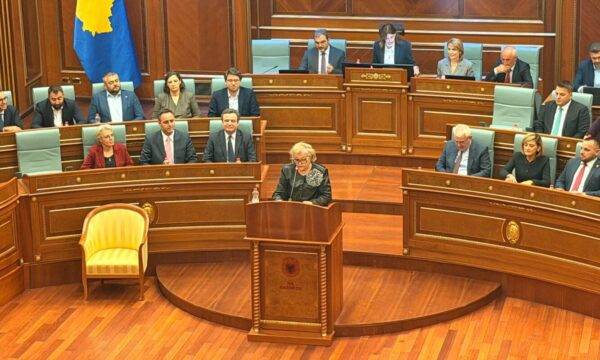
Shortly after midnight, the Assembly elected Justina Shiroka-Pula President of the Republic with 81 votes. She took the oath before the deputies minutes later. She is the third woman to become Kosovo's head of state and the first Catholic.
Kosovo's 2024 census recorded 93.49 percent of the population as Muslim and 1.75 percent as Catholic.
Tuesday's fight was about other things. Prime Minister Albin Kurti put four names on the table between mid-afternoon and late evening. Bedri Hamza, who leads the opposition PDK, turned the earlier ones down in front of the cameras: one was a party man, another belonged to the governing party whether or not she carried its card. PDK wanted the amendments to the Specialist Chambers law passed first, and got them. Deputies raced a deadline set by the Constitutional Court. When Kurti named Shiroka-Pula, Hamza accepted her within the hour.
Her faith never came up. Nobody offered it as a qualification or held it against her, and nobody asked for anything in exchange.
Article 8 of the Constitution reads: "The Republic of Kosovo is a secular state and is neutral in matters of religious beliefs." On Wednesday morning an overwhelmingly Muslim country woke up with a Catholic woman as its president because enough of its elected representatives had agreed on her.
Albanians have never fitted inside one religion. Muslims, Catholics and Orthodox share a language, a national memory and a political culture older than the borders drawn around them. Mother Teresa, an Albanian Catholic, has a cathedral in her name in the centre of Pristina. The new president comes from the same tradition.
She was born in Pristina in 1953, the eldest of three daughters. Her father, Simon Shiroka, came out of the old filigree workshops of Prizren, the third generation of his family in the craft, and became one of Kosovo's distinguished artists. His daughter chose economics. She taught at the University of Pristina from 1978, served as minister of energy and mining from 2008 to 2011, sat in parliament for PDK, and last December became the first woman to lead the Academy of Sciences and Arts. When Kurti put her name forward on Tuesday night without calling her first, she told a reporter she had guests from Sarajevo and needed a little time.
The deal that produced her was political, as deals in parliaments are. A democracy is measured partly by what its politicians do not need to bargain over. In Pristina they did not need to bargain over whether a Catholic could represent a Muslim-majority country.
Kosovo's direction has been as steady as its politics are loud. It applied for European Union membership in December 2022 and is still waiting for an answer. NATO soldiers have been on its soil since 1999, and it wants to be in the alliance. Last month it formally joined the stabilization force for Gaza built on President Trump's peace plan, where its officers had been working under an American general since spring.
Washington and Brussels spend a great deal of effort looking for Muslim-majority societies that are secular, democratic and on their side. One of them elected Justina Shiroka-Pula on Wednesday morning, and nobody asked her religion.