A week after Berlin and Brussels congratulated Serbia’s new majority on its European principles, the first EU head of government to describe the election night said he had seen none.
By Ardit Rada | 4 November 2026
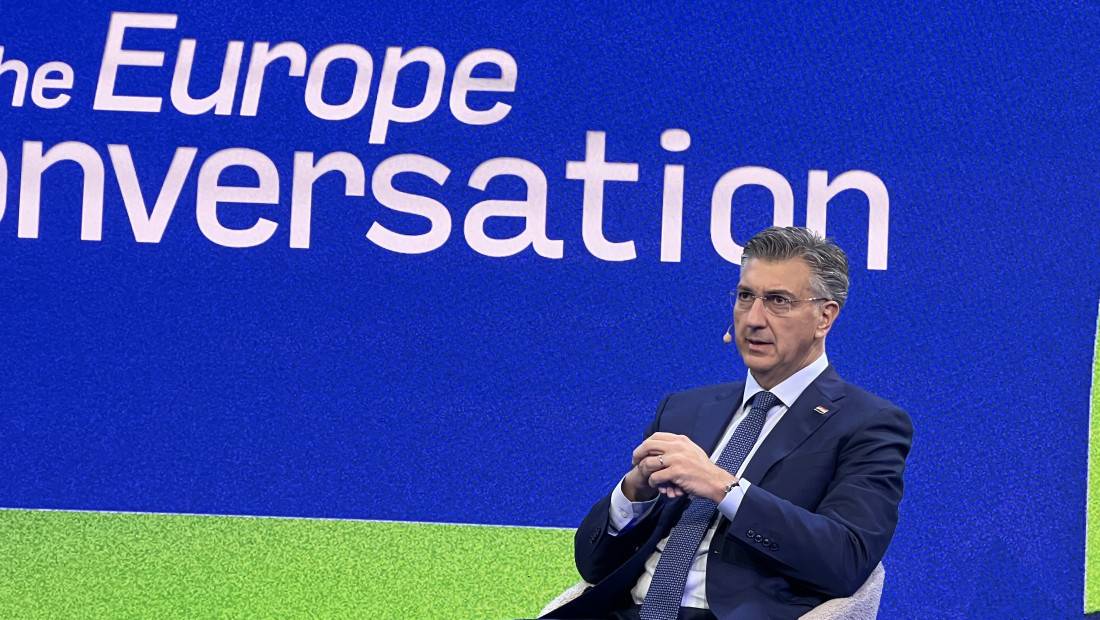
Euronews put the question to Andrej Plenković on Tuesday in Brussels, at its enlargement conference, nine days after the Student List won Serbia. Did he see Serbia on the road to the European Union?
He did not answer with a congratulation. “We do not know exactly what the Student List’s positions are. Their positions on European questions are, let us put it this way, complex.” The list had said little in the campaign, which he called tactically understandable. Then the sentence every Serbian outlet carried by evening: “At the victory celebration there was not a single European flag. Not one. So this was not something that could be described or understood as a very strong pro-European movement.”
Nine days earlier the same Union had read the same night differently. On 26 October Friedrich Merz wrote that the list had reached people with its commitment to the rule of law, the fight against corruption and basic freedoms, and placed it on the European path. Ursula von der Leyen and António Costa, Marta Kos, the German ambassador in Belgrade with her “truly European principles”, the CDU’s Balkans rapporteur with his “greatness” for Vučić’s concession: the vocabulary was fixed within hours. On the morning of the day Plenković spoke, Péter Magyar had the Hungarian parliament on its feet applauding the students.
One leader described what was on the screen. The others described what they hoped was on it.
The footage of the Belgrade celebration on the night of 25 October shows a square full of Serbian tricolours and student banners. The flag of the Union the list is supposedly marching toward does not appear in it. Merz needed the list’s slogans to reach his conclusion. Peter Beyer needed Michael Martens’s reading of the programme in the FAZ before he could endorse it. Plenković needed a television.
The programme the list ran on was read in Frankfurt as full of nationalism, and read in Moscow by Konstantin Malofeyev as a national, Orthodox, patriotic victory. On its first day the list’s spokesmen told RT Balkan there would be no sanctions on Russia and no change in the Chinese arrangements. All of it was public before the congratulations went out.
Belgrade will answer Plenković with Croatia’s own account. RT Balkan filed his remarks next to a piece on Zagreb’s demands over the 1990s, so that a Croatian observation about a flag reads as a Croatian condition on a government. Zagreb’s bill to Belgrade is long and specific. The flag test is open to anyone who watched the night, and in Berlin and Brussels nobody applied it.
Plenković was not immune. On 26 October he too telephoned Ilija Srdanović, congratulated him, and said he expected better relations. The cautious reading took him a week. In the Commission it has not arrived.
The next government in Belgrade will be asked to normalise relations with Kosovo, and Kosovo will be asked to meet it halfway, by a Commission that on 26 October found nothing complex about the list’s European positions. An EPP prime minister has now said the opposite at the Commission’s own event, and the Commission has left the two readings standing side by side.
Plenković gave the list a rule on Tuesday: when you take responsibility, you explain what you stand for. The list has not yet done so. Neither has the Commission that congratulated it before asking.