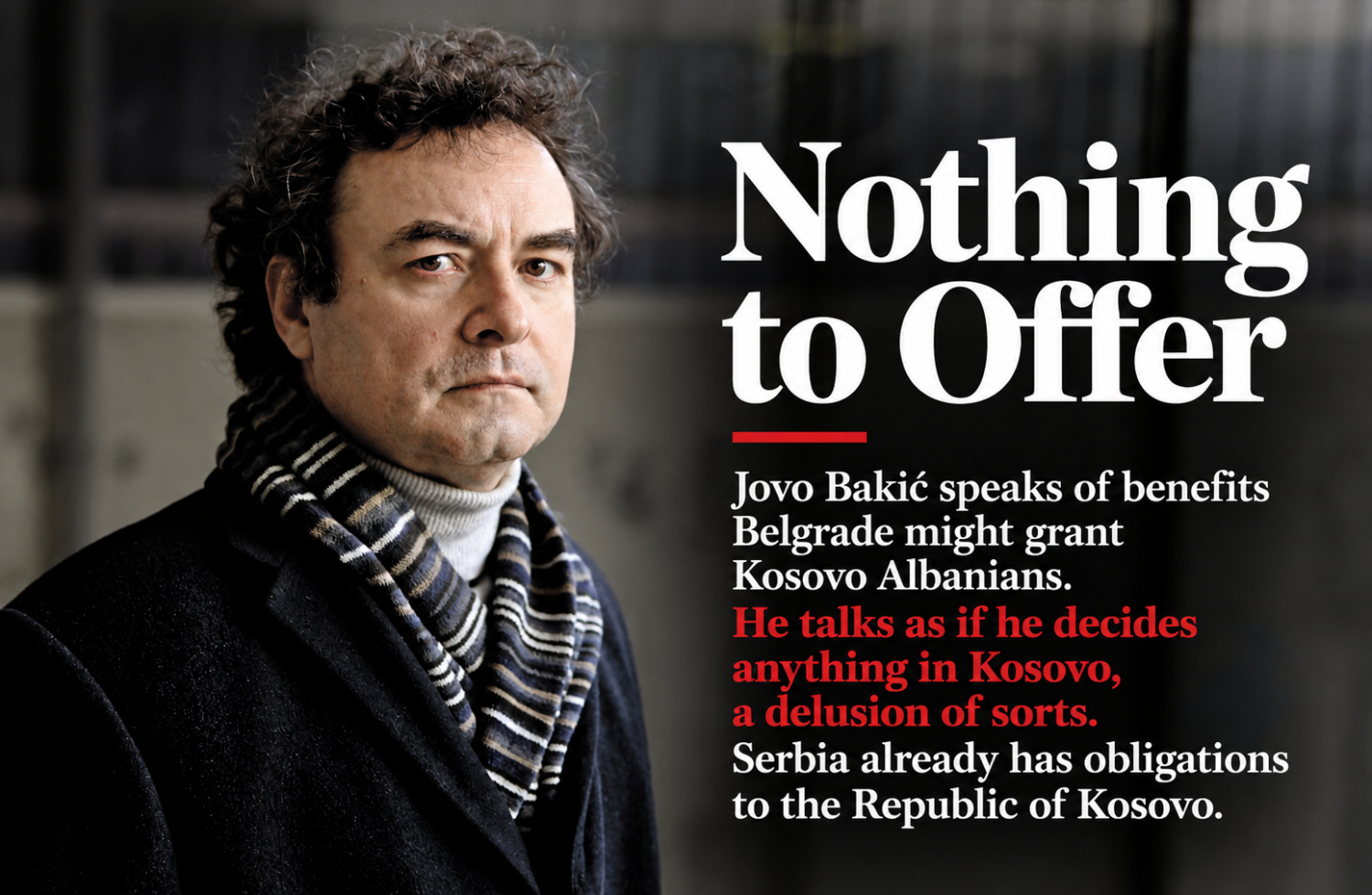
Serbia is not being asked to recognise Kosovo. It is being asked to honour commitments it accepted in 2023. Jovo Bakić’s “offer” to the Albanians is the Student List’s way of declining both.
By Ngadhnjim Brovina | 29 October 2026
Jovo Bakić teaches sociology at the Faculty of Philosophy in Belgrade, stood on the Student List on Sunday and would like to be Serbia’s next interior minister. On Wednesday he set out the list’s Kosovo policy for Vijesti.
Asked why Serbia cannot meet the EU’s condition on Kosovo, he answered: “Our Constitution says otherwise, and we committed to the people of Serbia that we would respect the Constitution from the first letter to the last. We offer the Albanians of Kosovo and Metohija an agreement for the benefit of all citizens who live there, but if that entails international recognition, there will be none of that” (Nudimo dogovor Albancima s Kosova i Metohije na dobrobit svih građana koji tamo žive, ali ako to podrazumijeva međunarodno priznanje, toga biti neće).
Asked what the agreement contains: “It may entail an easing of life for all citizens there. We are interested, of course, primarily in the Serbs, but the Albanians from Kosmet too may have some benefits if we agree so. But that in no way means international recognition. And that is the line we cannot cross” (Mi smo zainteresovani, naravno, prvenstveno za Srbe, ali i Albanci s Kosmeta mogu imati neke pogodnosti ako se tako dogovorimo).
The premise of both answers is that the European Union is forcing Serbia to recognise Kosovo. The accession file does not. The condition Serbia carries in it is the Agreement on the Path to Normalisation, reached in Brussels on 27 February 2023, with its Implementation Annex agreed in Ohrid on 18 March. Nowhere in either text is Serbia asked to recognise Kosovo’s independence. What Serbia accepted is specific: recognition of Kosovo’s documents and national symbols, passports, diplomas, licence plates and customs stamps included; no Serbian objection to Kosovo’s membership in any international organisation; the exchange of permanent missions; implementation of all earlier dialogue agreements; and no obstruction of the other side’s European path. The annex binds both parties to carry out every article in good faith and ties compliance to their EU processes, which is where the obligations now sit, in Serbia’s Chapter 35 and in Kosovo’s Special Group on Normalisation. On Wednesday, the day Bakić’s interview appeared, the European Union said in a sentence that those obligations remain unchanged. Individual European politicians may ask Belgrade for more; the file asks for this.
So the line Bakić says he cannot cross is a line the file does not ask him to cross. What he is actually setting aside is the list above, and he sets it aside by proposing a new arrangement in place of the one Serbia accepted. Ilija Srdanović, first on the Student List, said on Tuesday that every agreement reached in Brussels can be reviewed for conformity with the Serbian Constitution. The programme on the list’s website goes further and promises to prosecute the officials who concluded “unconstitutional agreements to the detriment of Serbia”, a sentence Michael Martens, reading the programme for the FAZ, places squarely under the 2023 agreement. Bakić on Wednesday restated the opening position of 2011, as if nothing had been agreed since. The “offer” to the Albanians is the device for not saying the words 27 February.
Nudimo, we offer. Dogovorimo, if we agree. Pogodnosti, benefits, the word for what an employer grants. The counterparty in the sentence is an ethnic group on a province, “Albanians from Kosmet”, and the content is whatever Belgrade decides they may have. The Republic of Kosovo, the party to the 2023 agreement, with its Assembly, government and courts, does not appear, because in the grammar of the answer it does not exist. This is the vocabulary of 1989 delivered in the tone of a seminar. Martens, in Tuesday’s FAZ, found the same habit on every page of the programme: a text written as though a Belgrade government could do as it pleases anywhere in Kosovo, and a claim to decision-making power there that, in his words, could be realised only through a war. Bakić’s first interview confirmed the reading.
Chapters 23 and 24, he said, Serbia will fulfil quickly. Chapter 35, “as formulated and even more as it is often interpreted, may not be possible”. And if the EU tells Serbia to decide for itself, by referendum, the list will put EU membership to a vote after six months to a year of debate: “Whatever the people want, that is what will be” (Šta god narod želi, to će biti). The congratulations from Brussels on election night and from Berlin the morning after were addressed to a list that, by Wednesday, had said the Kosovo chapter may not be met and the membership question may be handed back to the voters.
Earlier in the same interview, speaking of Montenegro and Bosnia, Bakić promised: “No state will be threatened by Serbia in the future. None” (Nijedna država neće biti ugrožena od Srbije u budućnosti. Nijedna). The pledge covers every state he recognises as one. Kosovo is outside it by construction.
Professor Bakić has nothing to offer because nothing is his to give, and nothing that happens in Kosovo waits on his agreement. Kosovo’s documents, symbols, institutions and army exist whether he recognises them or not. The only decision in his hands is whether Serbia honours the commitments it accepted, and that is the one he has answered. Kosovo and Serbia already have an agreement on the path to normalisation. Do your part.
Ngadhnjim Brovina teaches political science at UBT in Prishtina and writes on enlargement, conditionality and the institutional politics of the Western Balkans.