What Albania’s Defence Minister said about Kosovo, and what it means: a survival condition for any government in Tirana, one army if it comes to that, and an arms industry whose first test is a weapon that does not fail in Kosovo’s hands against a potential invasion by Serbia
Kosovo Dispatch Newsroom | 1 November 2026
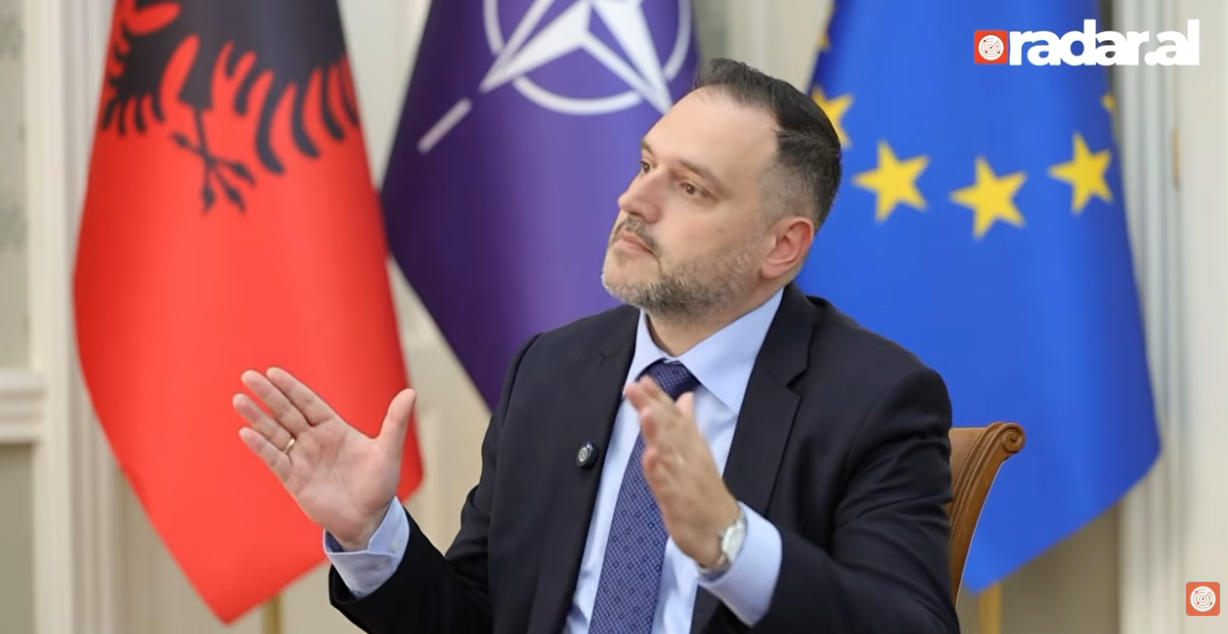
No government in Tirana could survive without giving itself one hundred per cent to the defence of Kosovo, Albania’s Defence Minister Ermal Nufi said on Sunday, and the weapons Albania intends to produce are chosen with one test in mind: when an Albanian soldier picks one up, or Albania hands one to Kosovo facing Serbia, it does not fail.
Nufi was speaking in the first edition of Hard Talk on the Radar.al media platform. The question put to him was the one Pristina lives with: Kosovo faces an existential risk, people there go to sleep and wake up with the idea of a surprise attack, Banjska in 2023 showed it is not a fairy tale, and Tirana does not seem to understand it. In practical terms, how committed is Albania?
“I believe one hundred per cent,” Nufi said. “I believe that not only this government, but no government in Tirana could stand if it did not give itself one hundred per cent to the defence of Kosovo.”
Pressed on the help rather than the sentiment, since the sentiment was there in 1999 too and what Kosovo needs is not open doors and refugee camps, he was asked whether Albania is ready to function with Kosovo as a single army. Even if there were no Kosovo and no Albania, Nufi said, there would be Albanians. The exchange between the Republic of Kosovo and the Republic of Albania, between Albanians on both sides of the border, is now such that there is no longer any discussion about the relationship between the two, “regardless of who is in power”. On a surprise attack: “Whoever wants to try it, here we will be, and we will see the result.”
The two eras cannot be compared, he said. In 1999 Albania was poor and weak, and Kosovo’s reality was what it was. Today Kosovo is a republic with its own institutions and its own difficulties, recognised by most of the world and all but a handful of states in Europe, with the United States as its main partner and the main European states behind it. He does not believe anyone still doubts the integrity of Kosovo as a republic, as territory, as a state. The fears people carry there are real, he said, and so is the new reality in the Balkans.
Asked whether Albania carries, beyond its NATO obligations, a particular obligation towards the United States for regional security and towards Kosovo, Nufi described the United States as the principal ally inside the Alliance and Albania’s commitment to it as absolute. Albania has just sent a helicopter to Kosovo, a step he placed in the NATO framework at a moment when American troops and assets in Europe may be reorganised towards other theatres. Kosovo, with KFOR on its soil, is the one neighbour of Albania that is not a NATO member and the one where the Alliance is fully present; asked whether Albania is prepared for a wider war in Europe, that presence was the first thing he named.
Kosovo was also the reason he gave for the arms industry Albania is trying to build, and for the term that has been used against it. In his statement to Parliament on 24 April he said the ministry’s commercial partners would produce weapons under current, “combat proven” patents. The phrase, he said, was pulled out of context to feed an audio recording and two months of trafficking accusations against a country that, by his own account, does not yet produce a single cartridge. What the term means in the trade is a weapon someone has used in a war, corrected after what failed, so that it does not fail in the hands of an Albanian soldier, “or when Albania hands it to Kosovo, facing Serbia”. Depots across the Alliance have been emptied into Ukraine, and what takes the eastern bloc three or four months to replace takes NATO procedures eighteen to twenty months. In a conflict, he said, that is fatal, and it is the argument for an Albanian production base that Kosovo can draw on.
The ammunition lines ordered in 2025 have not yet run. Until they do, the one hundred per cent is a promise, and Pristina will measure it the way it measures everything from Tirana, by what arrives.