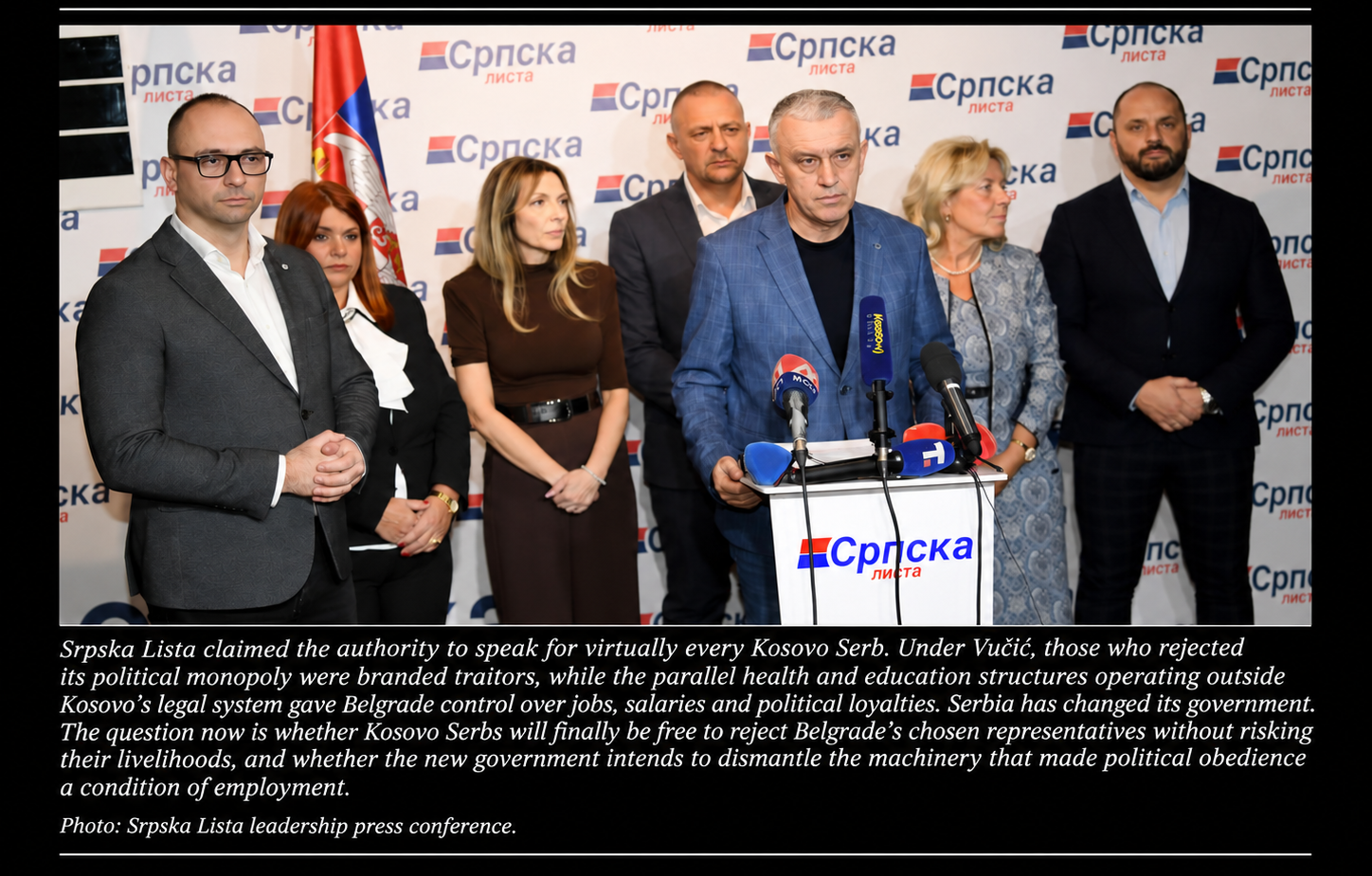
Belgrade was always entitled to aspire to one Serb list in Kosovo. It was never entitled to call everyone outside it a traitor. The new government has a week-old statement from Srpska Lista showing the habit outlived Vučić.
By Ngadhnjim Brovina | 1 November 2026
On Sunday night, a week after he lost, Aleksandar Vučić went on TV Pink and spoke about the Serbs of Kosovo. “There is great concern among our people,” he said. He hoped the winners “will understand their position”. He asked the new government to keep decent relations with the leadership of Republika Srpska. He did not say the words Srpska Lista.
Srpska Lista had spoken two days earlier, on Friday, after a silence that outlasted every journalist’s deadline. Its expanded presidency “took note” of the result. It described itself as the party of “more than 90 per cent of Serbs”. It asked that jobs, salaries and “all other forms of financial support to our people from the budget of the Republic of Serbia” be “in no way called into question”. And it called on “all political actors” in Kosovo to “immediately stop spreading disinformation” that “undermines trust in Serbian institutions”. It did not say who had won. The branch filed its invoice with the new owner and put the other Serbs on notice in the same paragraph.
The people now forming a government in Belgrade are about to decide whether to inherit Srpska Lista’s problem. It is worth saying plainly what the problem was.
It was never that Belgrade wanted Kosovo’s Serbs in one list. Minorities do this everywhere. The Albanians of the Presevo Valley go into Serbian elections on one list. The Albanians of Montenegro do the same. A small community pooling its votes to clear a threshold and speak with one voice is ordinary politics. If that were all Srpska Lista was, Kosovo would have no complaint.
The problem was what happened to the Serbs who did not want to join.
Under Vučić, a Kosovo Serb who stood outside Srpska Lista was not a rival. He was a traitor. The vocabulary was set from the top and repeated for twelve years. At the closing rally before the 2021 local elections, Goran Rakić told the crowd in Mitrovica that the other Serb candidates were “šibicari”, card sharps, “who want to sell all of us, our history and our state”. Zlatan Elek said Srpska Lista was “de facto the only Serb option”, because the others “registered as Serb parties, but they are not, and they have proved it”. Petar Petković, the man who signs the money, called the one Serb minister in Kosovo’s government “Kurti’s servant”. Nenad Rašić, Aleksandar Arsenijević, Rada Trajković, Oliver Ivanović while he lived: every one of them was placed outside the nation by the people who ran the nation’s budget in Kosovo. And on Friday, with Vučić gone five days, the Serbs who said out loud what everyone could see became, in Srpska Lista’s words, spreaders of disinformation who “create space for the authorities in Pristina”. The label survived the patron.
The budget was the point. The hospitals and schools Serbia pays for inside Kosovo are parallel institutions: outside Kosovo’s law, outside Kosovo’s inspectors, staffed and paid from Belgrade and run by Srpska Lista’s officials. Their employees are citizens of two states. In Kosovo they elect Srpska Lista. In Serbia, where more than a hundred thousand of them are on the roll, they vote by crossing into Raška, Vranje, Tutin or Kuršumlija, the only places Belgrade can open a ballot box for them. Four days before the Serbian vote, employees of those institutions told Radio Free Europe that their directors had ordered them whom to vote for in it, that they would travel to the polling station in organised groups, that “nobody dares say no, because everyone knows what follows otherwise”. ODIHR’s observers, reporting on the campaign across Serbia, recorded the same instruments: pressure to sign support lists, to collect “safe votes”, threats to employment. One employer, two ballots, and a label for anyone who objected. It is also why the first thing the party asked of the new Belgrade was that the money keep coming.
Vučić fought every attempt to bring those institutions into Kosovo’s system, and not because they served Serbs better outside it. A nurse paid by Pristina cannot be sacked from Belgrade for voting the wrong way. A teacher on Kosovo’s payroll does not travel to Raška in a bus organised by her director. Integration would have cost him the one instrument that made Srpska Lista’s “more than 90 per cent” possible. Jugoslav Gašić, the Student List’s man from Kosovo, now says registration in Kosovo’s system would be acceptable but “kosovarisation” would not. That is the same instrument held a little more politely. Registered or not, as long as the salary comes from the Office for Kosovo and the director is a party man, the leverage is intact.
The internationals knew this. They heard Rašić, Trajković and Arsenijević; they met them, they read their complaints. And they sat with Srpska Lista as “the representatives of the Serb community” for twelve years anyway, knowing how the community was represented. They called for its inclusion in every government and every dialogue. The other voices were not missing. They were heard and set aside, and that is the complicity: Brussels chose one voice knowing there were others, and helped Belgrade make the others cost something.
Belgrade has changed hands. Does the method change with it?
Gašić says Srpska Lista was “the SNS’s contractor” and that his list wants “no contact and no cooperation with them”. Fine. In the same breath he said the Student List “is not negotiating with any political organisation or group of citizens” in Kosovo. None. Not Rašić, who backed the students from the start. Not the councillors in Leposavić who did the same. Another candidate, Vladan Kuzmanović, said the new government “will first help them live with dignity”. Belgrade decides, Kosovo Serbs receive.
If the Student List takes Srpska Lista under its wing, cleans out Elek and installs its own man, the problem for Kosovo is identical. If it builds a new list from scratch, on Vučić’s script, with Belgrade’s payroll behind it and a traitor’s label ready for anyone who stays out, the problem is identical. If it keeps the parallel institutions as they are and only changes who signs the payslips, the problem is identical. Gašić replacing Elek with the same modus operandi is Elek.
The test is not whether Belgrade has one list. It is whether a Kosovo Serb can stand outside the list and keep his job, his reputation and his place in the nation. Under Vučić the answer was no, and the parallel institutions were the reason it was no. Srpska Lista’s statement on Friday, demanding that their financing “not be called into question”, says the answer is still no.
There is one way to make it yes. Serbia can keep paying for Kosovo Serbs’ health and education; nobody is asking it to stop. But the money should go into institutions that answer to Kosovo’s law, where a director cannot order a vote and a nurse cannot be punished for one. That is what integration means and that is why Vučić refused it. The new government in Belgrade, and the internationals who indulged the old one for twelve years, should stop defending the arrangement he built. The question to put to them, before the government forms, is not how many lists. It is who pays the Serb who says no, and whether he can be fired for it.
Ngadhnjim Brovina teaches political science at UBT in Prishtina and writes on enlargement, conditionality and the institutional politics of the Western Balkans.