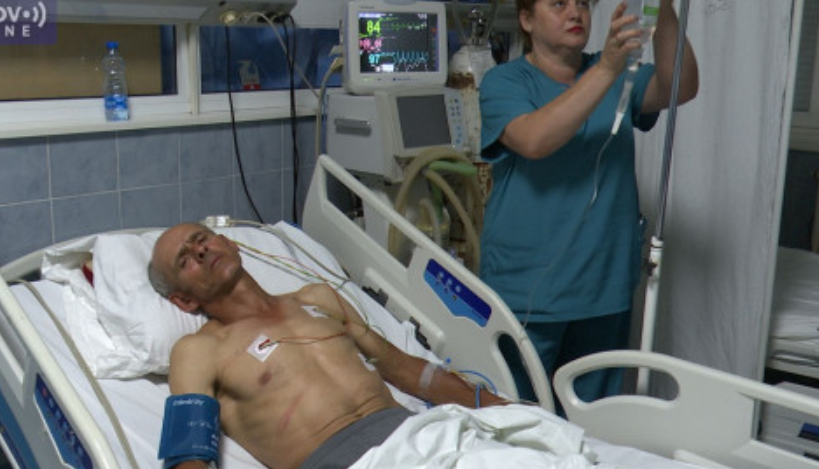
A man from Dren is in intensive care and says Kosovo's police put him there. I do not know yet whether that is true. I know what must happen next.
by Albatros Rexhaj | 12 August 2026
On Tuesday evening a 57-year-old man named Nenad Rašković was admitted to the hospital in North Mitrovica with injuries to his head, his back and his chest. The photographs are severe. From his hospital bed he told Radio Kontakt Plus that three police officers came to his house in Dren, in the municipality of Zubin Potok, demanding a weapon. "They asked for a rifle. I have no rifle," he said. He says one of them beat him in his own house, that he was handcuffed, taken into the forest, tied to a beech tree, gagged and beaten with a length of hose. He says they asked him about Momir Jakšić, one of the men detained in the Kaludra war crimes case. "I don't know Momir Jakšić," he says he answered.
These are allegations. A man's testimony, however vivid, is not proof, and I have spent enough years on this terrain to know that first accounts shift. Rašković's own telling already differs in material respects from the statement Srpska Lista issued in his name, and the hospital treating him is directed by the president of that same party. Kosovo Police say they have no information that any of their officers beat anyone. I note that position. I do not treat it as an answer.
Because the allegation itself is of the gravest kind a democratic state can face: that men wearing its uniform tortured a citizen. There is no version of Kosovo worth defending in which that sentence, if true, goes unanswered. The Police Inspectorate took Rašković's statement in his hospital room within hours and holds the case under Law 03/L-231. Good. Now it must go wherever the evidence goes, publish what it finds, and accept no ceiling on responsibility. The full truth, with zero obscurity. One outcome is acceptable, and it is not a verdict I presume. It is the truth, whole, in public. And I expect Minister Sveçla to say so himself, plainly and soon. He was quick to thank the police when the digging at Kalludra vindicated them; the same voice is owed now, committing his ministry to an unobstructed investigation of its own officers. Silence from that office would be a position too.
I have argued for years that Kosovo answers accusations with process where Belgrade answers with vocabulary. That claim is now on trial, on the least convenient facts available, and I would rather lose the argument than watch it be proven by exemption. A state exhuming the victims of a concealed crime cannot conceal anything itself. The dead of Kalludra e Vogël are owed an investigation no one can impeach, and an officer who beats a bound man in a forest hands Belgrade the impeachment for free. If Rašković's account holds, I expect prosecution with the full force of the law, up every rung of command it reaches, and a sentence the entire police service remembers.
And if the evidence disproves his account, or parts of it, that evidence must be published with the same completeness, and the record corrected without embarrassment. A false allegation is not yet a manufactured one. Manufacture is a third finding, and it too must be earned. But if the investigation establishes it, that the account was staged and scripted for political effect, the finding will be the gravest of all. The method is not new. In 1985 a farmer from Gjilan was turned into the founding exhibit of a propaganda decade, and the ground prepared then was spent on wars. The director of Belgrade's Kosovo Office had this case captioned as Kurti's "democracy" the same evening it broke; the rest of the apparatus followed by morning. Whoever manufactured it, if anyone did, was preparing ground, and everyone in this region knows what that ground is for.
The Inspectorate holds the statement, the medical file and the burden. Let it follow the evidence to whichever ending is true, and let no one stand in the corridor.
Albatros Rexhaj is an author, playwright, and analyst with a background in national-security studies and nearly three decades of experience in political and security affairs.
