Belgrade-funded schools in Kosovo are often presented as a humanitarian necessity for the Serbian community. Yet a closer examination shows that the issue is not access to education, but the persistence of a parallel administrative system maintained by Serbia inside Kosovo’s territory.
by Fatos Kabashi | 4 March 2026
By the standards of Balkan political messaging, the argument appears straightforward.
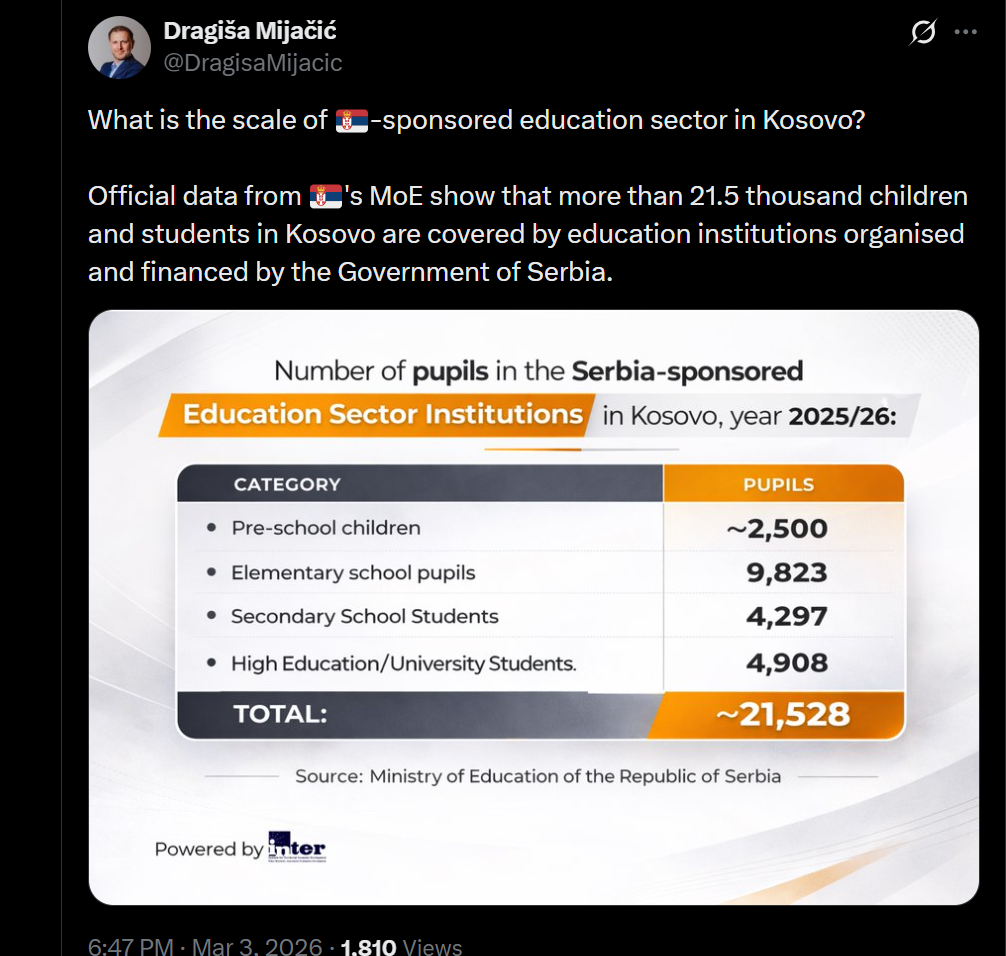
More than 21,500 children and students in Kosovo, Serbian policy advocate Dragiša Mijačić wrote recently, depend on education institutions “organized and financed by the Government of Serbia.” Closing those institutions, he warned, would endanger the Serbian community and risk destabilizing the Western Balkans.
The numbers he cited—drawn from Serbia’s Ministry of Education—appear compelling: roughly 2,500 preschool children, 9,823 elementary school pupils, 4,297 secondary students, and 4,908 university students, amounting to about 21,528 individuals enrolled in institutions funded and administered by Belgrade.
At first glance, the implication is clear. If those institutions disappear, thousands of children will be left without schools.
Yet the argument rests on a misleading premise.
The dispute over Serbia-funded schools in Kosovo is not primarily about access to education. It is about sovereignty, parallel governance, and the unfinished institutional normalization envisioned in the EU-mediated dialogue between Belgrade and Pristina.
A School System Operating Outside Kosovo’s State
The institutions cited in Mijačić’s argument do not function within Kosovo’s legal framework.
Teachers are paid directly from Serbia’s state budget.
Curricula are approved by Serbia’s Ministry of Education.
Diplomas are issued through Serbian academic institutions.
Administratively and financially, these schools form part of Serbia’s public education system operating inside Kosovo’s territory.
In practice, this means that Serbia maintains an entire segment of its state administration within another sovereign country.
Such arrangements are highly unusual in Europe. Minority-language education systems—from Hungarian schools in Romania to German schools in Italy’s South Tyrol—operate within the legal authority of the state in which they exist.
What exists in Kosovo is fundamentally different. It is not simply a network of linguistic or cultural institutions. It is a parallel administrative structure maintained by a neighboring government.
Minority Education Rights Are Already Guaranteed
Kosovo’s constitutional order—developed under the Ahtisaari Plan and supported by Western governments—provides some of the strongest minority protections in Europe.
These protections include:
- education in minority languages, including Serbian
- official nationwide status for the Serbian language
- extensive competencies for Serb-majority municipalities
- constitutional guarantees for cultural and educational autonomy
Serb-language schools already operate across Kosovo within its public education system.
The debate therefore does not concern whether Serbian children can receive education in their language. That right is already protected by law.
The real issue is institutional authority: whether those schools operate within Kosovo’s constitutional framework or remain under the direct administration of the Serbian state.
When Numbers Reveal the Real Story
Ironically, the figures cited by Mijačić illustrate precisely why the issue has become politically contentious.
If more than 21,000 students and thousands of teachers and staff are financed directly by Belgrade, the data reveal the scale of Serbia’s parallel institutional presence in Kosovo.
These institutions do more than provide education. They also sustain a network of public-sector employment and administrative authority linked to the Serbian state.
In this sense, the numbers do not merely describe an education system.
They describe the continued operation of a foreign state’s public administration within Kosovo’s territory.
Brussels Agreements and Unfinished Integration
The appeal to the Brussels Dialogue—frequently invoked in arguments defending these institutions—also carries an important contradiction.
The EU-mediated 2013 Brussels Agreement was designed precisely to dismantle Serbia’s parallel administrative structures in Kosovo and integrate them into Kosovo’s institutional framework.
That process has already occurred in several sectors.
Kosovo’s police and judicial institutions were once run through parallel Serbian structures before being integrated under the Brussels framework.
Education and healthcare remain among the last sectors where parallel administrative systems continue to operate outside Kosovo’s institutional authority.
For many European diplomats involved in the dialogue process, the long-term objective has never been the indefinite coexistence of two competing state systems on the same territory.
The goal has always been institutional integration within a single constitutional order.
The Stability Argument
Mijačić also warns that the fate of approximately 100,000 Serbs in Kosovo will determine the stability of the Western Balkans.
But presenting education institutions as a geopolitical fault line risks obscuring the central policy question.
Minority rights frameworks across Europe protect language, culture, and access to education. They do not typically permit neighboring governments to administer public institutions inside another country’s territory.
The real issue, therefore, is not whether Serbian communities should have access to education in their language—an internationally recognized right.
The question is whether another state should continue exercising elements of public authority inside Kosovo nearly two decades after the war.
Integration or Permanent Parallelism
The policy choice confronting Kosovo and Serbia is increasingly clear.
One model would allow Serbia’s parallel institutions to continue operating indefinitely within Kosovo’s territory.
The other would preserve Serbian-language education while integrating those institutions into Kosovo’s constitutional and administrative framework—similar to minority education arrangements elsewhere in Europe.
Nearly two decades after the war, the debate is no longer about whether Serbian children in Kosovo can attend school in their own language.
That right is already guaranteed.
The real question is whether the normalization process between Belgrade and Pristina will finally replace parallel authority with a single constitutional order—or whether fragments of one state will continue to operate inside another.