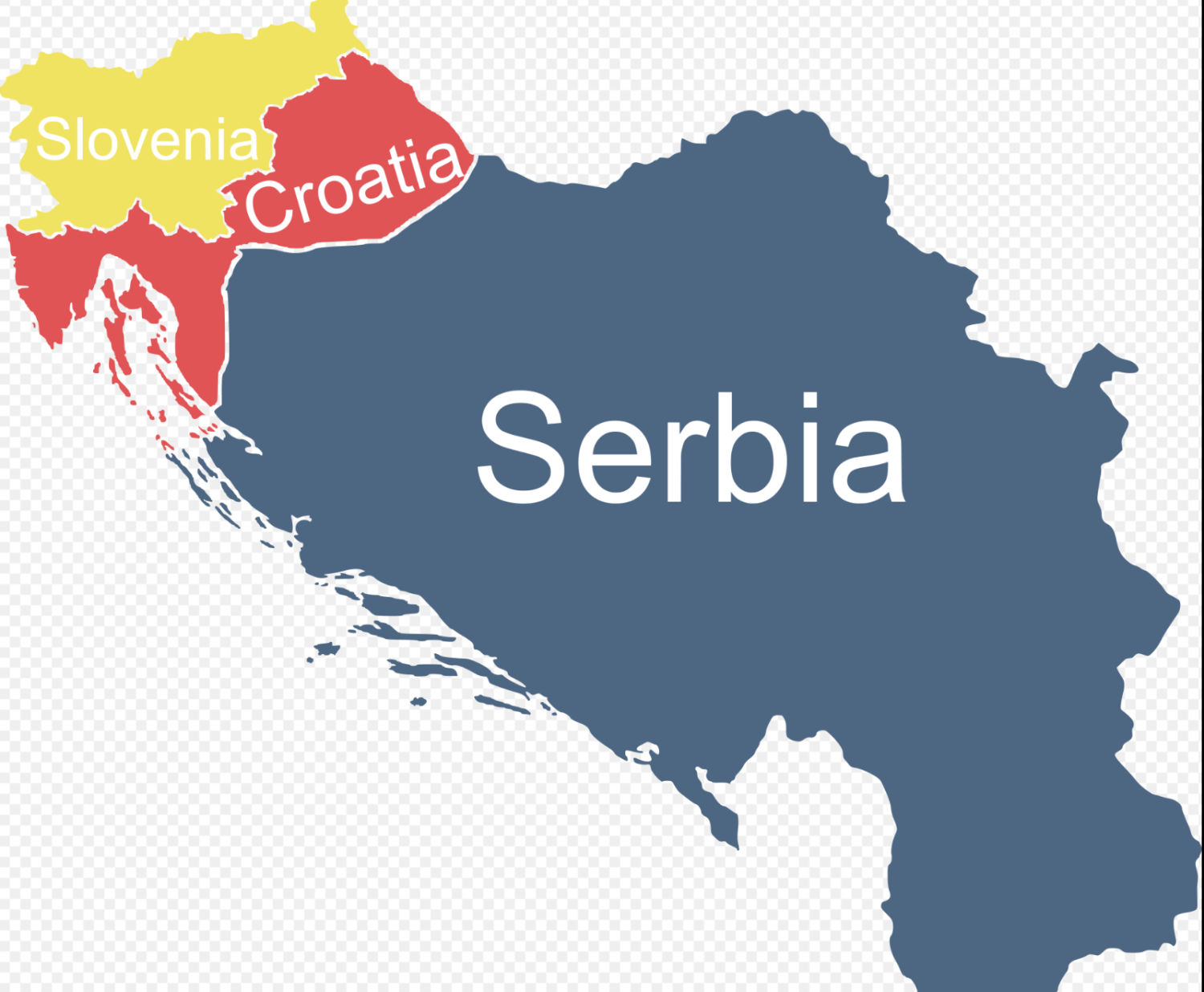
A Serbian professor’s remarks about Kosovo are not an isolated provocation. They are part of a structured narrative — political, academic, and digital — that treats reversal not as a risk, but as an expectation.
By Mark Gojcaj | 22 March 2026
On March 18, a clip of Professor Čedomir Antić of the University of Belgrade circulated widely on Serbian-language X. In it, the full professor of history addressed Kosovo Albanians — using the derogatory term “Šiptari” — with the following counsel: learn Serbian, obtain Serbian passports. You will need them. Things will turn around.
This is the kind of statement that gets dismissed as bluster, filed under “nationalist rhetoric,” and forgotten by the next news cycle. That dismissal is not caution. It is misclassification.
Antić is not a fringe agitator. He is a tenured academic at Serbia’s most prestigious university, president of the Napredni klub think tank, a former Democratic Party spokesperson, and a frequent presence on mainstream Serbian television. When he speaks of Kosovo’s reversal as an inevitability, he is not speculating. He is articulating a doctrine — one that treats the political settlement of 2008 not as a fact to be managed, but as an error to be corrected.
And he is not speaking alone.
The clip entered a rhetorical environment already structured for it. By mid-March, President Aleksandar Vučić had publicly declared — in RTS interviews amplified across Serbian-language platforms — that Croatia, Albania, and Kosovo had formed a military alignment aimed at Serbia. “They are waiting for a favorable moment,” he told viewers. “We are preparing for their attack.”
This was not received as a warning. It was received as confirmation.
In that context, Antić’s intervention does not read as deviation. It reads as calibration — a shift from alarm to prescription. If conflict is inevitable, then preparation must begin. If reversal is coming, then adaptation becomes rational.
The informal layer follows the same logic with less restraint. Accounts circulating Antić’s exact phrasing — “Naučite srpski i uzmite srpske pasoše — trebaće vam” — frame it not as opinion, but as future policy. Population charts are paired with tractor imagery. The caption recurs with minor variation: “The time of free tenancy is expiring.”
This is not noise. It is alignment.
What emerges is not a mood but a vertically integrated narrative system:
- the state defines threat,
- the academy supplies historical legitimacy,
- the digital sphere expresses the operational meaning.
Together, they form a coherent grammar: Kosovo’s statehood is provisional; its population is conditional; reversal is not only possible, but expected.
That grammar has a name. It is revanchism — not in its crude, mobilized form, but in its preparatory phase, where expectation is normalized before action is required.
The standard Western response is to treat this as ambient rhetoric: regrettable, monitored, not actionable. That response rests on a category error.
What is being produced in Belgrade is not episodic nationalism. It is expectation management at scale. It conditions a domestic audience to view reversal as legitimate, prepares the informational terrain for escalation, and signals to external actors that Serbia’s strategic horizon remains unchanged.
The costs of ignoring this are cumulative.
For Kosovo Albanians, the message is not delivered once. It is delivered continuously, across institutions: your sovereignty is temporary, your documents provisional, your presence contingent. The register changes — academic, political, anonymous — but the content does not. Over time, repetition converts assertion into atmosphere.
For Western policymakers invested in the Belgrade–Pristina dialogue, the implications are more serious than acknowledged. A negotiation in which one side’s mainstream intellectual and political class openly anticipates — and, in parts, welcomes — the reversal of the other side’s statehood is not a stabilization process. It is a managed asymmetry.
The framework does not fail because of what it says. It fails because of what it tolerates.
There is a second category error embedded in the Western posture: the assumption that rhetoric can be isolated from policy as long as formal commitments remain intact.
History does not support that distinction. In the Balkans, as elsewhere, political outcomes are preceded by periods in which language shifts first — where the unacceptable becomes discussable, the discussable becomes normal, and the normal becomes expected. By the time policy aligns with rhetoric, the decisive work has already been done.
Antić’s advice belongs to that sequence.
It does not instruct action. It prepares acceptance.
Serbia has been a formal candidate for European Union membership since 2012. Accession is not only a technical process. It is a normative one. It requires alignment not just of laws, but of expectations — including what a country’s intellectual class presents as legitimate futures.
A tenured professor advising a neighboring population to prepare for the disappearance of its state does not fall within the margins of academic freedom. It sits within the boundaries of political signaling. And in this case, the signal is consistent with, not contrary to, the broader direction of discourse.
The Croatian–Albanian–Kosovo defense cooperation agreement has accelerated that discourse by providing a concrete external reference point. But the underlying doctrine predates it. The belief that 2008 is reversible is not reactive. It is structural.
A policy framework that treats this as ambient rhetoric is not managing risk. It is underwriting it. The European Union’s accession process is built on the premise that candidate states align not only their laws, but their strategic expectations, with the Union’s political order. A public discourse that normalizes the reversal of a neighbor’s sovereignty is not a deviation from that standard. It is a breach of it. If that breach carries no consequence — diplomatic, political, or institutional — then the conditionality framework itself becomes declarative rather than operative. And when conditionality becomes declarative, it stops shaping behavior.
Systems built on that premise do not stabilize. They resolve.
Mark Gojcaj writes from New York on American conservatism and Southeast European political and security realities. He is a regular contributor to the Kosovo Dispatch's transatlantic coverage.
