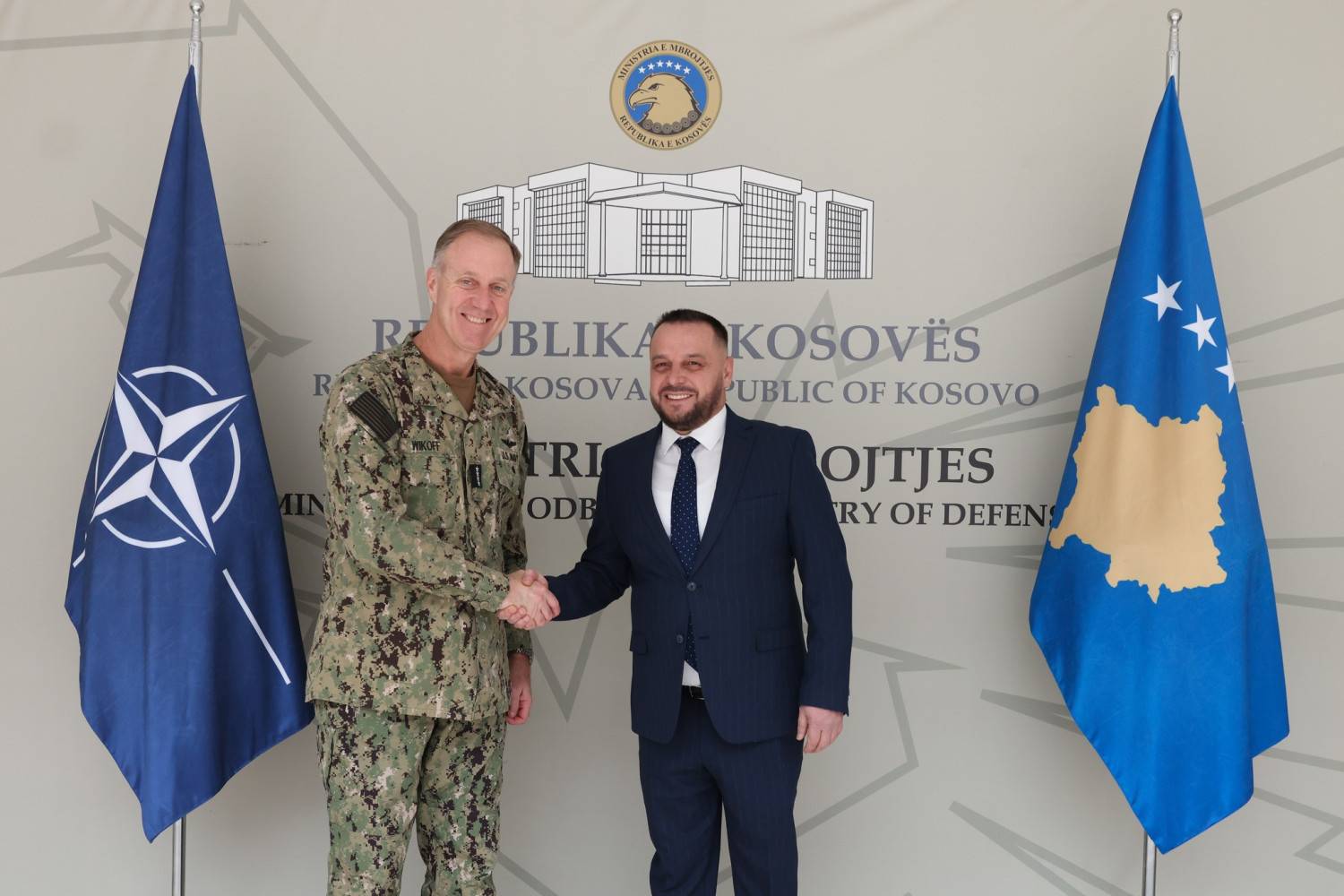
Two senior U.S. military visits to Kosovo within days underscore Washington’s sustained security focus on the Western Balkans at the outset of President Donald Trump’s second term.
by the Kosovo Dispatch | 13 Januar 2026
The most recent visit came from Admiral George M. Wikoff, the Trump-appointed commander of U.S. Naval Forces Europe and NATO’s Allied Joint Force Command Naples, who traveled to Kosovo shortly after assuming command. Wikoff’s early engagement included meetings on 12 and 13 January with President Vjosa Osmani, Acting Prime Minister Albin Kurti, Acting Minister of Defense Ejup Maqedonci, and KFOR Commander Major General Özkan Ulutaş.
According to official readouts, discussions focused on the security situation in Kosovo and the wider region, NATO’s role in maintaining peace and stability, and the continued development of Kosovo’s security institutions. Kosovo’s leaders used the meetings to reaffirm their commitment to close coordination with NATO and the United States, while emphasizing Kosovo’s strategic objective of eventual NATO membership.
In her meeting with Admiral Wikoff, President Osmani congratulated him on assuming command of one of NATO’s most strategically significant headquarters and expressed confidence in his leadership. She reiterated Kosovo’s gratitude to NATO and the United States for their decisive role in guaranteeing peace and security since 1999, highlighting KFOR’s role as a credible deterrent force and a guarantor of stability for all citizens. Osmani also raised concerns over what she described as destabilizing actions by Serbia, citing the lack of accountability for the attack on KFOR troops, the Banjska terrorist attack, and the kinetic attack on the Ibër-Lepenc canal. She warned that these actions pose serious risks to regional stability.
Acting Prime Minister Kurti, who met Admiral Wikoff on 12 January in their first official meeting since the admiral took office, framed Kosovo as a NATO success story — from intervention and liberation to state-building and economic development. Kurti underlined Kosovo’s aspiration for full NATO membership, calling it “the best answer for lasting peace, long-term stability, and security in the region,” and stressed that Kosovo’s security begins with the protection of its borders. He also briefed Wikoff on institutional efforts to combat organized crime, strengthen the rule of law, and increase investment in the defense sector.
On 13 January, Acting Defense Minister Ejup Maqedonci met Admiral Wikoff together with KFOR Commander Ulutaş. The Ministry of Defense said the talks addressed the current security environment, cooperation with KFOR, and the development of the Kosovo Security Force (KSF). Maqedonci emphasized Kosovo’s commitment to strengthening KSF capacities through officer education and training in line with Western standards, as well as through modernization supported by NATO member states. These efforts, he said, are aimed at improving citizen security and advancing Kosovo’s Euro-Atlantic trajectory.
While the meetings carried formal diplomatic messaging, the timing and level of engagement are notable. Early post-appointment visits by NATO and U.S. commanders are typically reserved for operationally sensitive theaters. Coming just days after another visit by a very senior U.S. military official, Wikoff’s presence reinforces the message that Kosovo remains an active security concern for Washington and NATO — not a residual post-conflict mission, but a standing element of Alliance deterrence on its southeastern flank.
Wikoff’s visit also aligns with a deeper, largely quiet architecture of U.S.–Kosovo military cooperation that has developed steadily over the past decade. As The Kosovo Dispatch has previously reported, this cooperation extends beyond high-level meetings to sustained training pipelines, advisory support, professional military education, and institutional linkages between the KSF and U.S. and NATO structures. These mechanisms rarely generate headlines, but they form the backbone of Kosovo’s gradual military professionalization and its alignment with Western standards — giving command-level engagement operational substance rather than symbolic value.
As NATO adapts to an era of renewed great-power competition and the Trump administration signals a security-first approach to foreign policy, the message emerging from these visits is one of continuity and reassurance. U.S. military commitment to Kosovo remains embedded within NATO’s southern command structure, reinforced through presence, planning, and long-term institutional integration rather than public theatrics.
