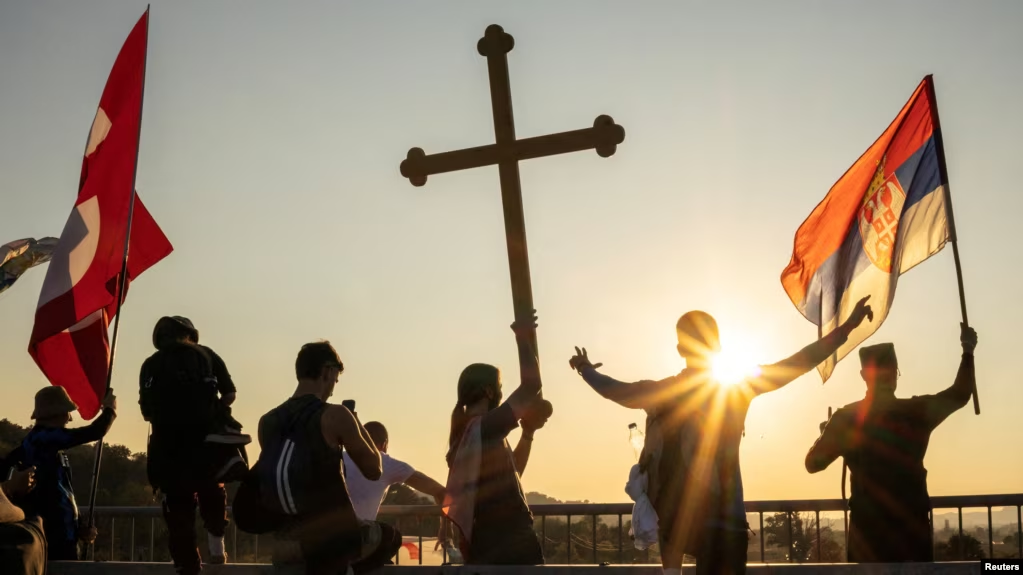
The students who defeated Aleksandar Vučić promise democracy at home while defending his claims over Kosovo, rejecting sanctions on Russia and deepening ties with China. Their foreign-policy programme threatens to reproduce the very nationalism they were elected to replace.
By Michael Martens (FAZ) | 27 October 2026
Celebrations in Belgrade on 26 October 2026. dpa
It is still unclear how the Serbian student movement will govern. Its foreign-policy platform, however, bodes nothing good for the Balkans.
In the Serbian parliamentary election, which drove the long-serving president Aleksandar Vučić from power and may even have rung in his political end, the issues were, first, second and third, domestic ones. Foreign policy played no role in the campaign, at least not for the victorious “Student List” and its voters. Yet foreign-policy questions will very soon come crashing down on a new Serbian government. And what is known of the student movement’s foreign-policy programme bodes nothing good for the region. On central questions, that programme follows on seamlessly from the Serbian nationalism of Vučić and his ousted Serbian Progressive Party (SNS). It is a backward-looking document. Any attempt to realise it would inevitably stoke conflict in the region.
That the students do not recognise Kosovo’s independence is no surprise. That position is written into the preamble of the Serbian constitution itself. But the student movement goes further: it appears unwilling even to take note of Kosovo’s statehood as a fact. Its programme reads as though a Belgrade government could do as it pleases anywhere in Kosovo.
For Serbia’s students, Kosovo is a “so-called republic”
They will fight for Kosovo to remain with Serbia, says the programme published on the movement’s website. How that fight is to be waged is left open. The former Serbian province is referred to only as a “so-called republic”: “We will consistently oppose the unilaterally declared independence of the so-called Republic of Kosovo and will not permit its accession to international organisations.”
Evidently they want to go back even behind what has already been achieved. On the agreement on normalising relations between Belgrade and Pristina, concluded in 2023 under EU mediation during Vučić’s rule, the programme says: “We will criminally prosecute all responsible representatives of the regime for any and all offences connected with the conclusion and implementation of unconstitutional agreements to the detriment of Serbia.”
Kosovo’s statehood is evidently to be reversed. As the Serbian student movement sees it, there is no democratically elected Kosovar government. Instead, it speaks of “provisional institutions of self-government” in Pristina. Even the Serbian university in North Mitrovica (Kosovska Mitrovica), in the compactly Serb-populated north of Kosovo, has, in the students’ wording, only a “provisional” seat there. Why provisional? Because they want to move it back to the capital, Pristina? Without consulting the Kosovar government? How is that supposed to work? The student movement’s claim to decision-making power in Kosovo could be realised only through a war.
On Kosovo, the student movement relies on the “traditional partnership” with Russia “to resolve open questions of common interest”. Consistently with that, it rejects the introduction of sanctions against Russia: “The Republic of Serbia will hold to its position of principle of not imposing restrictive measures against the Russian Federation.” Separately, a “comprehensive strategic partnership” with China is sought, and is to be expanded further, particularly in infrastructure and high-technology investment.
Solidarity with Palestine, silence on Srebrenica
The student movement also takes a clear position on Israel. The relevant passage opens with the sentence: “Our people knows very well what it means to be a victim of genocide and ethnic cleansing.” The conclusion: “Accordingly, we will not make ourselves complicit in the systematic attempt to destroy the Palestinian people that Israel is undertaking in the Gaza Strip. We will step up the delivery of humanitarian aid to Palestine in order to save human lives and reduce the number of victims.”
In their outrage at Israel’s policy toward the Palestinians, the Serbian students are not alone in Europe. The question is how credible such outrage is when it comes from a movement whose picture of history, and of its own country’s crimes, is above all an anthology of blind spots. The movement that claims the Serbian people knows very well what it means to be a victim of genocide and ethnic cleansing has not said a single word about the burial of the Serbian war criminal Ratko Mladić with military honours in Belgrade. It held a nationalist rally on the anniversary of the medieval Battle of Kosovo, but stayed silent on the anniversary of the 1995 genocide at Srebrenica, committed by Serbs.
All of this testifies, and not for the first time, to the view of history of a generation that has absorbed more of the nationalist atmosphere of the Vučić years than it is aware of.
An election programme is not yet policy. Perhaps pragmatism will come with power. But should what stands in the programme actually be the students’ foreign policy, Croatia, Montenegro, Kosovo and the majority population of Bosnia will likely combine, in some form, against such a Serbia. They will have to confront together a country that looks at itself, its past and its neighbours in so history-blind a way. The consequence would not be Serbia’s liberation but its isolation.
Originally published in Frankfurter Allgemeine Zeitung (F.A.Z.) on 27 October 2026, under the title “Serbia: What Do the Students Say About Foreign Policy?” Written by Michael Martens, F.A.Z.’s correspondent for Southeastern Europe, based in Vienna.