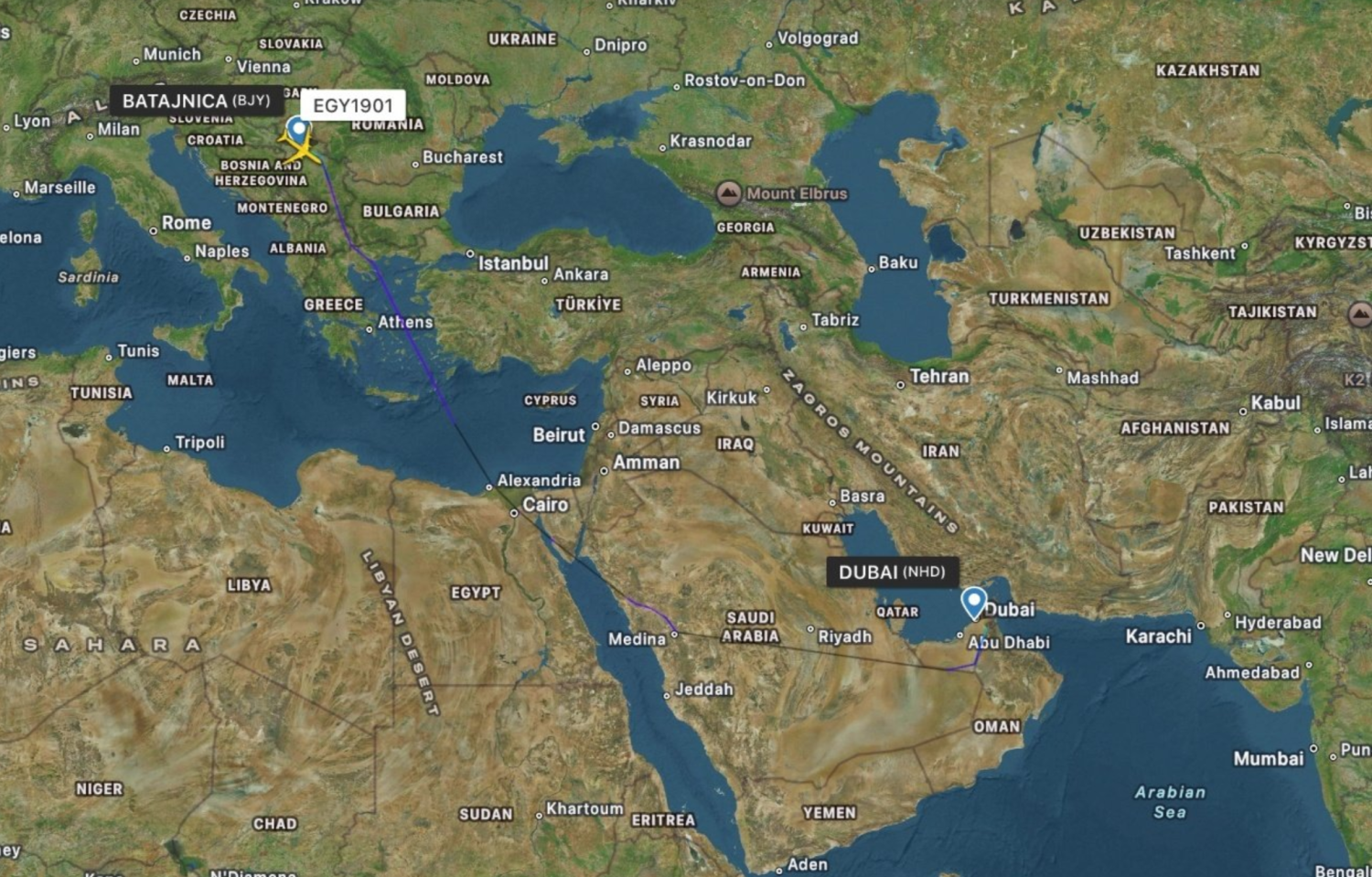
When an Egyptian military transport aircraft flies from western China to Serbia via a Gulf air base with its transponder disabled, the signal is not logistical—it is political. Repeated Il-76 landings at Batajnica suggest a deliberate supply chain moving sensitive Chinese military hardware into Europe through intermediaries. For Washington and Brussels, the question is no longer whether Serbia is diversifying its defense partnerships, but whether a quiet strategic dependency is being built in parallel with its formal path toward EU integration.
By Drizan Shala | 20 January 2026
In mid-January, an Egyptian Air Force Il-76MF military transport aircraft landed at Serbia’s Batajnica Air Base after a circuitous route spanning Egypt, western China, the United Arab Emirates, and finally Serbia. The aircraft had disabled its transponder for portions of the journey. Satellite imagery and flight-tracking data confirm this was not an isolated event.
For Western policymakers, the significance lies less in a single aircraft than in the pattern now visible often enough to stop being accidental.
Over the past year, open-source intelligence has documented a recurring logistics corridor linking Chinese military export hubs, Middle Eastern military intermediaries, and Serbia’s principal strategic air base. The route is consistent, the aircraft are military-only, and the operational opacity appears intentional rather than incidental.
This is not routine transport. It is a supply chain taking shape in plain sight.
A Corridor, Not an Incident
Batajnica Air Base is Serbia’s core military aviation and air-defense hub. It does not handle civilian freight, humanitarian shipments, or commercial logistics. Historically, aircraft of the Il-76 class landing there have been associated exclusively with weapons systems, major components, or sensitive military equipment.
The aircraft involved—Egyptian Air Force Il-76MF platforms—are state-owned, military-registered, and unsuitable for deniable private chartering. Their repeated appearance at Batajnica following stopovers in western China and the UAE points to intent rather than coincidence.
Western intelligence services do not require classified sources to draw this conclusion. The corridor has been observable, repeatable, and methodically constructed.
Why Egypt and the UAE Matter
China has increasingly relied on third-party military intermediaries to move sensitive defense equipment abroad when direct transfers risk diplomatic friction or sanctions scrutiny. Egypt and the UAE are particularly well-positioned for this role.
Both maintain deep defense cooperation with Beijing. Both operate strategic air bases frequently used for opaque military logistics. Neither faces the alignment constraints formally expected of EU candidate states.
Al Minhad Air Base in the UAE, a recurring waypoint in these flights, is already familiar to defense analysts as a transshipment node for advanced systems moving between Asia, the Middle East, and secondary theaters. Its appearance here fits a pattern observed elsewhere, not a novel improvisation.
What Is Likely Being Moved
There is no public confirmation of cargo contents, and the absence of confirmation is itself part of the method. Still, the technical and operational constraints narrow the field.
The Il-76MF’s payload capacity and internal dimensions are well-matched to:
- air-defense system components (radars, command vehicles, missile reloads),
- short- and medium-range SAM systems compatible with Chinese exports,
- unmanned aerial system (UAS) components, including avionics and weaponized payloads.
Serbia already operates Chinese-supplied FK-3 (HQ-22) medium-range air-defense systems and HQ-17AE short-range systems, acquired earlier through more visible channels. Incremental expansion or replenishment of these systems would not require headline procurement announcements—and would benefit from exactly the kind of discreet logistics now observed.
Drone-related transfers are also plausible. Serbia has increasingly functioned as a regional integration point for Chinese unmanned systems, raising longer-term proliferation and end-use monitoring concerns. The UAE leg of the route reinforces this possibility.
What is difficult to sustain is the idea that the cargo is civilian or dual-use. The routing, the secrecy, and the destination argue strongly against that interpretation.
Why the Secrecy Is the Signal
If Serbia were importing legacy spare parts, routine maintenance equipment, or non-sensitive materiel, there would be little operational need for:
- transponder blackouts,
- third-country military airframes,
- repeated Middle Eastern cutouts,
- or overnight stays at restricted military bases.
Opacity at this level is not a logistical convenience. It is a policy decision, likely shaped by an expectation of political scrutiny rather than technical necessity.
Strategic Implications for the EU and NATO
For Brussels, the issue is not merely Serbia’s procurement preferences. It is the direction of strategic dependency.
Serbia remains a formal EU accession candidate, yet its most sensitive defense acquisitions are increasingly sourced from China through deliberately concealed channels. This places pressure on EU conditionality, CFSP alignment, and the credibility of enlargement leverage.
For NATO partners—particularly those responsible for stability in the Western Balkans—the implications are cumulative rather than dramatic. A denser Serbian air-defense network complicates regional airspace management. The embedding of Chinese systems inside European military infrastructure raises interoperability and counter-intelligence questions that do not disappear with time. Transparency norms in a post-conflict region erode quietly before they erode visibly.
None of this suggests imminent escalation. It does suggest long-term strategic drift, managed below the threshold of public debate.
The Broader Reading
This is not really a story about one aircraft. It is about an infrastructure that is now recurring often enough to be intentional.
China is demonstrating that it can supply advanced military systems into Europe via friendly intermediaries, insulating itself from scrutiny while embedding long-term dependence. Serbia, in turn, is signaling a willingness to accept that support even as it seeks deeper institutional integration with the European Union.
Western policymakers have seen similar patterns elsewhere. The question is whether the Batajnica airlift corridor is treated as background noise—or as an early warning that alignment choices are being made quietly, but not ambiguously.
Kosovo Dispatch covers security, diplomacy, and institutional integrity in Southeast Europe. This analysis is based on open-source intelligence, satellite imagery, and publicly available flight-tracking data.
About the author:
Drizan Shala is a Kosovo-based security expert and political analyst specializing in national security, defense policy, hybrid threats, and regional geopolitics in the Western Balkans. He is a PhD candidate in Security Studies (Homeland Security) at the University of Sarajevo’s Faculty of Criminalistics, Criminology, and Security Studies. Shala serves as Executive Director of the Association of Criminal Law, Criminologists, and Victimologists of Kosovo and as Director of the Kosovo branch of the SIRAS Academy. His work focuses on security normalization, deterrence dynamics, and the integration of Western Balkan states into Euro-Atlantic security frameworks. He regularly contributes analysis to regional and international media and has published on NATO intelligence doctrine and contemporary defense cooperation models.