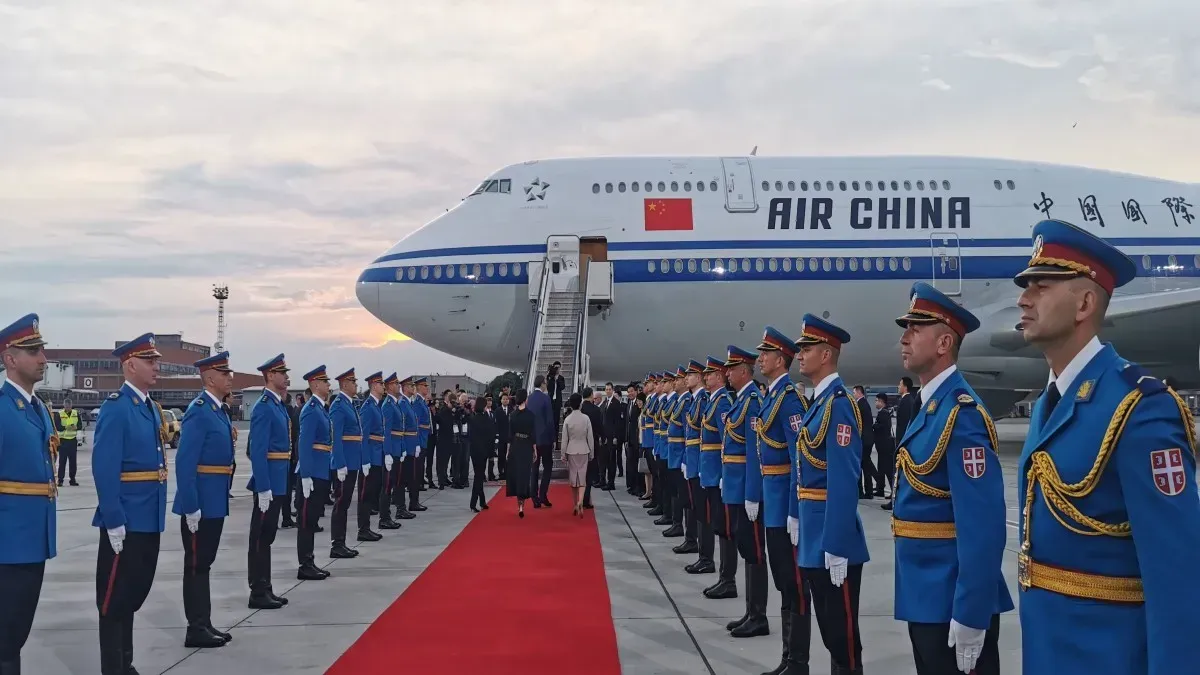
While pledging European integration, Serbia has built a modernized arsenal largely on Chinese and Russian systems, raising questions in Brussels about alignment, interoperability, and intent.
by Mark Gojcaj | 8 January 2026
Belgrade does not advertise it as a strategic turn. Officials prefer the language of “diversification,” “military neutrality,” and cost efficiency. But the numbers tell a clearer story: over the past five years, Serbia has sourced the majority of its weapons from China and Russia, a procurement profile that now sets it apart from the rest of Europe.
According to data from the Stockholm International Peace Research Institute (SIPRI), 57 percent of Serbia’s arms imports between 2020 and 2024 came from China, with Russia accounting for a further 20 percent. France, the leading Western supplier, represented just over seven percent. The figures, calculated using SIPRI’s Trend Indicator Value methodology, measure the military capability and production cost of major systems rather than simple contract values — but they nonetheless capture where Serbia’s modernization effort is anchored.
The concentration is striking. In a European landscape where most countries have moved decisively toward U.S., EU, or allied suppliers following Russia’s invasion of Ukraine, Serbia stands out as one of the very few European states importing high-value Chinese weapons systems. While Belarus and Russia also rely on non-Western sources, Serbia’s position is unusual for an EU candidate country that formally seeks accession and regularly pledges alignment with Brussels.
Drones, air defense, and a strategic signal
The bulk of the Chinese share is not symbolic. It reflects a series of concrete acquisitions that have reshaped Serbia’s air and air-defense capabilities. Deliveries over the period included CH-92 and CH-95 reconnaissance-strike drones, FK-3 medium-range air defense systems (the export version of China’s HQ-22), and HQ-17A short-range air defense platforms. These are not marginal purchases: a single air-defense system can dominate SIPRI’s import calculations for years.
By contrast, Russian deliveries slowed sharply after 2022 as sanctions and battlefield demand constrained Moscow’s export capacity. France’s role — including the much-publicized Rafale fighter deal — remains more prospective than operational within the 2020–2024 window, with deliveries still unfolding.
For Serbian officials, the logic is pragmatic. Chinese systems are comparatively inexpensive, delivered with fewer political conditions, and interoperable with legacy Soviet-era equipment already in service. Technology transfer has also been part of the appeal: Chinese drone cooperation fed into the development of Serbia’s domestically produced “Pegaz” UAV, allowing Belgrade to claim growing self-reliance.
An EU candidate with a non-Western arsenal
Yet the geopolitical optics are unavoidable. Serbia has been an EU candidate since 2012. Over that period, Brussels has repeatedly emphasized the importance of foreign-policy alignment, including on security and defense procurement. Belgrade has resisted, insisting on military neutrality and a “multi-vector” diplomacy that keeps doors open to Washington, Brussels, Moscow, and Beijing alike.
That balancing act is becoming harder to sustain. China is now Serbia’s largest single arms supplier by a wide margin, giving Beijing a tangible foothold in a European defense market where it otherwise has little presence. SIPRI data show China’s exports still flow overwhelmingly to Asia and Africa; Serbia is an exception, not the rule.
The issue is not only symbolism. Western officials privately warn that Chinese air-defense systems and drones raise interoperability and security concerns, particularly if Serbia deepens cooperation with NATO partners in peacekeeping or crisis-management roles. Others point to intelligence risks and long-term dependence on non-Western maintenance, software, and supply chains.
Regional reverberations
The buildup has also been closely watched in the Western Balkans. Neighbors such as Croatia, Albania, and Kosovo have accelerated purchases from Western and allied suppliers — including U.S. anti-tank systems and Turkish-made drones — citing the need to maintain deterrence and balance. Serbian officials dismiss suggestions of an arms race, arguing that modernization is defensive and long overdue.
But perceptions matter. Serbia’s procurement choices feed a wider narrative in the region: that Belgrade is hedging against a European future while keeping strategic options open with powers that openly contest Western influence. Joint military activities with China, including drone-focused exercises, have only reinforced that impression.
What it means for Brussels and Washington
For EU and U.S. policymakers, Serbia’s arms profile presents an uncomfortable dilemma. Belgrade remains central to any durable stability architecture in the Western Balkans. At the same time, its deepening defense ties with China — and residual dependence on Russia — sit uneasily with the EU’s post-2022 security posture.
The data do not suggest an imminent rupture. Serbia continues to cooperate with Western partners, participate in international missions, and pursue EU accession rhetorically. But numbers have a way of clarifying intent. When nearly four-fifths of a country’s recent arms imports come from Beijing and Moscow, claims of simple diversification begin to sound incomplete.
Belgrade may see its approach as flexible realism. In Brussels and Washington, it is increasingly read as a strategic signal — one that will shape how Serbia’s European ambitions are judged in the years ahead.
