Unproven allegations do not fade. They persist — especially when the West chooses not to challenge them.
By Drizan Shala | 21 March 2026
Serbia released a film. The West said little.
That silence is not new. It is a pattern. And it produces an environment in which Serbian disinformation operates without sustained scrutiny, while Kosovo continues to carry the weight of allegations that were never proven — and never established as fact.
Harvest is not a difficult case. It is a state-produced narrative instrument, funded by the Serbian Film Center, promoted by Serbia’s Director of Public and Cultural Diplomacy, premiered on a date chosen for symbolic weight.
Its central claim — that the Kosovo Liberation Army ran systematic organ trafficking operations against Serbian civilians — was investigated by a dedicated international court with full prosecutorial authority and years of resources.
That court issued no indictment for organ trafficking. It produced no prosecution. It recorded no conviction.
The gap between the allegation and what the law could establish is not a technicality. It is the answer.
The allegations were not substantiated. Not confirmed. Not sustained under investigation. Yet they were amplified — constructed into a narrative that outlived the evidence available to support it.
Serbia understood, earlier than most, that in the contemporary information environment an allegation does not need to be proven to do damage. It needs only to circulate — to be cited, to be repeated in enough committee rooms and enough newspaper columns that it acquires the texture of established fact.
The organ harvesting story was built to do exactly that. It succeeded well enough to contribute to the creation of an entirely new international judicial institution — built in significant part on claims that its own prosecutors could not sustain.
This follows a pattern familiar from Russian information operations — not as analogy, but as method. Manufacture a crime, attribute it to your adversary, demand an investigation, then treat the existence of that investigation as proof of guilt regardless of outcome.
Serbia applied this logic to Kosovo with precision and patience.
The Specialist Chambers were the result — not only as a judicial forum, but as a political instrument whose very existence carries reputational weight.
The West watched. It funded the court. Then it watched the narrative persist.
When mechanisms of accountability are triggered by unproven allegations, sustained by political pressure, and later used as diplomatic leverage, the international community has an obligation to respond.
It has not.
That silence has been read — correctly — as space to continue.
The consequences fall on reconciliation. Genuine normalization requires a shared baseline of acknowledged reality. That baseline cannot exist when one side operates a sustained narrative campaign while the other is expected to engage on evidentiary terms.
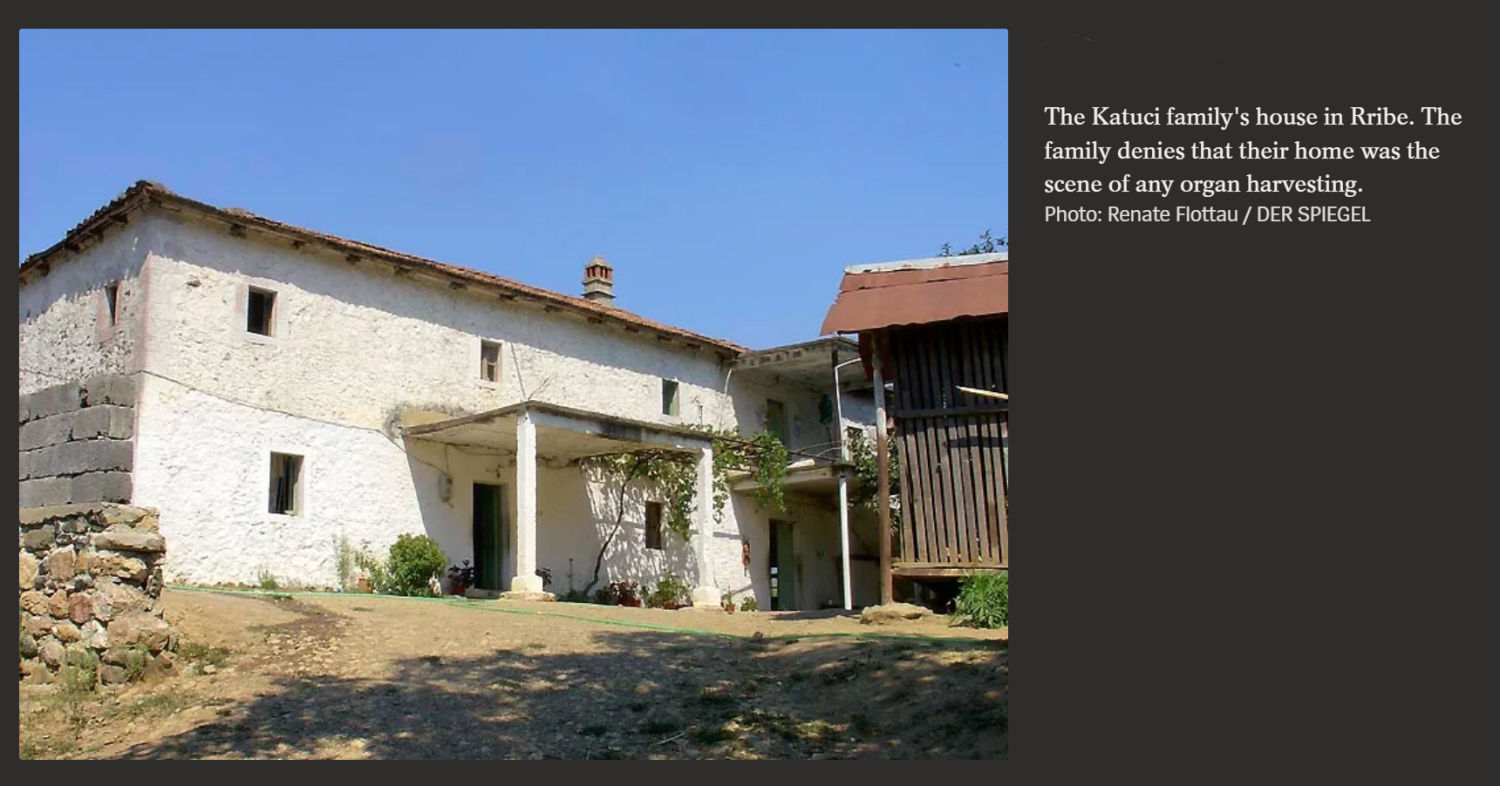
Every film like Harvest, every exhibition like Yellow House: Crime Without Judgment, every diplomatic amplification of these narratives makes that baseline harder to reach.
Silence does not preserve neutrality. It alters the balance.
Serbia has not acknowledged responsibility for the crimes documented in Kosovo. Instead, it has constructed a counter-narrative in which Serbia appears as the primary victim — of NATO, of Albanian violence, of international bias, of a KLA portrayed through allegations that were never established in court.
Harvest is the latest expression of that effort. It will not be the last.
The question is whether Western governments will continue to treat such narratives as cultural output, or whether they will recognize them as part of a sustained political strategy — one that affects accountability, diplomacy, and the conditions for any durable settlement.
Silence has costs.
In the Western Balkans, those costs accumulate. The bill remains open.
READ ALSO: Reconciliation Requires a Partner. Serbia is Not Offering One.
Drizan Shala is a security analyst and political analyst based in Pristina, specializing in defense policy, hybrid threats, and Western Balkans geopolitics. He serves as Executive Director of the Association of Criminal Law, Criminologists, and Victimologists of Kosovo and directs the Kosovo branch of the SIRAS Academy. He is a PhD candidate in Security Studies at the University of Sarajevo.
