The OSCE in Kosovo has kept the footnote and deleted the text
By Ngadhnjim Brovina | 10 November 2026
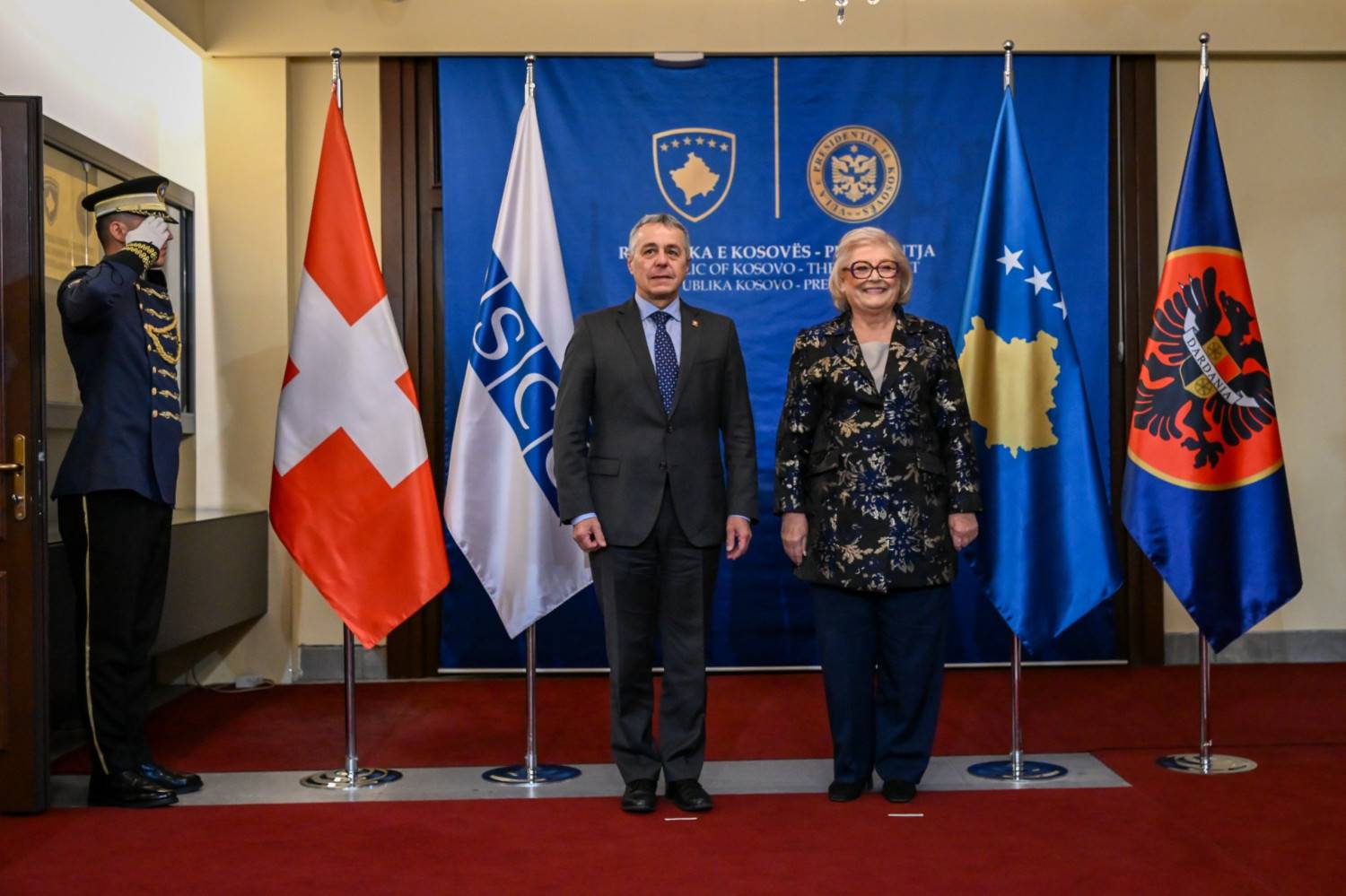
Last week the OSCE put out a press release on its chairman’s tour of the Balkans. It was a small document and it told the truth without meaning to. In Belgrade, Ignazio Cassis praised the Mission’s work with “Serbian institutions”. In Skopje, its work with “national institutions” and the OSCE’s partnership with “North Macedonia”. In Pristina he met the head of mission and his staff, and the Mission, we learn, “has worked with institutions and communities”. Institutions of what? Communities of where? The release does not say. Cassis had met the President of Kosovo, the Prime Minister of Kosovo and the Foreign Minister of Kosovo the day before. The Swiss government named all three. The OSCE named none. Four days earlier the same Mission had published photographs of its chief with the President, her flag cropped out of the frame.
The OSCE calls this status neutrality. Status neutrality has a model, and the model has a footnote. On 24 February 2012 in Brussels, Serbia and Kosovo agreed that “Kosovo*” would be the only denomination used in regional cooperation, that Kosovo* “participates on its own account and speaks for itself at all regional meetings”, and that the asterisk would lead to one sentence: “This designation is without prejudice to positions on status, and is in line with UNSC 1244 and the ICJ Opinion on the Kosovo declaration of independence.” The name in the text, the quarrel in the footnote. Belgrade signed up to it, and Kosovo Online, the portal that carries Belgrade’s line, complained in 2022 that an OSCE post about a visit to Pristina lacked the asterisk. The asterisk is Belgrade’s floor. The Mission in Pristina has gone below it, with no asterisk, no name and no flag. It has kept the footnote and deleted the text. Call it status negative.
The attitude has a date. On 21 December 2007 the Permanent Council extended the Mission’s mandate by one month and provided that it would be extended by one more at the end of every month thereafter “unless a participating State objects in writing”, whereupon the Mission would begin “closing down without delay”. The American delegation noted that two states had insisted on this. Serbia attached its own understanding: the Mission’s “full and correct name” should be “the OSCE Mission in Kosovo/Republic of Serbia”. Nineteen years and more than two hundred and twenty renewals later, the Mission still lives on that thirty-day lease, from a landlord who has told it in writing what it is called. Kosovo is not a participating State. It cannot write the letter. It can only host the tenant.
Tenants on monthly leases learn the landlord’s moods. Belgrade protested to Vienna in July 2024 when the Mission posted a photograph with a Kosovo flag in it. It protested again in August 2025 when the High Commissioner on National Minorities met Prime Minister Kurti with a flag behind him, demanding that the OSCE “fully respect its status-neutral mandate in the Province”. By November 2026 nobody in Belgrade needed to lift a pen. The Mission cropped the flag itself. Timothy Snyder’s first lesson on tyranny is: do not obey in advance. The OSCE in Pristina obeys in advance as a matter of office routine.
Serbia itself no longer asks for it. On 27 February 2023 in Brussels, Belgrade accepted the Agreement on the Path to Normalisation, whose first article says: “Both Parties shall mutually recognise their respective documents and national symbols, including passports, diplomas, licence plates, and customs stamps.” Its fourth article says Serbia “will not object to Kosovo’s membership in any international organisation”, a category that includes, one assumes, the OSCE. Serbia did not sign the text and calls it non-binding; the EU calls it binding and wrote it into Chapter 35. Belgrade has nonetheless acted on it. Since 1 January 2024, by decision of its own government, cars bearing the plates of the Republic of Kosovo cross at Merdarë (Merdare) with nothing over the name. Belgrade’s one reservation letter, in December 2023, was about UN membership and territorial integrity. It said nothing about flags.
So a Serbian officer at Merdarë waves through the symbol of the Republic of Kosovo every morning, and an OSCE photographer in Pristina crops it out every afternoon. The OSCE has achieved a neutrality more Serbian than Serbia’s.
Nobody announced status negativity as policy. It shows as a reflex, and reflexes show in small places. In a readout that mentions the Assembly without saying of what. In the word “Province”, which belongs to one party’s constitution and turns up in the other’s protest notes. In the Mission’s reply, in September, to Petar Petković’s request that its chief use his “personal powers” so that Serbia’s parliamentary election could be held on Kosovo’s territory: the Mission said it was ready to collect the ballots if Kosovo agreed. Kosovo did not agree, and on 25 October Kosovo Serbs queued at Merdarë and Jarinjë (Jarinje) to vote in Raška. A neutral mission does not volunteer to run one state’s election inside another; a status-negative one cannot see the objection, since in its own eyes there is no other state there.
The Mission was born in 1999 as a pillar of UNMIK, and it has kept the pillar’s habits long after the building changed use. Nobody in it ever decided that the host country does not exist. Everyone decided, meeting by meeting, not to be the one who said it does. After enough meetings the omission became a rule, the rule became a culture, and the culture hired its own photographers.
The cost falls elsewhere. The Mission monitors Kosovo’s courts and Kosovo’s Assembly, runs courses for Kosovo’s police, spends sixteen million euros a year across all thirty-eight of Kosovo’s municipalities, and cannot bring itself to say whose any of it is. That teaches Belgrade that a protest note works. It teaches the Serbs of the north that the state they live in is provisional, so keep waiting. It teaches Kosovo’s own officials to pose for the camera and check afterwards whether they were in the picture. A mission that behaves as if Kosovo does not exist has taken a side in the dispute over whether it does, the side that wants the question kept open.
The remedy is cheap. Neutrality costs a flag in a photograph, a noun in a press release and, at most, an asterisk. Belgrade conceded the asterisk in 2012 and the flag in 2023. The Mission is behind Serbia on both. If the OSCE cannot pay that price, it should stop using the word. Serbia offered the honest name in December 2007: the OSCE Mission in Kosovo/Republic of Serbia. The organisation declined to adopt it. It has spent nineteen years living up to it.