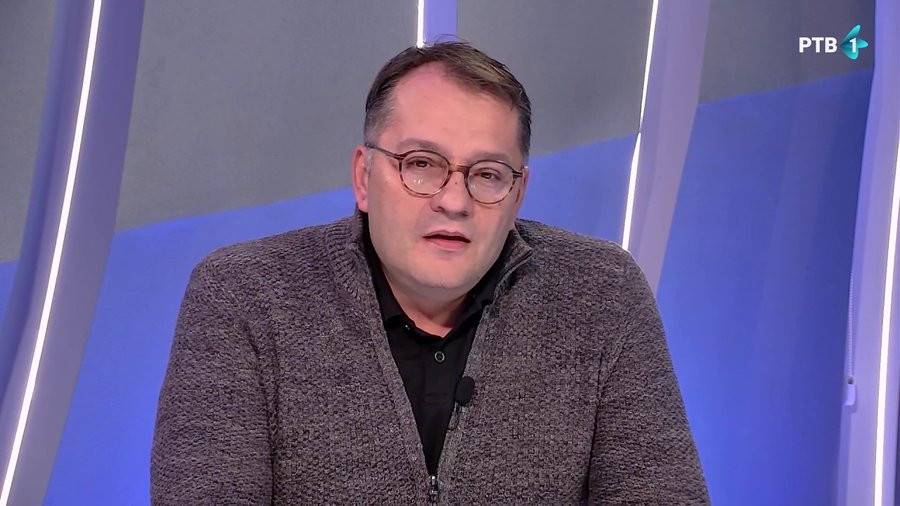
In two interviews on 11 November, the Student List candidate from North Mitrovica set out what the incoming majority in Belgrade intends for the Belgrade-run institutions in Kosovo, for Srpska Lista, for the dialogue and for the agreements already signed.
By KD Newsroom | 12 November 2026
Jugoslav Gašić, a candidate of the Student List that won Serbia’s parliamentary election on 25 October, gave two interviews on 11 November about the list’s visit to Kosovo and its plans. One was to RT Balkan. The other was a 40-minute appearance on “Pravi ugao” on Radio Television of Vojvodina (RTV), hosted by Ljubica Gojgić. Gašić is a physician and a professor at the Serbian-run medical faculty relocated from Pristina to North Mitrovica (Kosovska Mitrovica). The host said he grew up in Pristina and lives between Novi Sad and North Mitrovica.
The visit
Gašić told RT Balkan the delegation consisted of 20 students and six candidates from the list. The candidates were those tied to Kosovo, who live or work there or once lived there. The students came from all universities, including the one he calls the University of Pristina. Interest in joining was high and not everyone could be accommodated. He said he is convinced that anyone with a view on Kosovo changes or corrects it after visiting the monasteries.
On RTV he said two meetings had been planned: with Metropolitan Teodosije in Graçanica (Gračanica) and with Father Sava Janjić at the Deçan (Dečani) monastery. Some students were in Kosovo for the first time. There was little time to talk to residents, but Serbs in Graçanica waited to greet the delegation, thanked them for the election victory and said they expect the policy conducted from Belgrade towards Kosovo to change.
He said the visit was the first the list made after the Republic Electoral Commission declared the final results, before its members had taken their seats, and that this was meant to show seriousness. The position on what he called “our southern province” is clearly defined in the student movement, he said, and it would be frivolous to campaign on it and then drop it. The list will not give up what is in its programme.
Asked about criticism of the visit inside Serbia, he quoted Radoje Šoškić, a colleague from the informal group Proaktiv, who described the visit as a look in the mirror. Gašić said he expects noise from those who see only shards.
The Church
The conversation with Father Sava at Deçan lasted three hours, until midnight, Gašić said. The delegation was warmly received and the clergy were visibly glad of the visit. The brotherhood described the dangers it faces and its experience in recent years. Gašić said it was devastating to hear that the brotherhood learns of plans being prepared from Italian soldiers, and not from Serb representatives who sit in the structures where those decisions are made.
He said the state had done nothing for the Church in this period. One of the first measures will be to hear its needs and deliver support quickly. To RT Balkan he said the delegation had not known the extent to which the Church lacked the support of Srpska Lista, and that the Church is one of the pillars of Serb survival. Teams will be assigned to work against what he called the appropriation of Serbian cultural heritage.
Srpska Lista
Asked on RTV whether his earlier statement that the Student List will not cooperate with Srpska Lista had been too harsh, Gašić described the party as a parochial, clientelist interest group made up of spineless people, chameleons, Machiavellians and opportunists. There is no cooperation with such people, he said, and they are to blame for the position of Serbs in Kosovo. He compared their defence to a football team that loses 5–0 and blames the opponent for scoring.
He rejected the figure of 90 per cent support for Srpska Lista, saying anyone who believes it does not follow events on the ground. Srpska Lista was created as an exponent of the Serbian Progressive Party (SNS) in Kosovo, he said, and its dominant activity, besides listening to Belgrade, was collecting votes, in Kosovo’s elections and in Serbia’s, through pressure, blackmail and conditioning of the population. He told RT Balkan the party conditioned citizens’ free will on the allocation of aid.
Since the election, he said, people have been freed and evidence of these methods arrives almost daily. The list will deal with it once a government is formed. He said he is fairly sure many Srpska Lista figures face criminal liability.
On communication, Gašić said the Student List is not a political party, the student movement is weak in Kosovo, and the list will have no structure on the ground. Any communication, if needed, will go through the international community.
Of the Srpska Lista deputies in the Assembly of what he called “so-called Kosovo”, he said they had functioned by taking orders from Belgrade. They will no longer receive orders from the SNS, but they will have to answer to the people and act in the interest of the Serb people. If they do not, he said, “there are solutions for how that can be controlled” ("постоје решења како се то може контролисати").
At local level, he said the Student List will replace all managers in the institutions that operate under the system of the Republic of Serbia, which he hopes will remain. The new heads will work with Srpska Lista officials in local institutions on practical matters, and he expects cooperation from them. In future election cycles, he said, work will be done so that this cadre changes and no longer exists on the political map.
Money and institutions
Gašić told RT Balkan that nothing had happened during the transition of power to worsen the position of Serbs in Kosovo. He called talk that Belgrade would reduce or abolish payments malicious rumour. The list will insist that payments be expanded and distributed more fairly, and that those who do not live in Kosovo cannot expect to receive them.
He said Serbia’s statehood has been erased in Kosovo and that education, health and the position of the Serbian Orthodox Church are what remain. People fear for the remaining institutions, he said, but no more than they did under the SNS.
On RTV he said Serbs had seen no serious institutional protection from Belgrade. Serbs in Kosovo never regarded Serbia’s Office for Kosovo and Metohija as a serious institution, he said, and joked that they called it the office “for KiM and other spices”, issuing anaemic statements of no practical use.
The dialogue and the agreements
Of 14 years of Belgrade–Pristina arrangements, Gašić told RT Balkan: “we lost almost everything, we gained nothing” ("скоро све смо изгубили, нисмо ништа добили"). Everyone was aware, he said, that the negotiations were destructive for the Serb community and did not lead to a sustainable solution.
He said examining the constitutionality of all signed agreements, and their adoption in the Assembly of the Republic of Serbia, is one segment of the list’s programme. The fight to preserve health and education institutions will run in parallel. He said there is no time, because Pristina has announced actions to reduce Belgrade’s influence over those institutions.
On RTV he said the dialogue will have to continue in order to prevent negative steps by what he called the “provisional authorities in Pristina” against the remaining institutions. That, he said, will mean dialogue with the international community, to find solutions guaranteeing the survival of those institutions in the system the list wants.
The host put to him the argument that Serbia has not been present in Kosovo since 1999 and cited Albin Kurti’s count of 120 recognitions. Gašić replied that political diplomacy consists in avoiding “take it or leave it”. The reality, he said, is that the students won 53 per cent, which many European politicians do not have at home. The list has the capacity for serious talks and for solutions fully compatible with its programme. He said statements from Pristina carry no weight and compared them to the cosine of a right angle, zero.
On Kurti’s call for Serbia to end its campaign against Kosovo’s recognition and membership of international organisations, Gašić referred to the first Brussels agreement. Serbia fulfilled everything, he said, and Pristina almost nothing. What Kurti asks of Serbia is irrelevant, he said: let him think about what he should do.
On the Constitution, he said that if someone may invoke “the constitution of some Kosovo”, and the international community accepts that as grounds for Pristina not implementing the Brussels agreement, no citizen of Serbia can find it normal for Serbia’s Constitution not to exist. Serbia’s Constitution is also a reality, he said. Without a constitution there are no laws, and without laws there is mafia.
Treason accusations
Gašić said claims that the list would recognise Kosovo have nothing to do with reality. He said they come from people who erased Serbia’s statehood in Kosovo in 14 years, with mouths full of patriotism, full pockets and empty souls, wrapped in Serbian flags. He called that naked treason and said the Student List betraying Kosovo “will absolutely not happen”.
Crossing into Kosovo
Gašić attributed the phrase “invasion of the Serbian winners” to an opposition politician from the Haradinaj camp. Kosovo’s government, he said, stated that the delegation had come in a capacity that was not yet official. Private visits should remain possible, he said, while accompanied visits at state level would run into problems. As a deputy he expects to be able to travel to teach and practise medicine. If his presence were read as propaganda his movement would probably be restricted, and he doubts a member of the executive would be let in easily.
The Law on Foreigners
He said the grace period runs until 15 March, when the law begins to apply. It hits the university hardest, because most teaching staff have no regulated residence in Kosovo, and still more students come from the rest of Serbia or Montenegro. He expects work and residence permits to be obstructed: an applicant must show an employment contract, and Pristina regards a contract with his faculty as one with an illegal institution. He called the law an introduction to integration and said intensive activity is needed.
Asked whether education and health can be saved, he said he would not be working on it if he thought not. Proaktiv had worked on the question before the election, with no state backing. He said he has met some EU staff in Kosovo, who seem to him the address for starting serious talks on what to do and how fast.
Belgrade
Serbia’s Assembly is to be constituted on Tuesday 17 November. Gašić described the future opposition, led by the former president, as a semi-criminal interest group gathered from all sides. He said the list has many people with higher education and doctorates. It is not easy to become a doctor of science, he said, but entering politics in Serbia is very easy. The list wants to serve the people and not rule as masters, and for that only honesty is needed.
The names of ministers will be known “when we cut”, he said, invoking the proverb about measuring three times, and the list is now at the second measuring. The date of the presidential election will be known by Tuesday if outgoing speaker Ana Brnabić, whom he called “the loser”, calls it. Otherwise the new speaker, as acting president, will do so.
Asked about patriotism on Armistice Day, he defined it as love of homeland, people, culture, language and history. He said Serbia emerged from the First World War as one of five victors and liberated the land “from the Vardar to Triglav”. The Student List’s victory, he said, is a victory of truth, justice and respect for the law, and of youth, saving the state perhaps at the last moment.
His one fear, he said, is betraying the trust the people have given. He said that will not happen.