Kosovo’s Serbs have constitutional guarantees, reserved seats, an official language and a patron state. Foreign diplomacy still treats them as a category above citizenship, and expects the country’s other minorities to stand aside while it does.
the Editorial Board | 29 October 2026
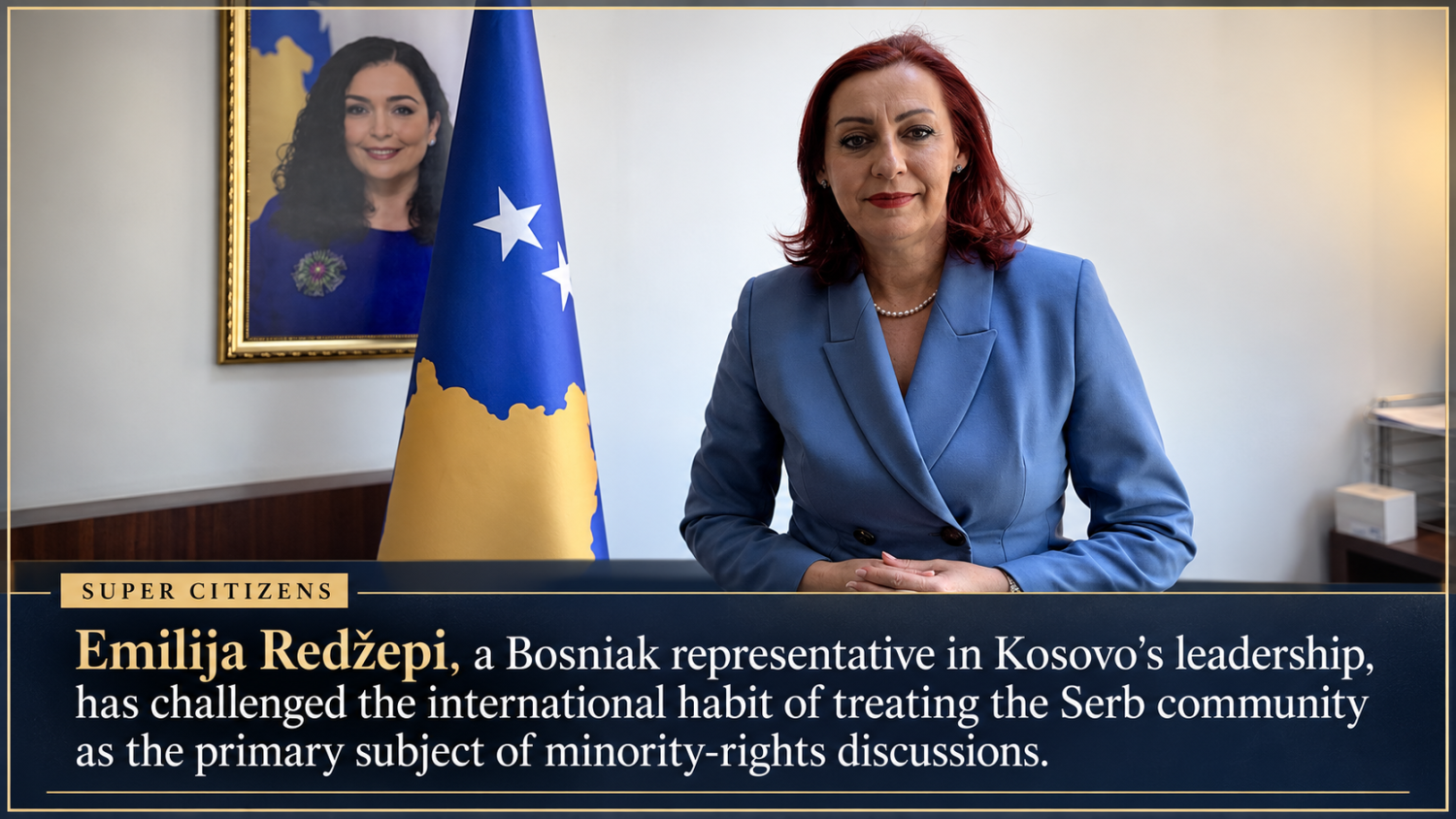
Emilija Redžepi went to room 506 of the Assembly of Kosovo on Wednesday as Deputy Speaker and as a Bosniak. The meeting was on the published agenda as the NATO Parliamentary Assembly’s session with the non-majority communities. The deputies of Srpska Lista did not attend. The question put to her, by her account, was about the readiness of Kosovo Serbs to integrate into the institutions of the Republic.
She told the visitors she was tired of it. Almost every discussion of non-majority communities in Kosovo, she said, focuses exclusively on the Serb community.
A Bosniak representative came to speak for the communities of her country and was asked to account for a community whose representatives had chosen not to come. The question carried its own presumption. After twenty-seven years of administration, mediation and supervision, asking about the Serbs has become the conventional way of asking about minorities in Kosovo.
This publication named the product of that convention in July, after five Western institutions pronounced on eleven cottages at Lake Ujman (Gazivode) without citing a law: the super citizen, a resident whose files close upward through embassies rather than sideways through courts. The term covers the status conferred on them from outside, on top of rights that are unconditional: a system that treats the concerns of one community as a standing diplomatic priority and the concerns of the others as a footnote.
The Constitution of Kosovo reserves twenty of the Assembly’s 120 seats for non-majority communities. Ten are guaranteed to the Serb community. The Bosniak, Turkish, Roma, Ashkali, Egyptian and Gorani communities share the other ten. Serbian is an official language of the Republic, alongside Albanian. Serb-majority municipalities hold enhanced competences in secondary health care, university education and culture under the 2008 law on local self-government, written at international insistence. None of this can be withdrawn by a simple parliamentary majority. In Brussels it is treated as the floor from which further demands are issued, never as evidence of what the state has already built.
The Association of Serb-majority municipalities is the demand. It has been pressed on Kosovo in the dialogue with a persistence no international actor has shown for the institutional needs of any other community. Its form remains contested because the difference between municipal cooperation and a separate political authority is the whole question in a country whose neighbour still claims its territory. Redžepi knows the difference. She voted for the Association process because she believed it meant integration. She now rejects any separate political entity, any parallel structure, any Republika Srpska inside Kosovo, because that is not what she voted for. A non-Albanian deputy is telling Brussels that the accommodation designed for another minority is being built as a means of separating that minority from the state she shares with it. Brussels has organised its Kosovo policy around the Serb question for so long that it has no desk to receive that sentence.
Diplomatic attention is power. A community whose complaints reach foreign ministries by the next morning holds leverage beyond its seats. Every ordinary act of administration that touches it, an inspector, a decree, a court order, acquires an international dimension. Other citizens seek their remedy in the institutions of their own country. The super citizen has a second route, through the institutions of other countries, and Kosovo’s partners built it. The concerns of the Bosniaks, the Turks and the Gorani have never held that place in the dialogue. They are integrated. Nobody asks whether they are ready to be.
The arrangement also hides Belgrade. Serbia is not an outside advocate for a minority; it is a neighbouring state that claims Kosovo as its territory, and the party that stayed away on Wednesday is the one whose own president described it this month on Serbian television as part of Vučić’s SNS. A policy that treats the position of Kosovo Serbs as separable from that strategy has misread the file. The Serbs’ future in Kosovo will be secured in institutions where they sit as citizens, which is where Redžepi’s community sits, and not under a permanent external guardianship that rewards their absence.
The Political Committee commands no troops. Its members sit in the legislatures whose governments decide Kosovo’s position in the world, and their assumptions travel. Redžepi did not ask them to care less about the Serbs. She asked why their care for everyone else disappears when the Serb question enters the room. Political complication is not a constitutional qualification for superior citizenship, and Belgrade’s refusal to recognise the state is no basis for ranking one group above the others inside it.
There is no category of super citizens in the Constitution of Kosovo. International diplomacy should stop behaving as though there were.