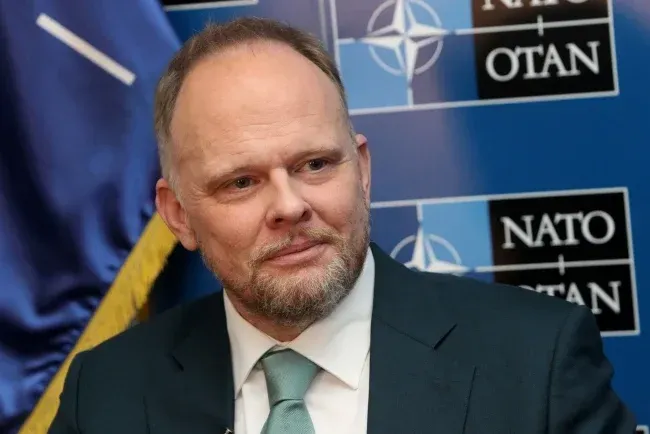
Hamilton said the right things in Pristina. So did Rutte in January. So did Stoltenberg before him. So has every senior Western official since 24 September 2023. The pattern is the position. Nobody is going to hold Serbia accountable for Banjska in any way that costs Belgrade something Belgrade actually values, and the diplomatic ritual of demanding accountability has become the substitute for producing it.
by Mark Gojcaj | 22 May 2026
Kevin Hamilton, NATO's Deputy Assistant Secretary General for Partnerships, told journalists in Pristina on Thursday that the Alliance knows the names of those who carried out the Banjska attack. He said the deepening of NATO's partnership with Serbia is on hold pending accountability for Banjska, Zvecan, and Iber-Lepenc. He said the ball is in Belgrade's court.
The ball has been in Belgrade's court since 24 September 2023.
It was in Belgrade's court when Jens Stoltenberg made essentially the same statement in the weeks after the attack. It was in Belgrade's court through every iteration of the EU dialogue track in 2024. It was in Belgrade's court when Mark Rutte made the same statement to the European Parliament in January 2026, name-checking his personal relationship with Vučić as if that relationship were an asset rather than a diagnostic. It is in Belgrade's court now because Hamilton has put it there again, in May 2026, on his first visit to Pristina.
The phrase has done two and a half years of work and produced nothing of consequence. That is not a failure of communication. It is the communication. When a diplomatic system repeats the same demand for thirty-two months without a corresponding cost imposed for non-compliance, the demand is no longer a demand. It is the substitute for one.
The grammar of the non-event
Read Hamilton's statement closely and the structure becomes legible. The Alliance "expects" accountability. The deepening of the partnership "cannot move forward" without it. The aspects of practical cooperation will not advance "without or until" justice is delivered. Each clause is constructed to sound consequential while committing the Alliance to nothing it is not already doing. There is no deadline. There is no specified threshold for what would constitute compliance. There is no escalation pathway if Belgrade continues to do what it has been doing for thirty-two months, which is nothing. The penalty for non-compliance is the withholding of an upgrade Belgrade has not requested and does not require. The status quo is the punishment.
This is not how policy works when policymakers intend to produce a result. It is how policy works when policymakers intend to produce a statement.
The accession file, honestly
A fair version of this argument has to concede the partial counter-evidence. Serbia has not opened a new EU negotiating cluster since December 2021. The opening of Cluster 3, which the European Commission has assessed Serbia technically ready to open for several years running, has been blocked by member-state consensus at the end of 2024 and again at the end of 2025. According to European Western Balkans reporting that draws on unofficial member-state sources, Banjska accountability is part of the reason for the blockage. So the accession file is not moving at the pace Belgrade would prefer, and Banjska is part of why.
This is the closest thing to an instrument of consequence that is actually being deployed against Serbia, and it is worth naming as such. The argument of this editorial is not that Belgrade pays no price at all. It is that the price being paid is structurally insufficient to alter Belgrade's behaviour, and that the more meaningful instruments are not being used.
Consider what is not happening. No Western government has imposed Banjska-related sanctions on any named individual in the Serbian security or intelligence architecture. Milan Radoičić remains in Serbia, having resurfaced there after the attack and given a recorded admission of his role. The chain of command and supply that produced an armed unit of approximately eighty militants with twenty-six armoured vehicles within striking distance of a NATO mission has not been pursued by any Western prosecutorial authority. The Commission's October 2024 assessment of Serbia, delivered post-Banjska and post-Iber-Lepenc, included Ursula von der Leyen telling Vučić in a joint press conference that "deeds follow your words." No senior Western capital has downgraded diplomatic representation. Bilateral high-level engagement has continued throughout. Serbia's CFSP alignment with EU positions remains in the 50s percent range, a level that for any other candidate country would constitute a structural objection, and that has not produced one.
The cluster lever is being pulled with one hand. The other hand is continuing to do business with the regime as if nothing happened. The two gestures cancel each other in Belgrade's calculation, which is why Belgrade has not adjusted its behaviour.
What real accountability would require
To hold Serbia accountable for Banjska in a way that Belgrade would experience as a cost, a Western government, or a coalition of them, would have to suspend an instrument Serbia actually values. Designation of named individuals under existing sanctions frameworks would qualify. A coordinated reduction of bilateral defence and intelligence cooperation would qualify. A formal Council of the EU statement linking Banjska accountability to specific accession milestones with named conditions would qualify. The public release of the names the Alliance now says it possesses would qualify. There is no evidence any of these steps are under serious consideration in any major Western capital. The reason none is under consideration is not mysterious.
The operative position of major Western capitals, repeated across two administrations in Washington, three in Brussels, and successive governments in the principal European chancelleries, is that Serbia must be managed rather than confronted. The management is rationalised in different ways depending on the audience. To Atlanticists it is presented as preventing further Russian penetration of the Western Balkans. To economic interests it is presented as preserving access to the regional market. To accession technocrats it is presented as maintaining the procedural integrity of the enlargement process. To the regional public it is not presented at all, because the regional public has correctly identified what is happening and presentation would be pointless.
Banjska is the price the West has decided to pay for keeping the management strategy alive. Hamilton's visit is one more installment.
The Belgrade readout
The most telling document of the week is not Hamilton's statement in Pristina. It is the readout published by Serbia's Ministry of Foreign Affairs of his meeting with State Secretary Nevena Jovanović in Belgrade. The readout describes a conversation about partnership cooperation, military neutrality, and Belgrade's expectation that KFOR maintain its status-neutral posture and protect the Serbian population in northern Kosovo. It does not mention Banjska. It does not mention Zvecan. It does not mention Iber-Lepenc. It does not mention accountability.
This is a foreign ministry telling its own public, on the record, that the substance of the meeting was something other than what NATO has said it was. It is also a foreign ministry telling NATO, on the record, that Belgrade does not consider the demand serious enough to acknowledge in writing. Belgrade has assessed, over thirty-two months of evidence, that there is nothing behind the demand that warrants a written response. The Serbian MFA would not erase the central point of the meeting from its public account if it believed the central point of the meeting were going to be enforced.
The readout is the verdict on Hamilton's visit. It was written by people who have read the diplomatic traffic for thirty-two months and who understand, with precision, what "the ball is in your court" means in practice. It means: we have said what we are required to say. We will say it again in six months. Carry on.
The names
Hamilton says NATO knows the names. The European Union's intelligence apparatus knows the names. The United States knows the names. Kosovo's institutions have published much of what is publicly knowable about the names. Radoičić has admitted his role on camera. The chain of command and supply that produced the operation is not a forensic mystery. It is a known fact pattern that the Western diplomatic system has decided not to act upon.
The "we know the names" register is, by this point, its own form of evasion. It implies that knowledge is the operative variable, that the file is being built, that the moment of action is approaching. The moment of action is not approaching. The names have been operationally known since approximately 25 September 2023. The question has never been whether the names are known. The question has always been whether any Western capital is prepared to do anything that costs it something to make those names answerable. The answer, demonstrated over thirty-two months of behaviour, is no.
What the ritual is for
If the demand will not be enforced, then what is the demand actually for? It reassures the constituencies in Kosovo, Albania, and the diaspora that the Alliance has not forgotten Banjska, which permits those constituencies to continue investing in a relationship with NATO that would be politically untenable without periodic reassurance. It provides a defensive position for Western officials when asked, in domestic press conferences, why Belgrade has not been held to account: the position is that the demand has been made, repeatedly, and the failure lies with Belgrade. It generates a paper trail that can be cited, in some hypothetical future moment, as evidence that the Alliance was always principled and Serbia was always recalcitrant, should that future moment ever require such a citation.
The ritual is, in other words, for everyone except the people who died at Banjska, the families of the KFOR personnel injured at Zvecan, and the Kosovo institutions that have spent thirty-two months presenting documentary evidence to interlocutors who decided in advance not to act on it. For those audiences, the ritual is an insult dressed as a process.
The honest sentence
The honest sentence that no senior Western official will say in public, but which is the operative position of every major Western chancellery, is this: Banjska accountability is not worth the diplomatic cost of a serious confrontation with Belgrade, and therefore it will not be pursued. Everything else is choreography. Hamilton's visit is choreography. Rutte's January statement was choreography. The next senior official's statement, in October or November of this year, will be choreography.
The choreography will continue until either the political economy of Western policy toward Serbia changes or Belgrade itself overplays its hand in a manner that forces the issue. Neither development appears to be on a near-term horizon. Belgrade has been disciplined enough to avoid the second outcome, and the structure of Western policy rewards exactly that discipline.
The names are known. The lever is identified. The condition is on the table. None of that has ever been the bottleneck. The bottleneck is that no one with the capacity to act is willing to pay the price of acting, and Belgrade has known this from the first week. Hamilton said the right things. So did the others. So will the next one. Anyone who watches the ceremony and mistakes it for a process is, at this stage, choosing to be deceived.
